




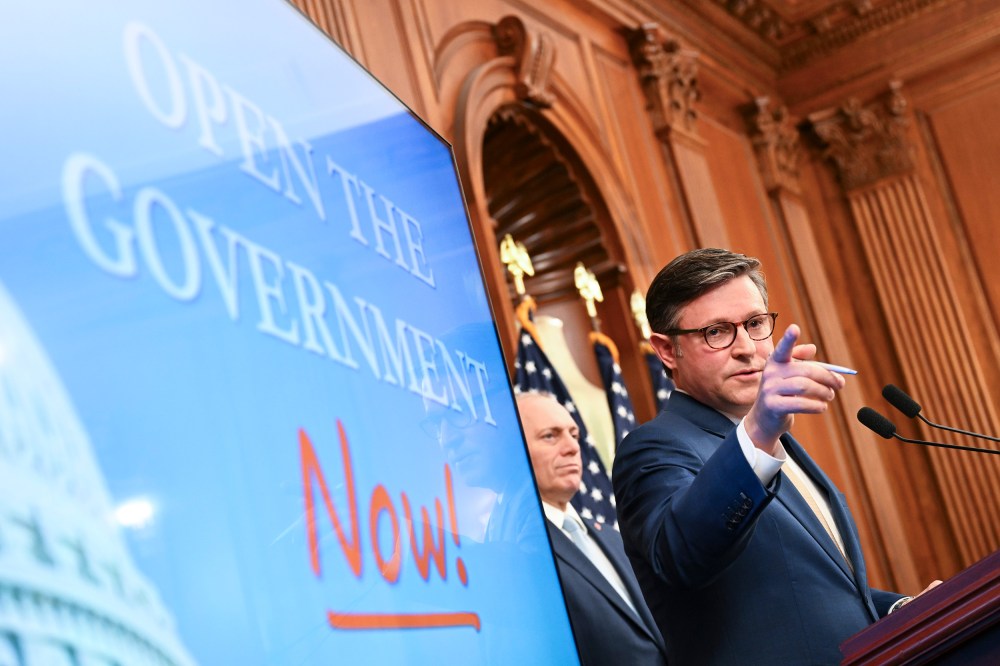
Congressional Republicans think they know when the shutdown is going to end. And the answer is: right after the election.
On Monday, House Speaker Mike Johnson, R-La., said Democrats were simply running scared of their voters, fearful their base would “punish” them if they caved to GOP demands before the election. But once those voters have a chance to cast their ballots on Tuesday, Johnson argued, Democrats will be able to “come to their common senses again and do the right thing.”
“I hope,” Johnson said, Democrats will “make the calculation that maybe we won’t have to hold that line anymore.”

There are plenty of other Republicans also pushing the narrative that Democrats will relent on the shutdown fight as soon as voting ends. Sen. Markwayne Mullin, R-Okla., told MSNBC last week that he believed it was “more than likely” the government will reopen after the elections.
“It won’t happen before then,” he said.
Sen. Kevin Cramer, R-N.D., told MSNBC on Monday that Democrats “have to get past tomorrow night before they see the off-ramp,” adding that Democrats “know they can’t win” in key races on Tuesday “without the extreme left wing of their party being enthusiastic.”
And Senate Majority Leader John Thune, R-S.D., told Politico that Tuesday’s off-year election “seems to be another inflection point” for the shutdown.
“Hopefully that frees some people up to be able to vote ‘yes,’” Thune said.
But just as Republicans said Democrats would give in on the shutdown as soon as the Oct. 18 “No Kings” rally was over, Republicans could, once again, be dead wrong.
In fact, Democrats who spoke with MSNBC dismissed the notion that Tuesday is some magical date.
“That is such a shallow perspective from the speaker,” Sen. Andy Kim, D-N.J., told MSNBC, calling it “offensive that the speaker just reduces everything down to politics.”
“But that’s just how his brain works,” Kim said.
Kim noted that the central Democratic demand of the shutdown — extending the Obamacare subsidies that are set to expire at the end of the year — hasn’t been met. And he pointed out that, no matter how Tuesday’s elections shake out, that won’t have changed.
You don’t have to go rustling around in the bottom of the bin to find a reason why we have this ongoing disagreement.”
Sen. Chris Coons, D-Del.
Kim, who has recently been campaigning in New Jersey ahead of his state’s gubernatorial election, said the families he’s hearing from remain concerned about skyrocketing health care costs.
Sen. Mark Warner, D-Va., likewise disagreed with the speaker’s assessment, telling MSNBC that lawmakers “could resolve it today.”
“We should have resolved it last week,” he said.
Voters on Tuesday will pick the next governor for Virginia and New Jersey, as well as the next mayor of New York City. In California, voters will decide whether state lawmakers can redraw the congressional map, with the aim of flipping a handful of Republican-held seats and undercutting GOP gains from partisan gerrymandering in other states like Texas.
While Tuesday’s elections could hand Democrats the wins — or losses — they need to change their shutdown strategy, there are plenty of reasons why many Democrats are full steam ahead.
For one, Republicans have yet to offer any serious proposal to deal with the Obamacare premiums, repeatedly insisting that the government has to be open before they’ll negotiate on the rising health care costs.
For another, politically, the shutdown strategy seems to be working. A recent CNN analysis of shutdown polling showed how Democrats have routinely come out ahead of Republicans on the question of which party voters blame more for the shutdown.

An NBC News survey conducted last week found that 52% of registered voters blame Trump and congressional Republicans more for the shutdown. By comparison, just 42% blamed Democrats.
And as CNN pointed out, Democratic voters are increasingly supporting their party leadership’s strategy, with the approval rating of Democrats in Congress increasing about 20 points — to 58% — from earlier this year.
Overall, as the current fight drags on, voters are siding with Democrats, and Democratic voters, specifically, are newly invigorated.
Democrats themselves point out how they’ve stayed remarkably consistent with their messaging, elevating one of the key issues on which Democrats outperform Republicans: health care.
“Republicans have had a different thesis … every week about: why are [Democrats] shutting the government down?” Sen. Chris Coons, D-Del., told MSNBC. “You don’t have to go rustling around in the bottom of the bin to find a reason why we have this ongoing disagreement.”
Meanwhile, Republicans seem to have muddled their messaging. President Donald Trump and other Republicans have tenuously claimed the shutdown is about providing free health care to undocumented immigrants. Trump has pinned much of the blame for the shutdown on Republicans by urging GOP senators to end the filibuster. And his claims that his administration couldn’t legally distribute food benefits was exposed when a federal judge said, actually, the administration can’t legally withhold funds in a Supplemental Nutrition Assistance Program (SNAP) contingency fund.

And then there’s the congressional GOP’s position. The House has been out of session since Sept. 19, with Johnson taking the position that a House-passed spending bill is the only option. The Senate GOP’s game plan hasn’t been all that different, with Thune and other Republican leaders maintaining that they won’t negotiate with Democrats until the government is open.
All of these factors have contributed to the public’s view of the shutdown, as well as the seeming belief among Democrats that, while the impacts of the shutdown are painful, they have the morally — and politically — superior message.
When asked about the polling, Sen. Bernie Sanders, I-Vt., told MSNBC that the American people “don’t want to see people dying unnecessarily because of soaring health care costs.”
Coons said the shutdown fight has made it clear that voters are not getting what they voted for.
“President Trump ran on reducing costs and making America healthy again,” Coons said. “People are seeing their costs go up, and they’re worrying they’re going to lose their health insurance.”
But in the GOP’s defense, discussions among rank-and-file senators have picked up significantly in recent weeks, with some lawmakers indicating that a shutdown solution may not be all that far off. If the shutdown suddenly ends this week, it’s likely because of the small group of more moderate Democrats and Republicans who have been discussing government funding and health care without their leaders’ direct participation.
Still, there is so far no clear way out. If the impasse is not resolved by Wednesday, it will break the record for the longest shutdown in U.S. history, set during Trump’s first term.
But rather than Democrats suddenly caving, some in the party hope Tuesday’s results could have the opposite effect. Democrats are hoping that their Republican counterparts see Democratic wins and rethink their shutdown approach.
“Republicans are angry, shaken up, confused, perplexed and dismayed because they thought that their ‘my way or the highway’ approach to governing was going to prevail,” House Democratic Leader Hakeem Jeffries of New York told reporters Monday.
“We consistently have been on the right side of the American people,” he added.
Kim noted that the central Democratic demand of the shutdown — extending the Obamacare subsidies that are set to expire at the end of the year — hasn’t been met. And he pointed out that, no matter how Tuesday’s elections shake out, that won’t have changed.

Kevin Frey is a congressional reporter for MS NOW.