




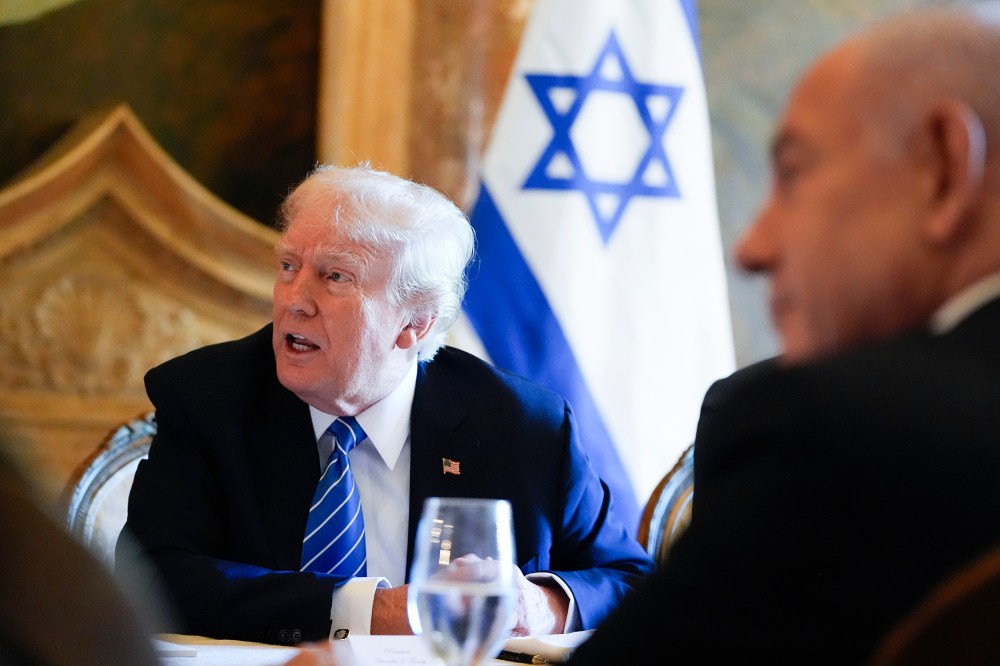
President Donald Trump said Monday that he and Israeli Prime Minister Benjamin Netanyahu had a “very productive” meeting at Trump’s Mar-a-Lago resort in Florida as they held critical talks surrounding the next phase of the fragile Gaza ceasefire.
At a news conference after the meeting, Trump said the two leaders have “very little difference in what we’re looking at and where we want to be.” Asked whether he had concerns about how Israel was negotiating the peace proposal, Trump said he was instead concerned about “what other people are doing or maybe aren’t doing.” Israel, he said, “has lived up to the plan, 100%.”
Earlier in the day, Trump spoke with reporters about the ceasefire, as well as Iran and Venezuela, as Netanyahu stood by. He said he believed that reconstruction in Gaza would begin soon, and he threatened Iran that if it begins building up its nuclear capability, he would support another strike “immediately.”
“I now hear that Iran is trying to build up again,” he added, “and if they are, we have to knock them down. We’ll knock them down. We’ll knock the hell out of them.”
Trump emphasized that he would like to get to phase two of the Gaza ceasefire deal “as quickly as we can,” adding that “there has to be a disarmament, we have to disarm with Hamas.” He said after the meeting that Hamas “will be given a very short period of time” to disarm, but did not specify how long.
The second phase requires Hamas’ disarmament, the beginning of reconstruction of the Gaza Strip and the creation of post-war governance.
Referring to the reconstruction of Gaza after the meeting, Trump suggested that the process for “certain things” had begun, including for sanitary conditions, though he did not elaborate. About 81% of all structures in the Gaza Strip have been damaged or destroyed as of October, according to U.N. satellite assessments.
The initial phase of the 20-point proposal included limited Israeli troop withdrawal, increased aid to Gaza and the release of Israeli hostages in exchange for Palestinian prisoners. All living hostages have been released to Israel. All but one of the deceased hostages have been returned.
The talks come as progress has stalled before phase two of the agreement has even surfaced, and amid growing international concern that the proposal is at risk of collapsing.
The agreement for the ceasefire went into effect on Oct. 10, three days after the two-year anniversary of the initial Hamas attack on Israel that killed more than 1,200 people, with Hamas taking 254 hostages. According to the Gaza Health Ministry, the death toll in the Gaza Strip has surpassed 70,000 people since Israel launched its military campaign there after Hamas’ attack.
Part of Trump’s push to end the conflict is to establish a Board of Peace, proposed as a transitional administration to govern Gaza to be chaired by Trump and involve other world leaders.
But even after two months since brokering the plan, Trump faces hurdles advancing the peace deal as significant parts of it remain undefined, including the blueprint for the international stabilization force to maintain security called for by the plan, and as Israel and Hamas have accused each other of major breaches of the deal.
The truce has been further tested by several airstrikes from both sides since the ceasefire, including targeted strikes that killed a top Hamas commander in Gaza, confirmed by Hamas earlier this month.
Iranian missile tests sparked concerns in the region last week despite Trump’s claim that the country’s nuclear sites were “completely and totally obliterated” after the U.S. carried out airstrikes on key nuclear facilities in June.
During a joint news conference with Greek Prime Minister Kyriakos Mitsotakis and Cypriot President Nikos Christodoulides last week, Nentanyahu said, “We are not seeking confrontation with” Iran but instead, “stability, prosperity and peace.”
Trump also gave few details Monday about a U.S. operation in Venezuela that he said took out a “big facility,” saying that there was a “major explosion in the dock area where they load the boats up with drugs.” Last week, Trump said on a conservative talk-radio show that under his orders, the U.S. military had “taken out” a facility in Venezuela two days before.
On Monday, Trump welcomed Netanyahu with praise, touting their “great relationship” and calling the prime minister a “phenomenal” leader. He reiterated his support for a pardon for the prime minister’s corruption charges.
“How do you not give a pardon? He is a wartime prime minister who is a hero,” Trump said. “I spoke with President Isaac Herzog. He tells me it is on its way.”
Herzog’s office quickly refuted Trump’s claim in a statement, saying, “There has not been a conversation between President Herzog and President Trump since the pardon request was submitted.”
Netanyahu also heaped praise on Trump, saying Israel has “never had a friend like President Trump in the White House. It’s not even close.” Later in the day, the Israeli prime minister announced that Trump was being awarded the Israel Prize, the country’s top civilian honor, marking the first time the award is being presented to a non-Israeli.
Trump has been wary of some Israeli actions in recent months, including strikes in Syria that killed 13 people and injured at least two dozen others. Trump is also mindful of America’s sentiment against getting caught in the middle of another extended war in the Middle East.
On Monday, Trump said he and Netanyahu have an “understanding” regarding Syria. Trump said he respects Syrian President Ahmed al-Sharaa, adding: “I’m sure that Israel and him will get along. I will try and make it so they do get along.”
Netanyahu added that Israel’s “interest is to have a peaceful border with Syria” and to ensure safety in the surrounding area.
The latest visit is Netanyahu’s sixth trip to the U.S. since the start of Trump’s second term. Ahead of the meeting, Netanyahu met with U.S. Secretary of State Marco Rubio on Monday morning, according to a video posted by Israel’s Prime Minister’s Office. He also met with U.S. Defense Secretary Pete Hegseth.
The U.S. delegation for Monday’s meeting included several members of the president’s Cabinet and key allies including White House chief of staff Susie Wiles, special envoy Steve Witkoff, deputy chief of staff Dan Scavino and Trump’s son-in-law Jared Kushner.
The meeting marks the second day of high-stakes diplomatic talks on peace deals at the core of the administration’s agenda. On Sunday, Trump hosted Ukrainian President Volodymyr Zelenskyy at Mar-a-Lago to continue his push for a peace plan between Ukraine and Russia, though the deal remains heavily a work in progress.

Ebony Davis is a breaking news reporter for MS NOW based in Washington, D.C. She previously worked at CNN as a campaign reporter covering elections and politics.