




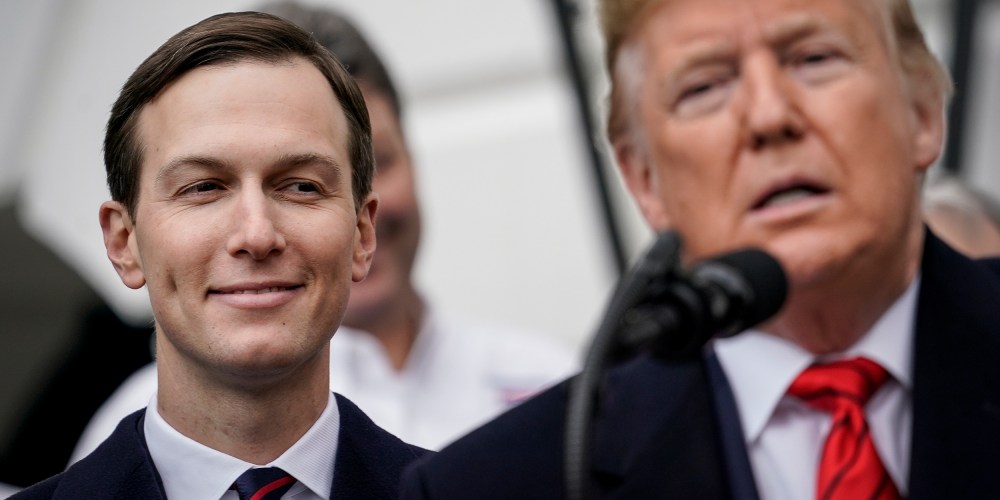
The opening to Jared Kushner’s new memoir, “Breaking History,” begins with the final stanza from Rudyard Kipling’s poem, “If:” “If you can fill the unforgiving minute / With sixty seconds’ worth of distance run, / Yours is the Earth and everything that’s in it, / And — which is more — you’ll be a Man, my son!” Kushner, one can only imagine, intends for the poem to foreshadow a story of stoicism and virtue. Instead, the poem aptly sets the scene for the musings of a sad, Lost Boy, desperate for the approval of a looming father figure.
“My duty to serve the president of the United States came first, even before family,” Kushner reflects several hundred pages later, without a whiff of irony.
The poem aptly sets the scene for the musings of a sad, Lost Boy, desperate for the approval of a looming father figure.
The fealty and revisionism are of little surprise. What is surprising, however, is just how tragic a figure Kushner reveals himself to be. He attempts to position himself as a man of strength and intellectual rigor but his prose comes across as childlike and flat. “Usually I avoid engaging in futile arguments, but this was enough. I could feel my voice rise,” he writes, describing a particularly tense moment with then-Secretary of State Rex Tillerson. Tillerson bitterly opposed Kushner’s handling of the Middle East and, specifically, his suggestion that the U.S. embassy in Israel be moved from Tel Aviv to Jerusalem — a decision decried by many policy experts as “reckless.” “My words had stung. The former oil titan was growing more frazzled and insecure, so I softened my tone.” So goes the biting account of a big boy who put an oil titan in his place. (Kushner’s ability to make such exchanges appear humdrum is one of the more impressive feats of the book.)
In an administration as damaging as former President Donald Trump’s, uncovering the Machiavellian ideology of key players holds a silver lining: Ideology grounded by clear political goals is more definable and, hopefully, more opposable. Kushner instead appears to be driven by sycophancy and insecurity; and this absence of intellectual cohesion or sophistication from many of Trump’s closest advisers, including Kushner, helped foster Trump’s distinctive flavor of White House chaos.


Kushner works overtime in his book to paint himself as worthy, capable, and competent — to the point of exhaustion for the reader. He quotes himself in conversation with Adam Boehler, the former director of the Center for Medicare and Medicaid Innovation, during a 2018 period when Kushner’s personal approval ratings hovered around 10%. “It’s hard to get attacked — by people who don’t know you — for giving up your business and comfortable life to do what you think is right,” Kushner recalls saying in the stilted language of a second-rate afterschool special. “Don’t come to Washington for appreciation, but if you want to have an impact on the country and millions of people’s lives, there’s no better place to work.”
Meanwhile Kushner recasts one of Trump’s most chaotic periods — his muddled, misinformation-laden COVID response (anyone here inject themselves with disinfectant?) — as a resounding success, in part, thanks to his own underappreciated contributions. Kushner describes Dr. Anthony Fauci as offering his sincerest gratitude: “‘It’s really not fair how the press is beating you up,’” he quotes an indebted Fauci as saying. “‘You made a very positive contribution. If you’d like me to say that to the press, I would be happy to.’”
Kushner works overtime in his book to paint himself as worthy, capable, and competent — to the point of exhaustion for the reader.
Kushner, we are told, comes by his humble intelligence honestly. While in prison (for allegedly trying to intimidate and blackmail his own sister), Kushner’s father meets a young man he believes to be redeemable. “He [the young man] told my father that he had become a drug dealer because his dad was a drug dealer. It was all he knew — and because of it, he wound up in trouble with the law,” Kushner describes, offering his readers probing insight into the problems with the criminal justice system. Kushner’s father reportedly goes on to help the man receive a scholarship after leaving prison, effectively saving him from a life of future crime. Integrity, the anecdote practically screams at us, runs in the Kushner blood.
Virgina Woolf’s famed novel, “Orlando,” highlights the often performative and empty nature of diplomacy: When top-level government officials meet, they play-act smoking and drinking, like children at an imaginary tea party — none of it is real, she suggests, all of it is for show. The middle of Kushner’s book, featuring photos of his crowning achievements, mirrors these scenes: Here we see former Mexican President Enrique Peña Nieto awarding Kushner the “highest honor for foreigners”; there we find former Israeli Prime Minister Bibi Netanyahu inaugurating the Kushner Garden of Peace in Jerusalem; there Arabella, Kushner’s daughter, recites poetry in Mandarin for Xi Jinping (“President Xi was deeply impressed by our five-year-old”). Kushner’s crowning achievements are as vacuous as he unwittingly portrays himself to be. But, then, what can we expect from a man who confuses being used for his proximity to power with being an actual powerbroker?

Noor Noman is a writer focused on culture, race and LGBTQ issues.