




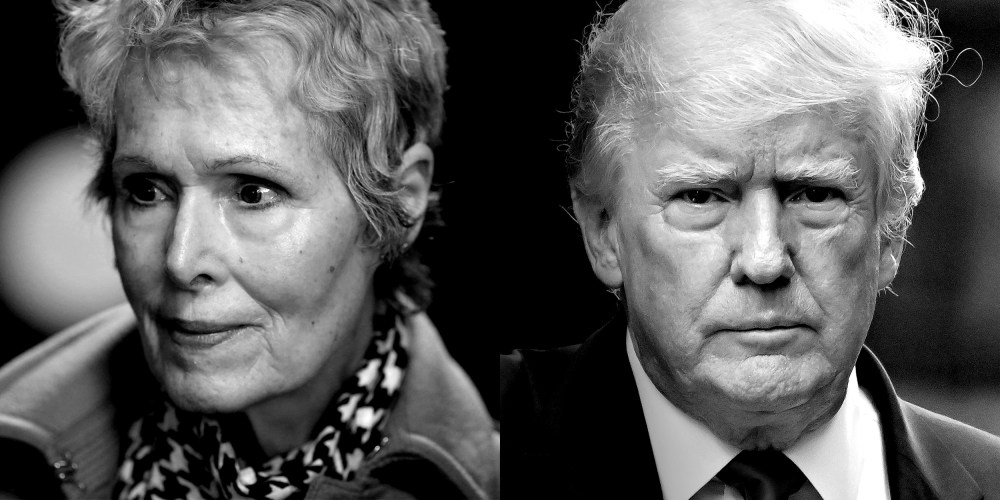
In response to the journalist E. Jean Carroll’s claim that Donald Trump raped her in the 1990s, the then-president said in January 2019 that “she’s not my type” and that “it never happened.” That denial, of course, suggests that being Trump’s “type” governs whether he would rape that person. Carroll sued Trump for defamation, and he has reached the point where he is out of good options, at least good legal options. The former president has been ordered to sit Wednesday for a deposition (yes, that means under oath) in a defamation case that centers on his denial of Carroll’s allegation. As I’ll explain later, this is one time where pleading the Fifth Amendment won’t help him much.
That denial, of course, suggests that being Trump’s “type” governs whether or not he would rape that person.
Represented by uber litigator Robbie Kaplan, whose successful advocacy led to the demise of much of the Defense of Marriage Act, Carroll alleges that Trump “through express statements and deliberate implications, accused Carroll of lying about the rape in order to increase book sales, carry out a political agenda, advance a conspiracy with the Democratic Party, and make money.”
To win, Carroll will need to show that Trump made a false statement of fact, that he knew or recklessly disregarded the fact that the statement was false, and that the statement caused injury to Carroll’s reputation. That means that if Trump is telling the truth and he did not in fact sexually assault Carroll, that he cannot then be held liable for defamation. In this way, defamation cases can provide a type of backdoor way to litigate alleged underlying criminal behavior.
But there is likely another hurdle for Carroll in this case that’s specific to the person she’s suing. Trump claimed that the federal government should become the defendant in the suit and that he is in fact immune to legal liability, because he was president when he denied raping Carroll or even knowing her. This matters because there is a federal law, the Westfall Act, that provides that the federal government should defend its employees against certain civil suits arising from actions the employee took “within the scope of his office or employment.” The legal questions here are whether Trump, as president, was considered to be an “employee” of the government and whether he was acting within the “scope” of that employment when he said that Carroll is not his type and that he didn’t rape her.

A divided panel of court of appeals judges concluded that Trump was an employee of the government when he spoke of Carroll. However, that panel asked the D.C. Court of Appeals to determine whether, with that denial, Trump was acting within the scope of that employment. That court has not yet ruled.
If Trump insulting Carroll and claiming not to have raped her 20 or so years before he became president is judged to be within the scope of a president’s official duties, then what type of statement would fall outside of those duties? I don’t know about you, but it seems to me that a smarmy denial of having committed a rape years before he was president should fall outside that scope. Taxpayers should not be footing the bill for such a defense.
But, here is why Trump may have just blown his best chance at getting out of this suit. On Truth Social (Trump’s social media site that often contains everything but the truth) he recently denied that he’d raped Carroll and reiterated the statements that are at the heart of this case. But here’s the problem for him: He is no longer the president. So he no longer has the protection of the Westfall Act. Barbara McQuade, a fellow MSNBC columnist and legal analyst, told Vice News that Carroll “should amend her complaint to include an additional count based on the new statement. Because Trump is no longer president, this statement was most certainly not made in the scope of his federal employment.”
Like he’s done in so many legal cases against him, Trump’s strategy in Carroll’s defamation case has been to delay.
Like he’s done in so many legal cases against him, Trump has adopted a strategy in Carroll’s defamation case of delay, delay, delay. He asked the judge overseeing the case to hold off his deposition until there’s a decision on the scope of employment issue. The judge said no, concluding, “Given his conduct so far in this case, Mr. Trump’s position regarding the burdens of discovery is inexcusable.” Put another way: No more delays. Trump must sit for the deposition.
Trump responded to the judge’s decision to make him sit for a deposition with his usual respect for and deference to the legal process. I’m joking. He called the legal system a “broken disgrace” and called Carroll’s suit a “hoax and a lie” and a “complete con job.”
The scheduled deposition of Trump on Wednesday is vital not just for this case, but, in the event that the case is dismissed, it’s vital for a different sexual battery case that Carroll has said she plans to file next month. You ask: Why didn’t Carroll file that suit long ago? She couldn’t. A new law in New York gives the adult victims of sexual assault one year to file civil suits, even if it’s beyond the statute of limitations. As of Tuesday evening, it didn’t appear that Trump was going to appeal the ruling ordering him to be deposed. Appealing that ruling would have been consistent with his typical delay tactics. But perhaps even Trump saw it would be nearly impossible to convince an appellate court that sitting for a deposition and answering questions under oath would cause such irreparable injury that he would be legally entitled to a delay. A successful appeal could have bought Trump some time, time which he’d have spent he hoping that the D.C. Court of Appeals would rule that his statements about Carroll were made in the scope of his employment as president and possibly dismiss her case. Here are some additional, but less-than-desirable, options for Trump. He could decide not to comply with the court order for him to appear for the deposition. But then he almost certainly would be, and should be, held in contempt. He could invoke his Fifth Amendment right against self-incrimination, but a jury in a civil case is often allowed to draw a negative inference from that decision. He could admit he lied when he said he didn’t rape her, thus handing her a legal win in her defamation case. He could try to settle the case, although many would view that as an admission of defeat. And, as we know from his response to the 2020 election, Trump does not like admitting defeat. This isn’t the end of the legal road for Carroll and Trump. Obviously the best option for Trump is if he could — consistent with his public, out-of-court statements — honestly testify that he never raped Carroll and never knew her. But that’s where his good options end. No matter what he says during Wednesday’s deposition, this isn’t the end of the legal road for Carroll and Trump. Look for her and Kaplan to make aggressive use of New York’s new law and put Trump back on the hot seat based on allegations of battery and intentional infliction of emotional distress. That suit could prove even more damaging than this defamation case.
Jessica Levinson is a Loyola Law School professor and MS NOW columnist. 


