




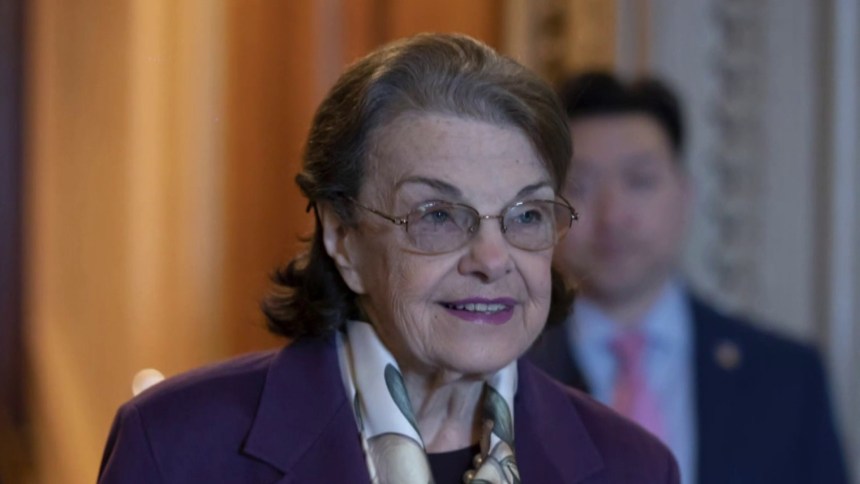
Sen. Dianne Feinstein, D-Calif., has been a member of the Senate for more than 30 years. As of Thursday, however, she has been missing from the chamber for roughly six weeks after a shingles diagnosis. With no timeline for her return, her absence has made Senate Democrats’ already-slim majority even tighter, particularly on the Senate Judiciary Committee. Without her vote, more than a dozen nominees for the federal bench had been stuck in the queue, before seven appointments managed to squeak through Thursday with modest Republican support.
But Democrats are struggling to find a solution for the other nominees, and there is zero chance of subpoenaing Justice Clarence Thomas to testify about his reported ethical violations without Feinstein in attendance. Senate Republicans have proclaimed satisfaction with the status quo and promised to block any temporary replacement for Feinstein on Judiciary. But here’s the thing: If they were smart, they’d have let Democrats have their way. Instead, they’ve likely sped up the process for Feinstein’s permanent departure from the Senate.
Feinstein should look at who is blocking her attempt to keep her seat without angering her party.
Feinstein’s office issued a statement last week saying that she’s requested Senate Majority Leader Chuck Schumer, D-N.Y., “to ask the Senate to allow another Democratic senator to temporarily serve until I’m able to resume my committee work.” On the surface, that seems like the perfect solution. But temporarily trading committees in the middle of a session isn’t easily done.
Like almost all Senate rules, though, the committee’s membership could be changed via unanimous consent, where all 100 senators give their leave to fudge things just a bit. Alternatively, the body could pass a resolution to shift committee assignments, which would require 60 votes to break any potential filibuster. In the last several days, though, the Senate GOP has with various degrees of cattiness made clear that either possibility is simply not gonna happen.
This makes absolute sense for Republicans in the short term. With Feinstein sidelined, the already glacial pace of the Senate slows even further, especially when it comes to bestowing judicial nominees with lifetime appointments. As Sen. Mitt Romney, R-Utah, told NBC News: “They’d like Republicans to help them speed the appointment of more liberal justices? Yes — when hell freezes over.” With no timeline for Feinstein’s return, this state of limbo could last indefinitely. While she has said that she will not run for re-election next year, her term doesn’t end until January 2025, leaving open the untenable scenario of her seat laying fallow for over a year and a half.


If Feinstein resigns entirely, though, California Gov. Gavin Newsom, a fellow Democrat, would appoint a replacement to complete her term. From there, the process is much better established than the ad hoc swap that Feinstein’s office proposed. There’d be no way for Republicans to block either Feinstein’s successor or another senator from taking her spot on Judiciary. Daniel S. Holt, assistant historian at the Senate Historical Office, points to a report from the Congressional Research Service (bolding added):
In filling vacancies that occur on standing committees after their initial organization, Senate Democrats follow the same procedure used for each new Congress. Committee vacancies may occur during the course of a Congress because party leaders decide to change a committee’s size or party ratio, or because Members die, change parties, or resign from the Senate. A new Senator replacing a late or former Senator may be chosen to fill the vacated committee seats. However, if the new Senator is of the opposite party from the departed Senator, adjustments in sizes and ratios often are needed to make slots for the new Senator. Moreover, incumbents also might seek to compete for the newly open committee seats, especially if they occur on one of the more prestigious panels, such as the Appropriations Committee or the Finance Committee.
It’s ironic then that Republicans’ opposition to a temporary switch removed a potential pressure release valve against the growing calls for Feinstein’s resignation. The option was only floated as a possibility after several Democratic lawmakers began openly saying what had only been whispered on Capitol Hill before then: It’s time for Feinstein to go. It was clear that she and her staff hoped that if she was no longer a roadblock on Judiciary, the calls for her resignation would die down again.
But this is just the latest in a string of reasons why Feinstein should step down. Before her latest sabbatical, multiple reports of memory loss and other declining cognitive abilities warranted her clearing the path for someone who can better represent California’s interests. And while backing Feinstein being swapped off Judiciary would be a short-term loss for Republicans, anyone who would fill her seat post-resignation would almost certainly be a more frequently reliable presence in the Senate for Democrats.
If nothing else, Feinstein should look at who is blocking her attempt to keep her seat without angering her party. Senate Republicans are gambling that her reticence to retire will outweigh her commitment to achieving broader goals for her party and country. That includes even supposed moderates like Sen. Susan Collins, R-Maine, whose audacious claim that she’s acting against a “concerted campaign to force her [Feinstein] off of the Judiciary Committee” must be taken with a grain of partisan salt. It would be in the interest of her health, her constituents and her legacy for Feinstein to defy their expectations and do the right thing by stepping down.

Hayes Brown is a writer and editor for MS NOW. He focuses on politics and policymaking at the federal level, including Congress and the White House.