





I still have vivid memories of the night in May 2004 when beloved sitcom “Friends” aired its final episode. I was a junior in high school, and my girlfriends and I all squeezed onto a big leather couch in my friend’s living room to watch Ross, Rachel, Chandler, Monica, Phoebe and Joey one last time. We laughed, we cried, we gorged ourselves on snacks. We were just a small drop of the 52 million people who watched “The Last One: Parts 1 and 2.” After 10 years and 236 episodes, it was truly the end of an era.
For people who invited “Friends” into their homes from 1994 to 2004 — and over the nearly 20 years since through reruns and streaming binges — losing Perry wasn’t some detached event.
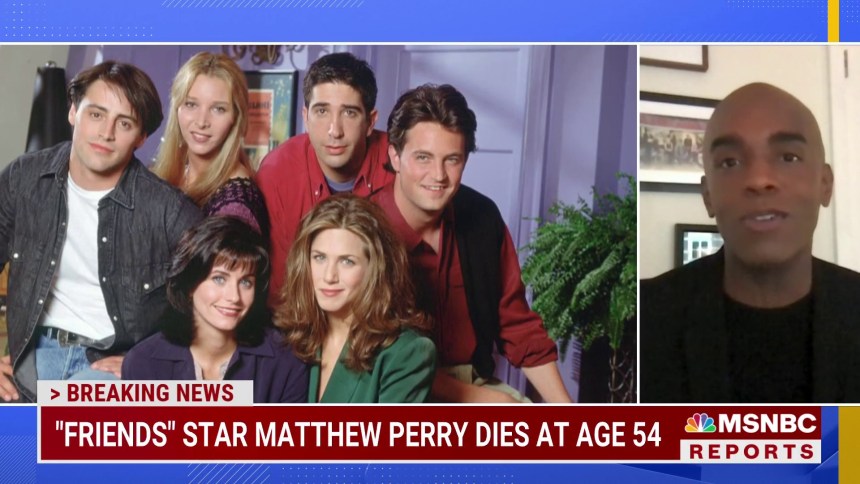
This weekend, we lost our Chandler Bing. Actor Matthew Perry — who was both synonymous with and so much more than his most beloved role — died at age 54 from an apparently accidental drowning. And among my peers, the outpouring of collective grief was immediate. For people who invited “Friends” into their homes from 1994 to 2004 — and over the nearly 20 years since through reruns and streaming binges — losing Perry wasn’t some detached event. It was akin to losing an old friend. Parasocial relationships, and the problematic aspects that can sometimes come along with them, are no longer a new phenomenon. But the grief I was seeing tied to Perry’s passing felt different from the usual celebrity death social media cycle.
And so I asked some of the most ardent “Friends” devotees in my life what losing Perry felt like for them. Why had they loved him so much and for so long?
Fatima Chaudhri, 35, described the news of Perry’s death as “an actual gut punch,” like losing one of her best friends — “someone who was there for [her] every step of the way when life got sad” and who her “whole family loved.”
This was a frequent refrain. When the world got hard and sad, many people knew they could count on your “Friends” to be there. “You felt like you were hanging out with your favorite people, and you trusted that they were going to make you laugh and sometimes make you cry,” said Liviya Kraemer, 35, who is now a TV producer. And Perry “was the best of all the things that ‘Friends’ had to offer.”
Perry’s Chandler was the sardonic, self-deprecating, relatable one on “Friends.” He wasn’t a pure comic foil in the way that Phoebe (Lisa Kudrow) and Joey (Matt LeBlanc) often were, but he was deeply hilarious. He also wasn’t a default romantic lead in the way that Ross (David Schwimmer) and Rachel (Jennifer Aniston) were, and yet his slow-burn relationship with Courteney Cox’s Monica is one of the best friends-to-lovers arcs I’ve ever seen.
So many elements of “Friends” don’t age well, but the Chandler-Monica love story absolutely does. As Jackie Perlmeter, 35, told me, Chandler topped her tween “list of perfect men” because he was “kind, caring, sensitive — even if he didn’t like dogs and never cried — funny, sarcastic and ultimately a wonderful partner.” For Chaudhri, Perry’s portrayal of Chandler taught her that “you could fall in love with your best friend in the world.”
Chandler Bing carried pieces of all the “Friends” friends within him; he was the quiet heart of the show.
Chandler Bing carried pieces of all the “Friends” friends within him; he was the quiet heart of the show.
And he was funny. So very, very funny. Perry was the kind of comic actor who could make you break into peals of uncontrollable laughter with one well-timed facial expression or deadpan joke. As “Friends” co-creator Marta Kauffman said in the 2021 “Friends: The Reunion” special: “When Matthew reads that dialogue, it sparkles, and it comes alive.”
If Perry connected to audiences because of his comic skill, he stayed connected to them because of the vulnerabilities that lay beneath. He was open for years about his ongoing struggle with substance abuse and addiction — opiates, alcohol, Xanax and cocaine were among his drugs of choice. And that off-screen pain somehow made his onscreen comedy feel deeper and more connected. Victoria Padow, 35, described Perry’s ability to find humor in dark moments as “his specialty, which seems all the more brave knowing what the actor was going through off-screen at the same time.”


In his 2022 memoir, “Friends, Lovers and The Big Terrible Thing,” Perry chronicled his 30 years of therapy, 15 rehab stints and 6,000 AA meetings. He wrote about the ongoing health issues he had as a result of his addictions. He wrote about his ongoing sobriety. He wrote about opening Perry House, a sober living facility for men. And he wrote about the way his TV co-stars rallied around him when he was in the worst throes of substance abuse disorder. “In nature, when a penguin is injured, the other penguins group around it and prop it up until it’s better,” he wrote. “This is what my co-stars on Friends did for me.”
That’s because they weren’t just “Friends” … they were friends.
The world can be a dark, depressing and unendingly cruel place, but Perry’s performances, and his ability to speak honestly about his struggles with addiction, provide a source of light. Television is an intimate medium, especially in a world before streaming platforms and bulk drops and the ability to easily record things to watch later. Watching “Friends” — and watching Perry — was a practice that so many families engaged in for a decade. How could we not feel like we knew him? And if we knew him, how could we not love him?
There is a quote from a 2022 interview Perry did on “Q with Tom Power” that has been circulating since his death in which Perry expresses that he knows people will talk about “Friends” when he dies but says he hopes it will be “far behind the list of things I did to try to help other people. I know it won’t happen, but it would be nice.”
He was right, of course — none of us can talk about Perry without talking about “Friends.” And yet … he also got it a little bit wrong. For so many people, whether or not they struggled with substance abuse issues of their own, Perry’s performances brought them healing and hope.
“At the end of the day, it’s both of those things together,” said Kraemer, “because we think of him as our friend. And that’s how he helped us.”

Emma Gray
Emma Gray, a freelance journalist focused on the intersection of gender, culture and politics, is the author of "A Girl's Guide to Joining the Resistance." She is a co-host of the podcast “Love to See It” and a co-author of the newsletter “Rich Text,” and she has spent the last 10 years as a senior reporter and editor at HuffPost.