




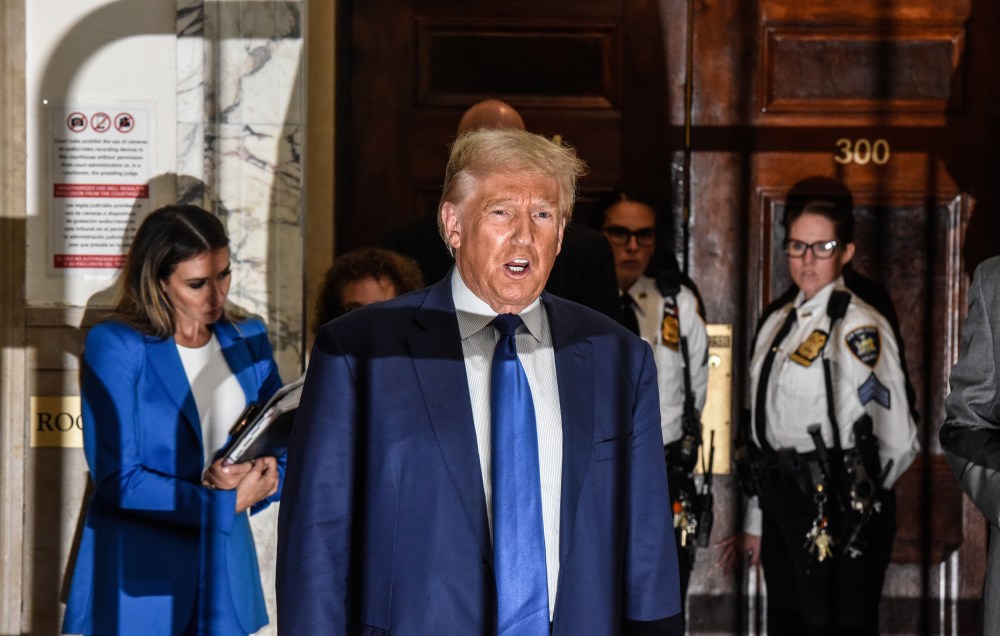
This week, former President Donald Trump shared a post on his ironically named social media platform, Truth Social, that could and should make him liable for incitement. He shared a post from another Truth Social user calling for New York Supreme Court Judge Arthur Engoron and New York Attorney General Letitia James to be placed under citizen’s arrest. The post not only potentially subjects Trump to liability for incitement, but it also telegraphs his strategy in this case and possibly the other pending cases against him. He is trying to take his fight out of the courtroom and onto the screens of his would-be voters.
Trump shared a post from another Truth Social user calling for Judge Arthur Engoron and New York Attorney General Letitia James to be placed under citizen’s arrest.
James is the prosecutor who charged Trump, and others, with civil fraud for allegedly inflating the value of Trump-owned properties to get larger loans from banks and better coverage from insurance companies. Engoron, the judge overseeing the case, granted James a partial victory before the rest of the case even went to trial. This week’s social media share was not the first example of Trump antagonizing the two. He unleashed a torrent of baseless criticisms against James and Engoron when he testified in the case last week.
But this week, Trump stepped up those criticisms and by “ReTruthing” a call for the arrest of Engoron and James endorsed that message.
As an initial matter, it is important to state the obvious. There is no basis for a citizen’s arrest of James or Engoron. New York does allow for such arrests, but only when the person being arrested has committed a felony in the presence of the person making the arrest. Neither James nor Engoron is guilty of doing anything other than their jobs.
Additionally, the fact that Trump “re-Truthed” someone else’s post, instead of posting it himself, makes no difference. Sharing a suggestion may be, and should be, tantamount to a suggestion. He should not be able to hide behind the fact that he is not the original author of the post. That he only amplified, instead of authored, the post should be of no legal consequence.
Next, the speech here should be viewed as incitement and Trump should be held to account for it. Under Supreme Court case law, speech can only be punished as incitement where it is “directed to inciting or producing imminent lawless action” and “likely to incite or produce such action.”
Trump, through his “re-Truthing,” is signaling support for the view that people should take matters into their own hands and make a lawless arrest of a prosecutor and a judge. This is not supporting vigilante justice, but goading people to engage in criminal behavior. We need look no further than Jan. 6, 2021, to understand that it is entirely reasonable to believe that people will take actions based on Trump’s words. As Ty Cobb, former White House special counsel during the Trump administration, said about the former president sharing that social media post, “these are the types of incendiary attacks that do lead to violence.”

Of equal, if not greater, importance, Trump telegraphed his strategy for fighting this case, and likely others. Given that he previously called Engoron biased and accused James of being the one to engage in fraud, and has now amplified a call for them to be arrested, it’s obvious he’s not trying to curry favor with them. In fact, his priority doesn’t to seem to be finding a winning legal strategy at all. Instead of combating the charges, he is appealing to those outside the courtroom: his voters and his donors. He is trying to turn the courtroom into a high-stakes political theater.
Trump wants his federal election interference case to be televised. It’s easy to see why. Televising the proceedings is the best shot he has to transmit his intended political theatrics outside the courtroom to potential voters.
Trump has told anyone who will listen that he is the victim of the greatest political witch hunt in our nation’s history. Trump has told anyone who will listen that he is the victim of the greatest political witch hunt in our nation’s history. And now that cases have been filed against him, and the big and small losses in those cases accumulate, he is using those losses as proof of his point. He is trying to turn legal accountability on its head. Each time the legal system works as intended, he cites it as proof the system is broken. Trump will keep lashing out against judges, prosecutors and investigators. He will likely continue to violate gag orders, as he did in October when he attacked Engoron’s law clerk. He may engage in more speech that meets the definition of incitement. Trump doesn’t care about the verdicts in the cases before him nearly as much as he cares about winning votes and discrediting a justice system that could call him to account. If Trump becomes president again, he could attempt to pardon himself for any federal crimes he is facing or was convicted of. He could also challenge Georgia’s ability to incarcerate a sitting president. Winning back the Oval Office may be Trump’s best shot at avoiding time in a different venue — a federal prison. Thus, his strategy of criticizing those seeking to hold him accountable and possibly inciting violence against them as he tries to bulldoze his way back into the presidency.
Jessica Levinson is a Loyola Law School professor and MS NOW columnist. 


