




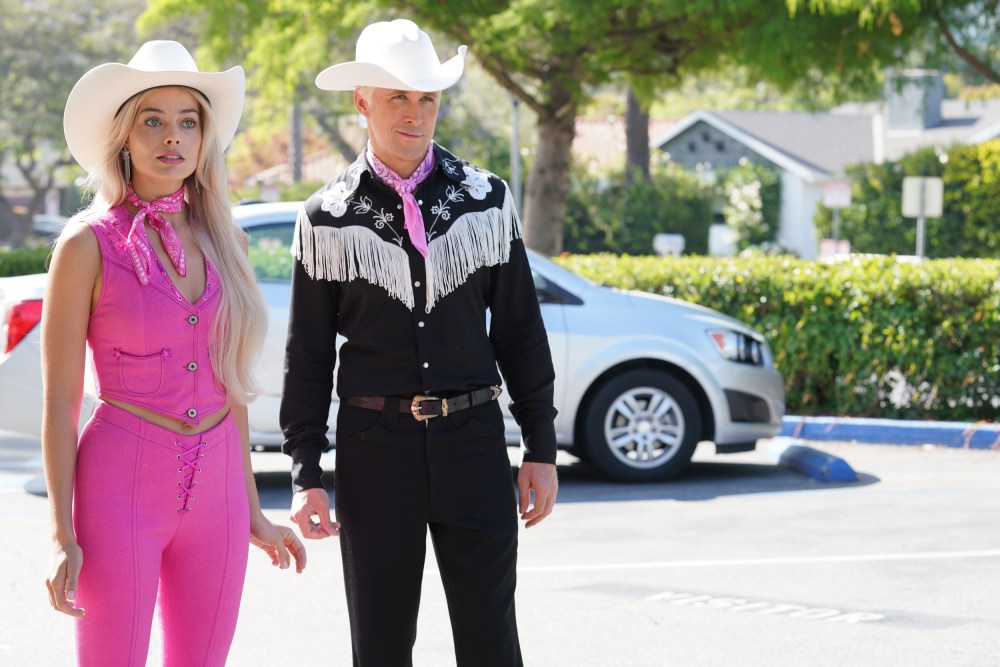
Fans of “Barbie” are outraged that the movie was “snubbed” in this year’s Oscar nominations. Even though the movie was nominated for eight awards, “Barbie” stans are furious that Greta Gerwig wasn’t nominated for best director or Margot Robbie wasn’t nominated for best actress. The two snubs mark a miscarriage of justice in the eyes of “Barbie” partisans, who have been circulating memes arguing that the Academy of Motion Picture Arts and Sciences has replicated the patriarchal norms that the movie objects to. Ryan Gosling, who was nominated for best supporting actor for his role as Ken, released a statement saying Gerwig and Robbie should’ve been recognized because they “made history.” Former Secretary of State Hillary Clinton published a post on social media standing in solidarity with Robbie and Gerwig. She included the hashtag #HillaryBarbie.
This debate means a lot to some people, which speaks to how skillfully Gerwig walked the narrow art-commerce tightrope. But it also overstates what is liberating about “Barbie” and understates what’s oppressive about it.
“Barbie” is witty and extremely fun, and it featured a thorough and compassionate examination of how patriarchy traps not only women but also men with its oppressive value system. Yet it’s misguided to think the film objectively deserved to receive more nominations than it got — or that not being nominated for 10 Oscars can only be explained by obvious misogyny.
The bigger tragedy here may be that “Barbie” is being decorated at all. “Barbie” was an actual two-hour toy commercial backed by Mattel that, by its very nature, could never offer us radical ideas about feminism and power in society.
The academy — which consists of thousands of film industry professionals who generally vote in the categories that they specialize in (directors for directors, actors for actors, etc.) — hardly showed disrespect for a movie that was nominated eight times, including for best picture. “Barbie” was one of the most nominated films at the Oscars. And while it’s safe to assume that sexism and all other forms of prejudice are at play during every Oscars cycle, outrage over “Barbie” has helped obscure the good news that more female directors received best picture nominations this year than ever before.
The academy seems generally fond of the manifestly talented Gerwig. She is the first filmmaker in history to have had her first three solo features, all of which feature rebellious women, nominated for best picture. One of those movies, “Lady Bird,” also landed Gerwig a best director nomination. Robbie is no stranger to Oscar nominations herself, having been nominated multiple times before, including for best actress.
The issue, some “Barbie” fans argue, is the asymmetry between Gosling’s nomination and Gerwig’s and Robbie’s non-nominations. But there are confounding variables. Gosling was in the least competitive category of the three — supporting actor — and benefited from a script that positioned him to deliver many of the funniest lines in a comedy. Gerwig faced stiff international competition and was passed over by a pool of voters — directors — who are also averse to nominating comedies and commercial blockbusters. (“Barbie” was both.)
And somehow this crowd seems to be overlooking that America Ferrera, who plays a Mattel employee, was nominated for best supporting actress.
There is of course no way to rule out the way that biases shape any nomination process. But getting too litigious about these things is unreasonable. Despite what today’s fervent fandoms seem to take as an article of faith, no film “deserves” any kind of special recognition any more than your favorite color or your favorite food deserves special recognition as my favorites. This is about subjective judgments and expressing taste. And as far as my own taste is concerned, I’m sympathetic to the argument “Barbie” should’ve been snubbed completely.


“Barbie’’ was the first product of Mattel’s in-house film division, which saw the movie as a way to boost the sale of Mattel products. Mattel had to convince Gerwig, one of the most talented young directors in America, into making something that Mattel saw as a giant ad. Mattel’s goal was to boost sales, and it succeeded in that goal.
Perhaps most harrowingly, the success of “Barbie” appears to have spawned a new subgenre of toy-centric films backed by toy companies, which may mark the next chapter of intellectual property hell as lifeless superhero films finally begin to decline in popularity. Like with “Barbie,” these high-dollar projects are soaking up top directing and acting talent who could otherwise be making exciting art that isn’t likely to be controlled by toy sales projections.
Gerwig did the best job imaginable given the source material. The movie not only feels fresh, but it featured criticisms of previous Barbie toys as retrograde and Mattel as an opportunistic, profit-seeking entity. But despite reports that Gerwig had freedom over the creative process, she had to have known that she was making a movie backed by (and in conversation with) a commercial entity that clearly would’ve drawn lines over certain criticism, political orientations and artistic flourishes.
Robbie Brenner, an executive producer of Mattel Films, told Time magazine that “Barbie” is “not a feminist movie.” That doesn’t mean it doesn’t include some feminist ideas — it does — but Brenner’s remark reminds us of the risk-averse corporate interests and the implicit boundaries around the project. Given Mattel’s oversight, one has trouble imagining, say, a deeply pessimistic take on women’s liberation, or a socialist feminist perspective, or a radical attack on the very idea of gender making its way into the movie. Ultimately, “stereotypical Barbie” is the hero of the film.
As much as Gerwig’s movie is critical of Barbie dolls for promoting unhealthy ideas about womanhood, it features a redemptive arc for the toy. At the end of the film, Barbie Land is set on the path of gender harmony, and Robbie’s Barbie spends time with a character who represents Ruth Handler, the original creator of the doll. The real-life Handler reportedly declined to identify as a feminist and came up with the idea for Barbie after seeing a German doll that was a sexualized gag gift for adults in the mid-20th century. Her Barbie designs represent a complicated relationship with women’s empowerment. But she is presented in an unambiguously positive light in the movie. Is that how Gerwig really feels? Or did she feel the need to soften her blows against Mattel? We don’t know.
Instead of making a call to arms over the nominations garnered by a movie seeded by a toymaker to sell more toys, we should be looking to bring about a quick end to this inherently stifling subgenre of movies that toy companies are about to roll out. Rather than send memes denouncing the academy for a nomination she didn’t get, those rooting for Gerwig, like I am, would do better to wait until the next time she serves up something exciting and free from this suppressive model of film creation.

Zeeshan Aleem is a writer and editor for MS NOW. He primarily writes about politics and foreign policy.