




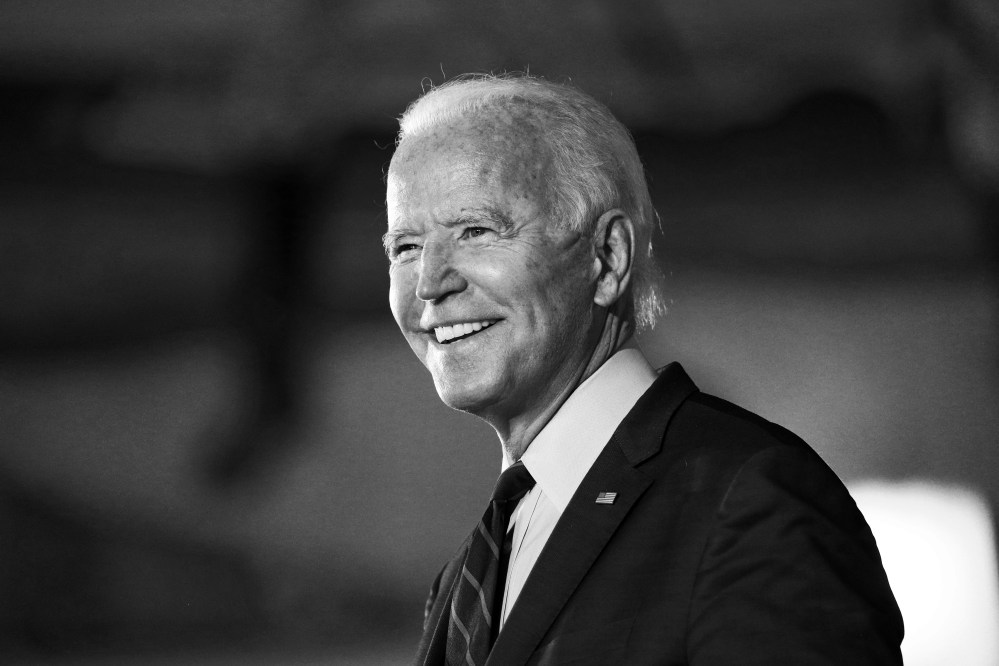
Americans are flagging with election fatigue. We don’t want to fight anymore; President Donald Trump has exhausted us, Covid-19 is killing us, and the lockdowns are sapping our resolve and testing the limits of our compassion. We’re looking for leadership that will engage our vagus nerve, not produce endless pulses of cortisol.
We’re looking for leadership that will engage our vagus nerve, not produce endless pulses of cortisol.
That may be why, despite not leaving his voters dripping with enthusiasm, Democrats are smashing early voting records, turning out for former vice president Joe Biden in states like Texas several weeks before the election. It may be why reluctant Trump voters — the ones who since 2016 have wished he’d shut up and work instead of tweet — have shifted sides.
This makes intuitive sense to a degree: Trump has not met the most basic needs of Americans during the pandemic; he has turned women off with his misogyny and entire populations with his racism. He now has to squeeze more voters out of an increasingly smaller share of the his nonmetropolitan electorate. And Biden is the right balm, at least in Ezra Klein’s telling, because his campaign fills an empty space in our hierarchy of social needs: People want their president to be decent, and not cruel.

But the answer may be even more basic than that. Even people who invested heavily in the idea that Trump could creatively destroy Washington and rebuild it to fit the needs of the forgotten are simply and utterly tired of feeling like every moment is Sept. 12, 2001 — with no idea whether there’s going to be something new to be terrified of or outraged about. Biden’s workman-like progressivism, combined with his instinct not to fight at every moment, could help recondition us about the amount of brain space our president should take up in our daily lives.
Where everything Trump touches seems to die, everything Biden says seems to be designed to tell us that we are simply not going to be placed into the middle of his personal drama. Although human beings are conditioned to avoid thoughts of mortality, and effective authoritarians understand how to harness existential frustration to their political benefit, Trump has not shown us how to manage our terror once he’s instigated it. What really flipped the switch was a pandemic that made all of us actually consider death. It’s a shared historical space that hardened resistance to Trump’s chaotic pugilism.


Where everything Trump touched seemed to die, everything Biden says seems to be designed to tell us that we are simply not going to be placed into the middle of his personal drama.
Does Biden’s turning away from mortal combat have ramifications for his agenda? Absolutely. Biden himself doesn’t care what people say about him online. He does not organize his brain that way, and his campaign wears this indifference as a badge of honor. If he becomes president, this might pose a challenge and could be a circuit breaker for activism momentum, so much of which is galvanized online. Although the major problems we face won’t disappear after a Biden election, and in fact might get worse because of their own motive forces, many people will want to simply take a break. Some may find comfort in acting like they’ve solved the problem — or cede the responsibility to Biden.
The progressive left will want to hold Biden’s feet to the fire, and rightly so: “Medicare for All”; hewing to the framework of the Green New Deal; statehood for Washington, D.C.; meaningful police reform; and most especially, fealty to the pace of change. Biden may have beaten the socialist, as he likes to brag, but the left is incredibly powerful at setting expectations. They have already begun to pressure Biden (through Senate Minority Leader Chuck Schumer) to call to replace Sen. Dianne Feinstein, D-Calif., as ranking member of the Judiciary Committee because she gave Republican Sen. Lindsey Graham a hug and, in validating him with her remarks, potentially a re-election gift.

But that’s not how Biden works. He will listen to the base, but like Trump, he is constitutionally incapable of becoming someone he isn’t. Loyalty, for example, is extremely important to him. Biden’s inability to command outrage — and then to cynically reinforce that outrage online — may make it harder for his critics to use social media to hold him accountable for his promises to them.
Although the major problems we face won’t disappear after a Biden election, and in fact might get worse because of their own motive forces, many people will want to simply take a break.
Progressives are not Biden’s natural base, but he has adopted them; the Democratic Party, as he says, is his now. So, he will need to find some way to make sure Democrats remain engaged on his behalf. He does not need them to try and find a challenger to run against him in 2024. There are two realistic options: One is to cede the progressive portfolio to his vice presidential running mate, Kamala Harris, and let her run with it. The other is to populate his White House and his Cabinet with much younger leaders, people who have more generational overlap with the parts of the party he will always be distanced from.
If he becomes president, I think progressives will give Biden a few months to operate more or less freely, as he tries to untangle the knots Republicans have left for him. When the lockdowns lift, the vaccines arrive and the economy begins to recover more equitably, our political fatigue may dissipate. That’s when he’ll face his long-delayed reckoning with his party’s energetic progressivism.

Marc Ambinder
Marc Ambinder is a senior fellow at the USC Annenberg Center for Communication Leadership and Policy. A former White House correspondent and political reporter, he is the author of several books about national security, including “The Brink: President Reagan and the Nuclear War Scare of 1983.” He is a consultant for Spycraft Entertainment and lives in Los Angeles.