




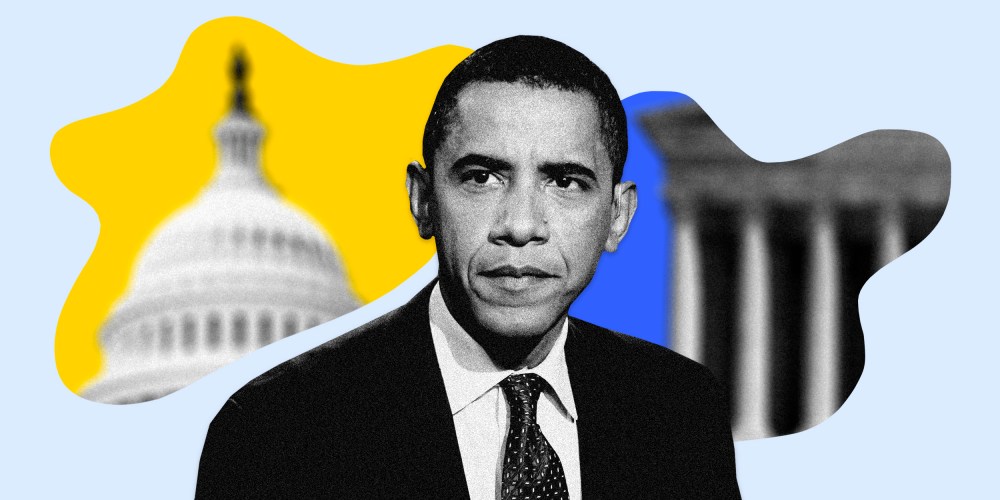
Barack Obama finally hit the campaign trail for his former vice president, Joe Biden, on Wednesday night, after four years of mostly shying away from the political spotlight. But while his razor-sharp speech was a welcome reminder of how great a campaigner Obama is, maybe he doesn’t have to spend the rest of his post-presidency as a warmup act.
At the start of the Trump administration, Obama seemed to vanish overnight. We’d catch glimpses of him from time to time, memes of him having a great time on Richard Branson’s yacht, a scene that clashed with the horror show of everyday life for the rest of us. He and Michelle got a Netflix production deal, and he would drop the occasional Spotify playlist or give an address to young people every now and then. But it’s only in the last year that he’s finally made a fuller return to public life.
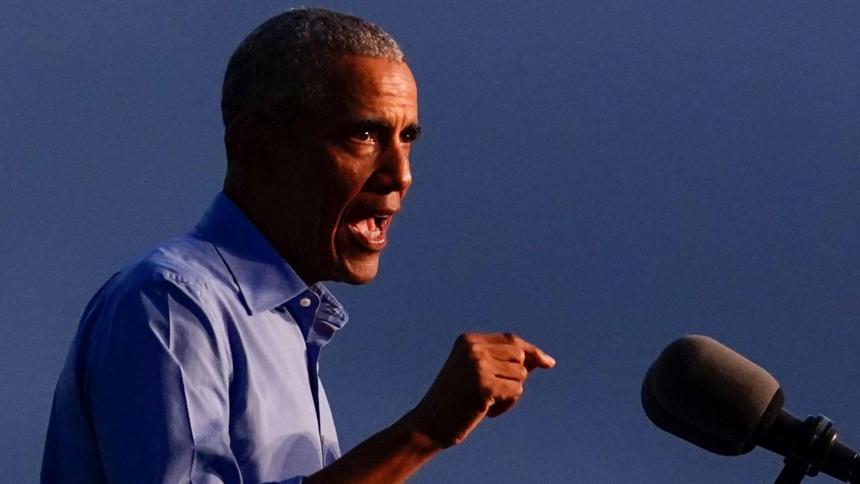
Obama delivered his sharpest attack on the Trump administration since he turned over the keys to the Oval Office in 2017.
In his drive-in speech to Black voters in south Philadelphia on Wednesday night, Obama delivered his sharpest attack on the Trump administration since he turned over the keys to the Oval Office in 2017. But being who he is, he ended on a hopeful note: “We can’t just imagine a better future. We’ve got to fight for it. … What is best in us is still there, but we’ve got to give it voice, and we’ve got to do it now.”
Hearing him back on the stump, I feel called to paraphrase Wes Anderson’s film “The Royal Tenenbaums“: Everyone knows Obama said “this is my last campaign” in 2012. But this essay presupposes … what if it wasn’t? What if it turns out that with the accomplishments of his presidency threatened, the best way to protect and strengthen them isn’t just to get Biden elected? What if making good on promises unfulfilled and policies now broken means Obama’s returning to government service and fighting for that future himself?
Obviously, the 22nd Amendment keeps Obama from running for a third term as president, which is as it should be, no matter how many times President Donald Trump hints that he’d like to change it. Taking up a position in a future Cabinet could raise troubling questions about the line of succession, as well as create some awkward situations after he’d held the top spot. But that still leaves two whole branches of the government open for Obama to consider.

Obama spent only two years in the Senate before beginning his run for president. Of his arguably brightest legacies in office — the Affordable Care Act and the Iran nuclear deal — one has been under constant attack since it passed and may soon fall before the Supreme Court. The other has all but collapsed after his successor withdrew U.S. support. There are still years, potentially decades, that Obama could serve his country and build an even more lasting legacy — one that he might have set aside in his desire to become president.
Should Obama re-enter the Senate, more than a decade after he left, he’d have the chance to be the workhorse that his former rival-turned-colleague Hillary Clinton became after she crossed over from the other end of Pennsylvania Avenue. A legislative world without the filibuster — as Obama recently endorsed — would be a far different one from what he’d left behind as president. A Democratic majority in Congress could actually advance the legislation he was unable to push through during his two terms.
A returning Sen. Barack Obama would have a hand in crafting the immigration reform that the country requires, potentially moving beyond the package that nearly passed Congress early in his second term. He could write and lobby for the Deferred Action for Childhood Arrivals program to become the law of the land, rather than an executive order on shaky legal ground. With his legal mind and view of racial justice, Obama could tackle recrafting the Voting Rights Act, which was gutted in his second term, which would be an even finer tribute to the late Rep. John Lewis than his incredible eulogy. And he could finally make good on his promise after the Sandy Hook massacre to institute the kind of gun control legislation that died an ignoble death in the Senate in 2013. Plus, can you imagine Obama working in the Senate alongside his 2012 rival, Mitt Romney? The mind reels.
And there’s precedent. John Quincy Adams lost his re-election bid in 1828 to Andrew Jackson, handing over the White House to a man who would become an idol of Trump’s more than a century later. Adams, despite coming from a political family, determined that he would retire to private life, but it didn’t take — two years later, he was running for Congress in southeastern Massachusetts. Both his wife and his son thought it was bad form on his part, but the people of his district disagreed: He won with nearly three-quarters of the vote.
Charles Edel, in his 2014 biography of Adams, laid out Adams’ mindset ahead of taking up his seat in the 22nd Congress:
Just before he left Massachusetts for Washington in the winter of 1831, Adams wrote that to be both a good and a great man, one must use one’s abilities to pursue ends for the benefit of mankind. Looking back on his career, he conceded that his abilities had been, and still were, ‘very imperfect.’
It’s not hard to see Obama reaching a similar conclusion. Adams was 64 when he joined the House of Representatives and continued to serve in Congress until he died 17 years later. Obama is only 59 and has plenty of years left to serve.


But if the House isn’t prestigious enough for him, he could consider his old stomping grounds in the upper chamber, the Senate. There’s precedent here, too, albeit a less savory one. Sen. Andrew Johnson of Tennessee was chosen to be Abraham Lincoln’s second running mate to help balance the ticket in 1864. After he assumed office following Lincoln’s assassination, Johnson was impeached and was just barely acquitted in 1868. Having alienated the Republicans over the course of his term, Johnson was too toxic to be nominated for re-election. But the fine members of Tennessee’s Democratic-controlled Legislature chose to overlook that and send him to back to the Senate in 1875. He died just months after he took up his seat — not exactly a model to live up to but a proof of concept, nonetheless.
The big question, then, is where Obama would want to relaunch a political career. Since he left office, the Obamas have lived in the Kalorama neighborhood of Washington, D.C., which doesn’t do him much good strategically. If he wanted to return to Illinois, though, Sen. Tammy Duckworth is up for re-election in 2022, and she has been suggested as a potential secretary of veteran affairs should Biden win. Sen. Kamala Harris’ seat in California will also be up for grabs at the time, but if she’s vice president in 2022, Obama would have to fend off locals like Kevin DeLeon, who just barely missed out in his challenge for Sen. Diane Feinstein’s seat in the last midterm election, and potentially heavyweights like former Gov. Jerry Brown, whom Gov. Gavin Newsom could name to fill her seat in the meantime.
If running for office doesn’t appeal to Obama, though, there’s a third route: the Supreme Court. Obama has the background, having taught constitutional law at the University of Chicago after graduating from Harvard Law. And again, history is on his side. The Senate confirmed William Howard Taft as chief justice of the United States in 1921, eight years after he vacated the White House. In his time on the bench, Taft led the dominant conservative wing of the court, continuing to side with businesses over labor unions, much as he had done when in office. Overall, he was much happier as chief justice than he ever was as president. And unlike what a Justice Obama would likely face, Taft’s policies as president rarely reached the court. He recused himself from a case once, according to Smithsonian Magazine, “when a murderer whose death sentence he commuted sued for freedom.”
A spot on the Supreme Court would be more of a long shot than another run, especially considering how firmly entrenched the current justices seem to be. But with a lifetime appointment, Obama could write decisions in future cases involving privacy rights and international law — or, more likely, should the conservative majority hold, dissents that legal students would still be reading a century from now.
As one of the pre-eminent members of the Democratic Party still, Obama makes for an exceptional figurehead. He’s become a symbol of a more normal time as the Trump administration has carried on with its steamrolling of previous laws and standards. We need more than iconography, though, to help salvage our government whenever Trump leaves office, be it next year or January 2025.
None of this is to say that it would be smooth sailing for the former president. Obama is still a prime target for Republican ire nationally. Democratic House Speaker Nancy Pelosi fills that niche now, but Obama brings the bonus of still being the same Black man he was when he was first elected and all the racist vitriol that came with it. He’d also be running with a full eight years of policies to resurface during a campaign — the attack ads practically write themselves. And, well, Michelle may literally kill him. That’s just a fact we have to raise. But it’s something that he should consider both for his own legacy and for another shot to “pursue ends for the benefit of mankind.”
While you let that sink in, here are some links for your morning:
- NBC News: National Intelligence Director John Ratcliffe held a surprise news conference Wednesday night, soon after Obama finished speaking. He announced that Russia and Iran had obtained U.S. voter files — and claimed that Iran was behind the emails intimidating to voters signed by the Proud Boys. It’s a lot.
- The Washington Post: Meanwhile, Trump is reportedly considering firing FBI Director Christopher Wray because of course he is! Wray and Attorney General William Barr are in trouble with the president for not prosecuting his political enemies like he wants. Not exactly a comforting thing to have out there.
- Politico: Nahal Taloosi reports that the Secretary of State Mike Pompeo, looking to shore up his pro-Israel credentials ahead of a potential presidential run, wants to label Amnesty International and other human rights groups as anti-Semitic:
The declaration is expected to take the form of a report from the office of Elan Carr, the U.S. special envoy to monitor and combat anti-Semitism. The report would mention organizations including Oxfam, Human Rights Watch and Amnesty International. It would declare that it is U.S. policy not to support such groups, including financially, and urge other governments to cease their support. The report would cite such groups’ alleged or perceived support for the Boycott, Divestment and Sanctions movement, which has targeted Israel over its construction of settlements on land Palestinians claim for a future state. It’s also expected to point to reports and press statements such groups have released about the impact of Israeli settlements, as well as their involvement or perceived support for a United Nations database of businesses that operate in disputed territories.
- BuzzFeed News: And finally, ICE has begun implementing a new policy to speed up deportations for undocumented immigrants taken into custody who have been in the U.S. for two years or less. The administration would love to skirt overburdened immigration courts, and now it seems like they’re taking the chance.

Hayes Brown is a writer and editor for MS NOW. He focuses on politics and policymaking at the federal level, including Congress and the White House.