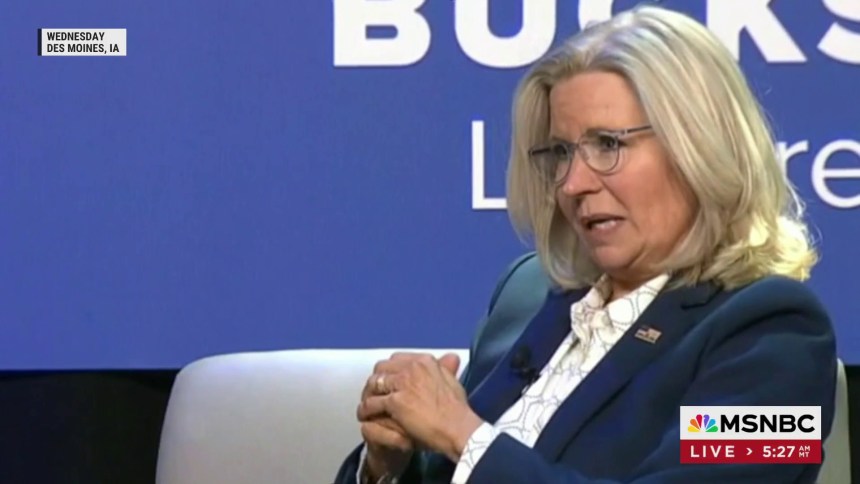
By now the cowardice of the hollow men of the GOP is an old story, from the flip-flopping of Lindsey Graham to the opportunism of Kevin McCarthy.
But what happened this week with the Gerald R. Ford Presidential Foundation is still worthy of note, because of what it tells us about the politics of retribution and intimidation.
David Hume Kennerly, a Pulitzer Prize-winning journalist and Ford’s White House photographer, resigned from the foundation’s board of trustees on Tuesday with a scathing letter. Kennerly claimed his former peers were refusing to honor Rep. Liz Cheney, R-Wyo., out of fear that Donald Trump might retaliate against the foundation if he returns to the White House — specifically, that he might prompt the IRS to revoke the foundation’s tax-exempt status.
But, as the Financial Times’ Ed Luce commented, the whole controversy was a dispiriting look into the not-so-unlikely future.
If Trump can scare the Gerald Ford Foundation from giving an award to @Liz_Cheney six months before the election, imagine the spinelessness we'd see after he won. Really terrible foretaste what would be in store.
— Edward Luce (@EdwardGLuce) April 10, 2024
Indeed, the foundation’s allegedly pre-emptive surrender was a reminder that self-censorship is a feature of authoritarianism. The most effective regimes rely on a population internalizing the need to submit. Fearful of what comes next, they put the handcuffs on themselves. A vengeful president does not need to take punitive executive action; he only needs to seem capable of doing so. Like clockwork, politicians, institutions and businesses fall in line.
After the story of Kennerly’s resignation broke, the foundation announced that it had awarded its top award to former Indiana Gov. Mitch Daniel. Gleaves Whitney, the foundation’s executive director, said in a statement that selecting Cheney for its Gerald R. Ford Medal for Distinguished Public Service when she may or may not be contemplating a future presidential run “might be construed as a political statement and thus expose the Foundation to the legal risk of losing its nonprofit status with the IRS.”
Kennerly wasn’t buying that explanation. At all.
Notably, former Vice President Dick Cheney received the same award in 2004, when he was a candidate for vice president.
The most effective regimes rely on a population internalizing the need to submit.
In his resignation letter to his fellow trustees, Kennerly wrote that the foundation had instead refused to honor Cheney because of “your agita about what might happen if the former president is re-elected.” And the fact that the foundation was so worried about Trump weaponizing the IRS specifically was deeply ironic, continued Kennerly: “Gerald Ford became president, in part, because Richard Nixon had ordered the development of an enemies list and demanded his underlings use the IRS against those listed. That’s exactly what the executive committee fears will happen if there’s a second coming of Donald Trump.”
Kennerly noted that Cheney had previously received the (similar) Profile in Courage Award from the John F. Kennedy Library Foundation along with Ukrainian President Volodymyr Zelenskyy and three other “defenders of democracy.” The JFK Foundation praised Cheney for her conviction, calling her a “consistent and courageous voice in defense of democracy” and applauding her refusal “to take the politically expedient course that most of her party embraced.” In contrast, Kennerly wrote, “Those of you who rejected Liz join many ‘good Republicans’ now aiding and abetting our 45th president by ignoring the genuine menace he presents to our country.” The former presidential photographer added that it “was a painful decision to resign from the Gerald R. Ford Presidential Foundation, but necessary. I hope more people around the country will follow Liz Cheney’s example and speak out about the threat to our democracy.” In a second statement, Whitney reiterated its reasoning, calling it a “fiduciary responsibility” guided by legal counsel. “The Foundation’s action this year in no way precludes her from serious consideration to receive the medal in a future year,” the statement noted. Like Kennerly, I’m not buying it. Courage is far rarer than complicity, especially among groups that are risk averse. And Trump is counting on that as he continues to promise a presidency of “retribution.”
Charlie Sykes is an MS NOW contributor and the author of the newsletter "To the Contrary."