




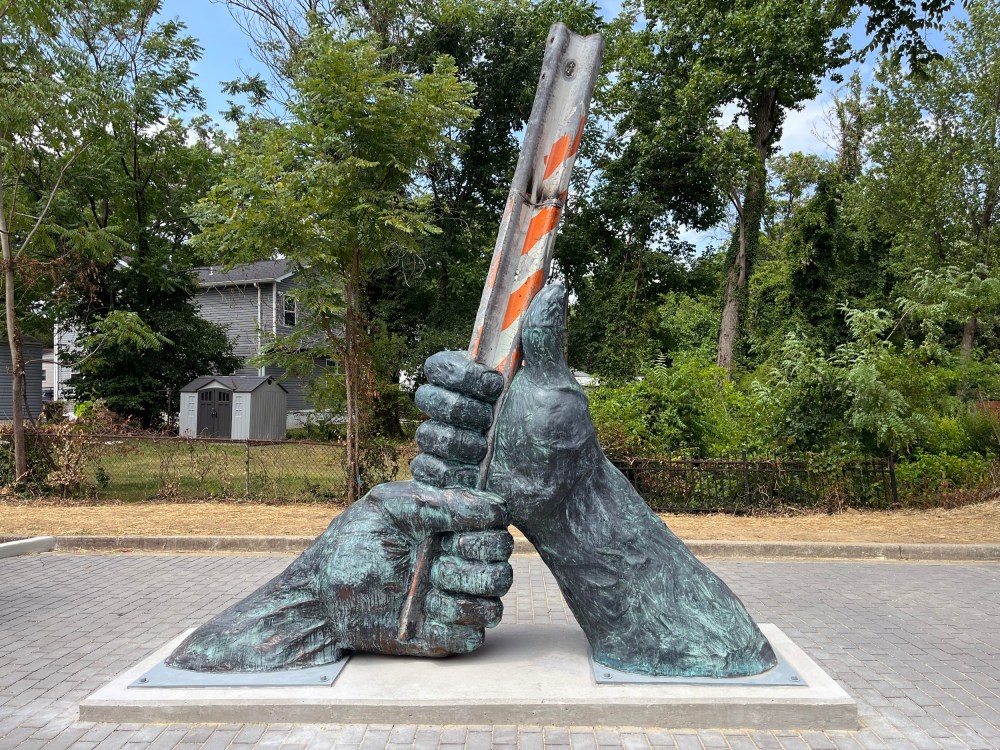
One day in 1957, a road crew pulled up to Windom Road and put a corrugated metal highway barrier sideways across the street.
The barrier stopped cars from going down the road connecting two small Maryland towns just north of Washington, D.C. But it also made clear the danger for residents of the historically Black town of North Brentwood if they crossed the border into majority-white Brentwood, a “sundown town” where they would be at risk of violence after dark.
The barrier wasn’t unique. Across the country, in cities as far apart as Miami, Detroit, Atlanta and Fort Worth, Texas, people in white neighborhoods and towns put up similar “segregation walls” in the 20th century to create physical barriers that would reinforce racial divisions. Some have been torn down or fallen into disrepair. A few have historical markers to explain the racist reason they were built.
The two Brentwoods, though, chose to tear down their barrier and replace it with art, which was officially unveiled last weekend. How they did it is a lesson for the rest of the country.
Despite their similar names, the towns had long been divided. Both were built on farmland along the Northwest Branch of the Anacostia River subdivided by a white Civil War veteran who had commanded a regiment of Black soldiers. He sold the flood-prone land along the river to Black families who built homes, formed churches and opened a juke joint frequented by Duke Ellington and Pearl Bailey in what became North Brentwood. The land farther south where white families lived became the town of Brentwood. Before they were incorporated, the towns were sometimes called “Black Brentwood” and “White Brentwood.”
Like other segregation walls, the barrier was more of a physical reminder of the attitudes and laws that kept the races apart than an enforcer of it. North Brentwood Mayor Petrella Robinson, who was 7 when the barrier was erected, said she and her friends used to walk past it on the way to middle school without incident, though they were aware that they needed to be careful in Brentwood.
“It was more of a sign than anything else, saying, ‘You are not welcome here,’” she said.
But in recent decades, attitudes changed. Brentwood saw an influx of immigrants from Central America and other new residents, and racial tensions between the towns ebbed, though they didn’t go away entirely. Some Brentwood residents gradually forgot why the barrier had been constructed, and many people who lived in the surrounding area didn’t even know it was there. Over the years, there were intermittent discussions of tearing it down that didn’t lead anywhere.
In 2016, representatives from the local volunteer fire department asked Brentwood Mayor Rocio Treminio-Lopez if the barrier could be removed so that fire trucks could pass more easily between the towns. Treminio-Lopez, who lived near the barrier, had always assumed it had been put there to keep cars from using it as a shortcut for a busy state road nearby, but she agreed to talk with Robinson about it.
The two mayors quickly agreed that it needed to be taken down, but they didn’t want it to be forgotten either.
At a meeting with town staff and former officials, the history of the barrier came out. Horrified, Treminio-Lopez said it should be taken down, but Robinson said she didn’t want people to forget that it had been there and what it symbolized.


The two mayors, one Black and one a Latina immigrant from El Salvador, worked together over the next seven years to decide what to do. Joe’s Movement Emporium, a nearby arts organization, held a dance performance that highlighted the barrier’s history. The towns received grants to upgrade the area into something of a miniature park and make plans to connect it to nearby historical sites. And the towns hired a local artist, Nehemiah Dixon III, to create a piece of public art marking the history of the barrier.
Dixon, whose day job is at the Phillips Collection, a trendy modern art museum in Washington, D.C., had never done anything like it. His initial ideas were more abstract, but as he talked with neighbors and the two mayors, they kept emphasizing that they wanted something that would send a message of unity.
Eventually, Dixon came up with the idea of two hands lifting the barrier, bringing in local sculptor Wesley Clark to help build it.
After building a steel and foam core, the two began fabricating the hands from epoxy resin. Each artist focused on a different hand so that their varying styles would make them look more like the hands of two people working together. They then finished with a patina that gives the hands a greenish hue reminiscent of the Statue of Liberty. Dixon said that also leaves the race of the two hands ambiguous.
“The community is changing,” Dixon said. “We wanted to reference the past, but also the future. We don’t know who these two people are, and it doesn’t matter. They can be Black and white, old and young, strong and weak — however you want to interpret it. The only important part is taking that barrier from horizontal to vertical.”
The location is also meaningful. The sculpture is located directly on the boundary identified by a surveyor, so one hand rises from North Brentwood, and the other from Brentwood.
Windom Road, which once divided the two towns, now brings them together.

Ryan Teague Beckwith is a newsletter editor for MS NOW. He has previously worked for such outlets as Time magazine and Bloomberg News. He teaches journalism at Georgetown University’s School of Continuing Studies and is the creator of Your First Byline.