




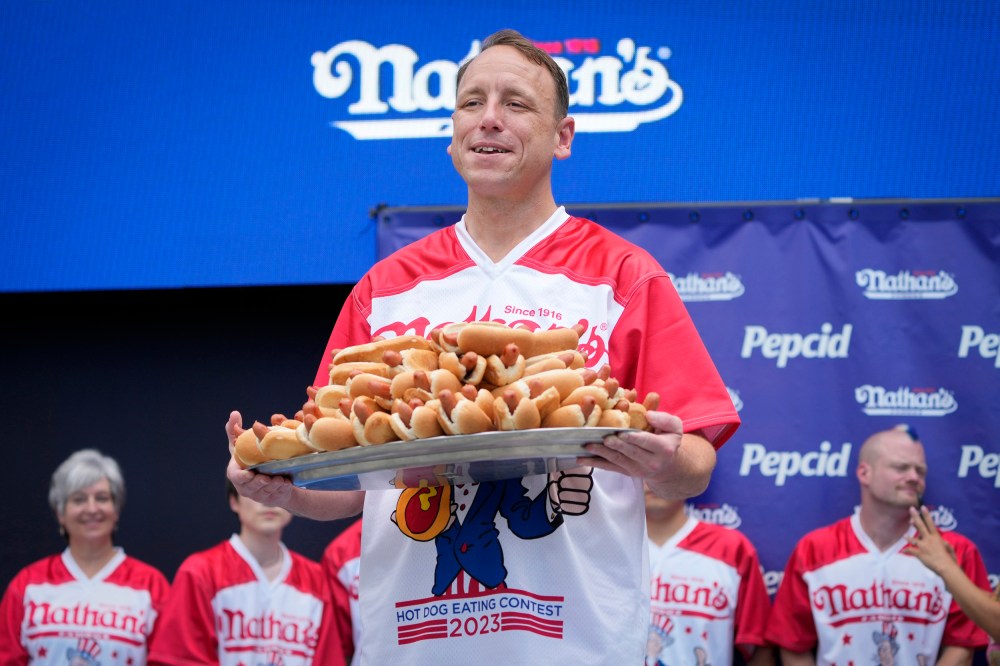
The July Fourth fireworks began early last month when Major League Eating announced that Joey “Jaws” Chestnut would not defend his Nathan’s Famous International Hot Dog Eating Contest title. (It seems appropriate that the name of the contest is a mouthful.) Chestnut, who has won the event 16 times, is billed by Major League Eating as “the greatest eater in history,” but the world’s fastest will likely be fasting instead of feasting this Fourth of July.
Depending on whom you ask, Chestnut either made the choice not to compete or he was unceremoniously banned by the league.
Depending on whom you ask, Chestnut either made the choice not to compete or he was unceremoniously banned by the league. The problem, reportedly, is that Chestnut inked an endorsement deal with Impossible Foods, which makes meatless sausages and other animal-free products. Just how much he’ll earn from the deal is unclear, but you might say Chestnut bit off more than he could chew.
With brands being protective of how their products are marketed, the indigestion is perhaps understandable. So, too, though, is Chestnut’s motivation. We all want a little extra bread. Even a championship eater has got to put food on the table.
Counterintuitively, losing its most bankable star already has been a win for the league — and for Nathan’s. The men’s competition (which begins at 12 p.m. ET on ESPN2) will still take place, and, with the favorite out, it’s anyone’s game. The drama was all over the news weeks before the competitors were scheduled to step up to the, er, plate, providing better publicity for the hot dog giant than money could buy.
That money is at the heart of the dispute should come as no surprise. This is the way things are in sports.
I can hear your questions now: Is wolfing down hot dogs really a sport? Why do we have eating contests? Why do people compete? Is competitive eating morally wrong? Let me attempt to address these.
We have eating contests because brands make money through them. That’s the American way. They are wildly successful marketing investments, thanks in large part to the throwback showmen behind Major League Eating. A brand spends money to host a competition. That competition attracts media attention, becomes an event, becomes a thing, builds brand awareness — and, ultimately, sells more product. The eating contest categories usually showcase products that are local to that place and in abundance, or that bear some strong connection to the community. And they have been held across the country for many decades. (To wit, New Orleans, where I live, was the site of blackberry eating contests as early as 1891, shrimp eating contests as early as 1893, oyster eating contests as far back as 1902 and crawfish eating contests by 1922.)
People compete because that’s their nature. We like to see how we measure up against others — in lots of different ways. Or at least some of us do. Is it sophisticated? Maybe not. But our entertainment need not always be high-brow. We love our boxing and pro wrestling. “Dumb and Dumber” was box-office gold. Bill Shakespeare and Jeff Chaucer told some very dirty jokes, and they did all right for themselves.


Yes, competitive eating is really a sport, and eaters are real athletes. Some eaters — Chestnut chief among them — are blessed with a natural ability to consume large amounts of food, and training only makes them better. They aren’t trying to swish a ball through a metal hoop or carry a spheroid into a certain area of a field after battling through an army of defenders. They aren’t trying to lift the most weight over their heads or to cross a line before others. They’re trying to place the most amount of weight into their stomachs, as fast as possible.
Is competitive eating a moral affront? Experts may wish to weigh in, but I think of it this way: A competitive eater consumes several days’ worth of food in just a few minutes. But their caloric intake over those several days is likely largely the same whether they eat the food over time or all at once. That is to say, a person may down 50 or 60 hot dogs in 10 minutes. But, then, they will not eat again for several days. Binging and purging this is not. A “reversal of fortune” is grounds for disqualification in Major League Eating.
Yes, competitive eating is really a sport, and eaters are real athletes.
(That is not to downplay food insecurity, which is a horrible problem in America and elsewhere that must be solved. But my understanding is that putting a couple of hundred hot dogs from Coney Island back onto the open market is unlikely to do it.)
Major League Eating, fans and Joey Chestnut himself seem to hold out hope for a resolution. But we may have seen our last serving of Joey Jaws. (At least as an MLE competitor. Chestnut has said he’ll be competing in a hot-dog eating contest July 4 at Fort Bliss Army base in El Paso, Texas.) As in all sport, though, if he doesn’t return to Major League Eating, a new generation waits in the wings, hungry for their chance. A new hero will arise. Ruth beget Gehrig, who beget DiMaggio, who beget Mantle and Jackson and Jeter and all the rest.
They say every dog has its day, and Chestnut had plenty of dogs in his. Now, someone else gets a taste of the action. May the best eater wien.

James Karst
James Karst once ate 15 dozen oysters in 8 minutes in the ACME World Oyster Eating Championships. It wasn’t enough