





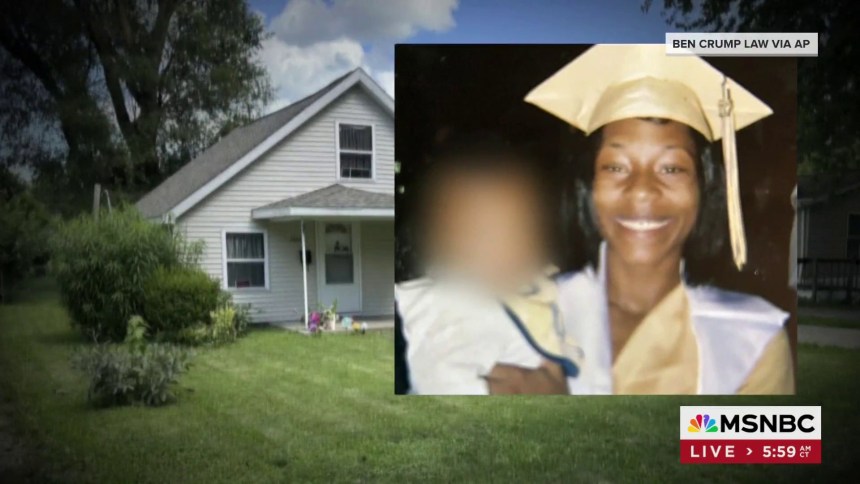
Sonya Massey, 36, called 911 at 12:50 a.m. July 6 to report noises outside her Springfield, Illinois, home. Within 15 minutes, two Sangamon County deputies arrived. According to bodycam video recorded by his partner, Deputy Sean Grayson rang the doorbell, knocked on the door and repeatedly identified himself as a deputy from the sheriff’s office, “the one you called.” After some delay, Massey opened the door. “Please don’t hurt me,” she said. He replied, “I won’t hurt you. You called us.”
After some delay, Massey opened the door. “Please don’t hurt me,” she said. He replied, “I won’t hurt you. You called us.”
But within minutes, Grayson, who has now been fired and charged by a grand jury with first-degree murder, shot Massey dead. While bodycam video recorded how the deputies mishandled their interaction with Massey, Grayson’s work history suggests that the Sangamon County Sheriff’s Office mishandled its hiring process and either ignored or didn’t see the red flags that warned against bringing him onto the force.
He joined the Army in 2014 but left in 2016 for an unspecified “serious offense.” Court records show that Grayson twice pleaded guilty to driving under the influence of alcohol, once while he was enlisted in the Army and once after he was out. A spokesperson for Sangamon County said the sheriff’s office knew about both DUIs Grayson had pleaded guilty to. In addition, the Sangamon County Sheriff’s Office position was his sixth law enforcement job since 2020. That’s not the work history of a law enforcement official I’d ever want to hire.
Video shows that it was a calm scene after the two deputies entered Massey’s home and she sat on a sofa fumbling through her purse for the driver’s license they’d asked her for. Then he pointed toward a pot of water boiling in the kitchen and said, “We don’t need a fire while we’re here.”
Grayson was right to recognize the danger there. But a marginally well-trained officer — or a cop with common sense — would never send a potential suspect away from him and toward a potentially dangerous object. This is especially relevant because video had previously captured her being asked, “Are you doing all right, mentally?” And she answered, “Yes, I took my medicine.” Her family says she’d had recent mental health struggles. Given her response to the question about her mental well-being, deputies knew — or they should have known — that she was being treated for a mental illness.
By sending her away from him and toward the boiling pot, Grayson relinquished control of the situation and put himself, his partner and, obviously, Massey in harm’s way.

“Right,” Massey said when Grayson said, “We don’t need a fire.” After she turned off the stove and started moving the pot to an adjacent sink, the deputies, still in the living room area, instinctively backed away.
“Where are you going?” Massey asked.
Laughing, Grayson responded: “Away from your hot, steaming water.”
“Away from the hot, steaming water?” Massey replied in a light tone that reflected Grayson’s laughter. “Oh,” she continued, “I rebuke you in the name of Jesus.” Again, the tone strikes me as light, not threatening.
“Huh?”
“I rebuke you,” she repeated, “in the name of Jesus.”
Grayson fired three times. His partner, who also drew his weapon, did not fire.
“You better f—in’ not,” Grayson snapped as he put his hand on his holstered weapon and threatened to shoot her and ordered her to “Drop the f—in’ pot!”


“OK,” Massey said. “I’m sorry.”
The living room was separated from the kitchen by a counter. Grayson moved around the counter to see her. Bodycam video shows her crouching lower, raising both hands to her head in disbelief or panic, then rising up slightly while holding up the pot in one hand. At this point, Grayson fired three times. His partner, who also drew his weapon, did not fire.
“Yeah, I’m not taking f—ing boiling water to the f—ing head,” Grayson said after he’d shot Massey. When he called for EMS and backup, Grayson asked whether law enforcement had previously been called to Massey’s home over any mental health issues.
Again, Grayson was released from the Army in 2016 for unspecified but serious misconduct. On his application for the Logan County, Illinois, Sheriff’s Office, where he worked from May 2022 to April 2023, he said he’d been intoxicated “a lot” in his life. A supervisor at the Virden, Illinois, Police Department reported that Grayson never resigned but one day just stopped showing up for his shifts. Auburn, Illinois, Police Department officials reported that he wrongly described his military discharge from the Army as “honorable” and that the department never sought to verify it. In Kincaid, Illinois, where he’d worked for the police department, a member of the Kincaid Board of Trustees described him as a “loose cannon … arrogant and cocky.”
Sonya Massey was killed by an officer who drifted from one law enforcement job to another after leaving the Army after a serious offense. It doesn’t appear that any of the departments that hired him thoroughly vetted him. How could they have hired him if they had?
It doesn’t appear that any of the departments that hired him thoroughly vetted him. How could they have hired him if they had?
Grayson killed Massey. But she was also the victim of a deeply flawed approach to human resources in the law enforcement agencies that employed him. I wish I could say this is an aberration in American law enforcement, but I can’t. Police agencies are generally understaffed and very often poorly staffed, which puts pressure on them to hire applicants they should turn away.
Then there’s the issue of training. A licensed plumber must have thousands of hours of training. The same for a licensed cosmetologist. A police officer? On average, fewer than 700. Indeed, the U.S. has among the lowest police training requirements in the world. It’s unclear what they were taught, but the way the deputies performed inside Massey’s home doesn’t reflect good training.
We demand excellence in surgeons, nurses, airline pilots and others who have our lives in their hands, and in pursuit of that we require that they be vetted and trained. But when it comes to law enforcement, we make no such demands, and we seem unwilling to make the necessary investments.
Standing at her door, all Massey asked was that Grayson not hurt her. Turns out, that was too much to ask.

Cedric Alexander
Cedric Alexander, a former commissioner of community safety in Minneapolis, is a law enforcement expert with over 40 years of experience in public safety. Alexander has also been deputy commissioner of the New York State Division of Criminal Justice Services and an assistant professor at the University of Rochester department of psychiatry. He is a former national president of the National Organization of Black Law Enforcement Executives (NOBLE). He is the author of "The New Guardians: Policing in America's Communities for the 21st Century" and "In Defense of Public Service: How 22 Million Government Workers Will Save Our Republic."