




The economy President Joe Biden inherited is, uh, not great, to say the least. Everywhere you look, people are still struggling to make ends meet after the pandemic forced millions out of their jobs.
Even for those who are employed, the struggle for basic working conditions seems to have permeated every segment of the economy lately. That was abundantly clear last week, as headline after headline showed labor being attacked, penalized and otherwise exploited by bosses in search of maximum profits.
What’s really interesting to me, though, is that when it comes to management’s refusal to offer fair compensation, it doesn’t seem to matter whether you’re a so-called blue-collar or a white-collar worker right now.
When it comes to management’s refusal to offer fair compensation, it doesn’t seem to matter whether you’re a so-called blue-collar or a white-collar worker right now.
Democrats have said for years that as a party they stand with workers, not big business — and now is their chance to prove it. They can start by tackling the abuse in the gig economy. Once praised for its flexibility, the field has been a nightmare for anyone who wants anything resembling job security or benefits.
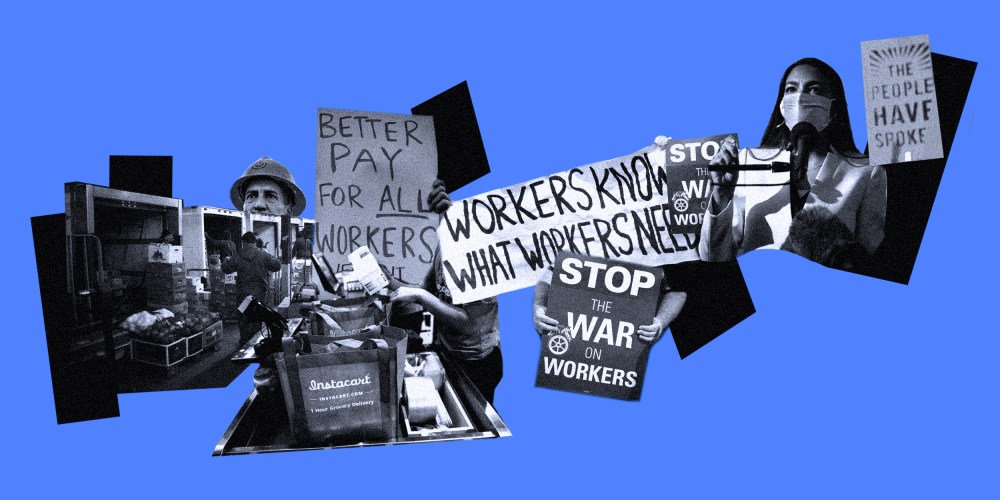
When 10 employees of the grocery delivery company Instacart successfully voted to unionize last year in Skokie, Illinois, it was seen as a potentially huge shift. It meant gig workers could have the ability to bargain for better working conditions. Isn’t it a coincidence, then, that all 10 unionized Instacart workers were laid off Thursday as part of a broader set of job cuts?
Nearly 2,000 of Instacart’s 10,000 grocery store shoppers will be cut, with the company offering a paltry few hundred dollars in severance or the chance to become nonunion-eligible gig workers. Instacart showed its first profit last year.

The more traditional blue-collar worker isn’t faring much better. Biden’s $1.9 trillion stimulus package, meant to be phase one of his response to the pandemic, seems to be stalling out already. Senate Republicans are skeptical that more aid is needed so soon after the last $900 billion package passed. That has to be hard to hear for people who would benefit most from the direct payment checks, the guarantees of expended unemployment benefits and a raise in the federal minimum wage in Biden’s proposal.
Meanwhile, writers at The New Yorker went on a 24-hour strike Thursday. The magazine’s writers unionized two years ago and have been bargaining with management ever since. Things came to a head when management agreed to set up a salary floor but set it at $45,000 — only $3,000 more than the lowest current full-time salary, the New Yorker Union said in a statement.
That may sound like a lot in most of the U.S. — but not in one of its most expensive cities in the country. According to NerdWallet’s cost of living estimates, living in Brooklyn on that salary would go as far as $23,208, or around $11 an hour, would in Raleigh, North Carolina.
Even society’s soulless capitalist id hasn’t escaped the trend. Now, nobody is saying we need to cry tears for the poor Wall Street financiers, but Bloomberg reported last week that while Wall Street has enjoyed a windfall during the pandemic — which is, in and of itself, a wild thing to write — employees haven’t reaped much of the benefit. Goldman Sachs managed to get 15 percent more revenue out of its workforce last year, according to Bloomberg, but it spent just an average of 2 percent more per person. At JPMorgan Chase’s investment bank, a 1 percent pay bump came after a 22 percent increase in revenue per employee.
It just goes to show you that more revenue for corporations isn’t turning into increased wages even at the top of the income brackets, let alone at the bottom, where every dollar matters more.
Thankfully, workers managed to get in a win last week — one that Democrats should pay close attention to. The 1,400 Teamsters at the Bronx’s Hunts Point Produce Market, which supplies an estimated 60 percent of New York City’s fresh fruits and vegetables, spent most of the week on strike. The union had demanded a raise of just $1 an hour per year for the next three years for its members to better cover the safety risks of working during a deadly pandemic.


More revenue for corporations isn’t turning into increased wages even at the top of the income brackets, let alone at the bottom, where every dollar matters more.
“Our workers can’t be protected by staying home. We have to show up,” Danny Kane, the head of the local union, told The Wall Street Journal. “You have to put your mask on and wash your hands and hope for the best.” Management had counteroffered with a 32 cents-an-hour raise each year, sending the market’s workforce into the streets.
Finally, after six days of picketing, the union announced that it had come away with a win. “It’s the largest deal we’ve ever signed,” Kane said of the new contract, which guarantees a $1.85-an-hour raise over the next three years. A worker told AM New York that the outpourings of solidarity from other unions and local politicians, like Rep. Alexandria Ocasio-Cortez, D-N.Y., gave him “new hope and appreciation for the people’s power.”
I bring all this up because one of the biggest complaints about Democrats in recent years is that they’ve focused too much on “identity politics” over economic issues. I think that’s bunk, but last week showed that no matter how well off you are, or what color of collar your job supposedly has, there is always someone who will be unwilling to share the benefits they’ve earned from your labor — and there are victories to be had if unions have the right backing.
Government should likewise hold management accountable in all cases and at all class levels, with special focus on those oppressing the lowest rungs of the economic ladder. During his decades of public service, Biden has always highlighted his blue-collar background as something that taught him the value of unions and of the middle and working classes. Now we need to see him, and the rest of his party, take this message to everyone who draws a paycheck from someone else.
We need to see Biden’s pro-union labor secretary nominee, Boston Mayor Marty Walsh, break land speed records as he restores the regulations his predecessor weakened in a quiet yearlong blitz. Walsh also needs to be ready to enact new regulations, forcing companies like Uber to treat gig workers as employees and shoring up protections for workers as the pandemic continues.
I want Biden’s pick to be general counsel of the National Labor Relations Board to go after Instacart for its retaliation and union busting. Biden fired the former counsel — who was jaw-droppingly anti-union — on his first day in office, clearing the way to replace him with someone who will interpret labor law in favor of workers and prosecute management’s violations.

And on Capitol Hill, let’s see the Democrats take their new majority out for a spin and transform some of these suggestions into law. Congress can and should weaken “right-to-work” laws in the states and boost the capacity to negotiate for minority unions like the one recently at Google. That can start with the House’s repassing the Protecting the Right to Organize Act, as it did last year, and Democrats’ using their new majority in the Senate to get the bill to Biden’s desk.
It’s been a hard year, but it seems decidedly unfair that as big business thrives, workers struggle. The disillusioned and downbeat American workforce needs leadership that shows that when even its collective strength has been thwarted by corporate titans, the government will stand on its side. It needs more wins like the one at Hunts Point Market.

Hayes Brown is a writer and editor for MS NOW. He focuses on politics and policymaking at the federal level, including Congress and the White House.