





The first night of the Democratic National Convention concluded with President Joe Biden’s valedictory speech passing the proverbial torch to his vice president, Kamala Harris. But the proceedings before Biden’s address, which closed with the two hugging on stage, made clear Biden has done more than hand off a presidential nomination. He’s also bequeathed her a party that, thanks in part to his efforts, is perhaps more united than any time in history.
Eight years ago, at the 2016 Democratic convention, the divide between partisans for Hillary Clinton and Bernie Sanders was impossible to ignore. Sanders’ supporters remained bitter about his defeat in the 2016 primaries, with many falsely accusing the DNC of rigging the election against him — and staging large protests in the streets of Philadelphia. Hundreds of his supporters walked out of the convention hall when Clinton officially clinched the nomination, while those who stayed held up signs criticizing Clinton and maintaining their support for Sanders. Given the narrowness of that November’s election, the left-wing insurgency against Clinton arguably contributed to her defeat.
This new spirit of party unity is driven, in part, by vast and often underappreciated shifts within the two parties.
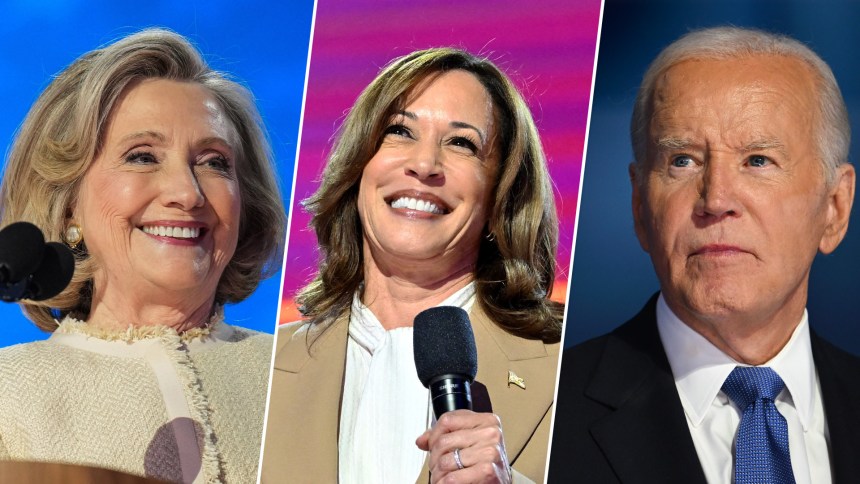
None of these divisions will be evident this week. On Tuesday night, Sanders will deliver a prime-time address, following last night’s similarly plum speaking spot for the woman who seconded his nomination at the 2020 convention: Rep. Alexandria Ocasio-Cortez. Indeed, Ocasio-Cortez might have bumped into Clinton backstage on Monday night, as the two spoke just minutes apart.
Even more importantly, both women offered similar messages supporting Biden’s accomplishments and Kamala Harris’s promise. The Democratic Party still has some divisions, particularly over the war in Gaza, but even on that issue, there is far more unanimity among elected Democrats than it might seem. On Monday night, when Ocasio-Cortez called for a cease-fire in Gaza and a return of Israeli hostages, she was endorsing the White House’s position on the issue.
This new spirit of party unity is driven, in part, by vast and often underappreciated shifts within the two parties. In the run-up to this week’s convention in Chicago, much was written about comparing this event to the party’s Windy City convention in 1968. But for all the similarities, many of those present in Chicago 56 years ago would likely not recognize the Democratic Party of today.
In 1968, there were significant and unbridgeable differences among Democrats over the war in Vietnam, civil rights, law and order and even the proper role of government in the lives of the American people.
In fact, for a good chunk of the Democratic Party’s modern history, there were two distinct political wings — a Southern wing of unreconstructed segregationists and a Northern wing of more liberal Democrats and Black Americans.
The two parties have gone from being unwieldy heterogeneous groupings to largely homogenous political constellations.
But over the past two decades, the South has become increasingly dominated by the GOP, while Democrats have conquered the North and the West Coast. Moderate Democrats — and moderate Republicans — have gone the way of the dodo bird. Polarization has led to less split-ticket voting and greatly decreased the incentives for members of either party to avoid party dogma. The two parties have gone from being unwieldy heterogeneous groupings to largely homogenous political constellations.


But despite greater ideological agreement, the divisions in 2016 were real and serious. Biden has gone out of his way to smooth them over. When he won the Democratic nomination in 2020, with Sanders again the runner-up, Biden did the opposite of what most presumptive nominees have traditionally done — rather than run to the political center, he extended an olive branch to the left. He adopted key elements of the left’s policy agenda on everything from crime and the environment to education, health care and trade.
Biden’s actions as the nominee befitted a politician who navigated between the center and left in his decades in the Senate and seemingly always ended up smack dab in the middle of the two sides.

As president, Biden continued this balancing act — maintaining lines of communication with the left and supporting parts of their policy agenda, most notably on the issue of student loan forgiveness. While other Democratic presidents (see Bill Clinton and Barack Obama) have had adversarial relationships with the left, Biden has been the exact opposite. It was small wonder that in July, when many Democrats were clamoring for Biden to step down as party nominee, Ocasio-Cortez, Sanders and their allies were among the biggest proponents of Biden staying on the ticket.
To be sure, the specter of another Trump term in office is perhaps the strongest unifying force for Democrats. Still, when it comes to hot-button issues that once divided the party — abortion, guns, immigration, trade, unions, civil rights, even criticisms of corporate America — there is little evident daylight among Democrats. That has helped create a striking sense of unity this week that goes well beyond antipathy toward the GOP nominee.
While Republicans are seemingly united by their support of Donald Trump, the seamless shift from Biden to Harris shows that Democrats, in 2024, are largely signing from the same policy hymnal. Even more than his full-throated endorsement of Harris, this might be Biden’s biggest gift to her — and to the Democratic Party.

Michael Cohen is an MS NOW columnist. He is also the publisher of the newsletter Truth and Consequences and hosts the weekly podcast That ‘70s Movie Podcast.