




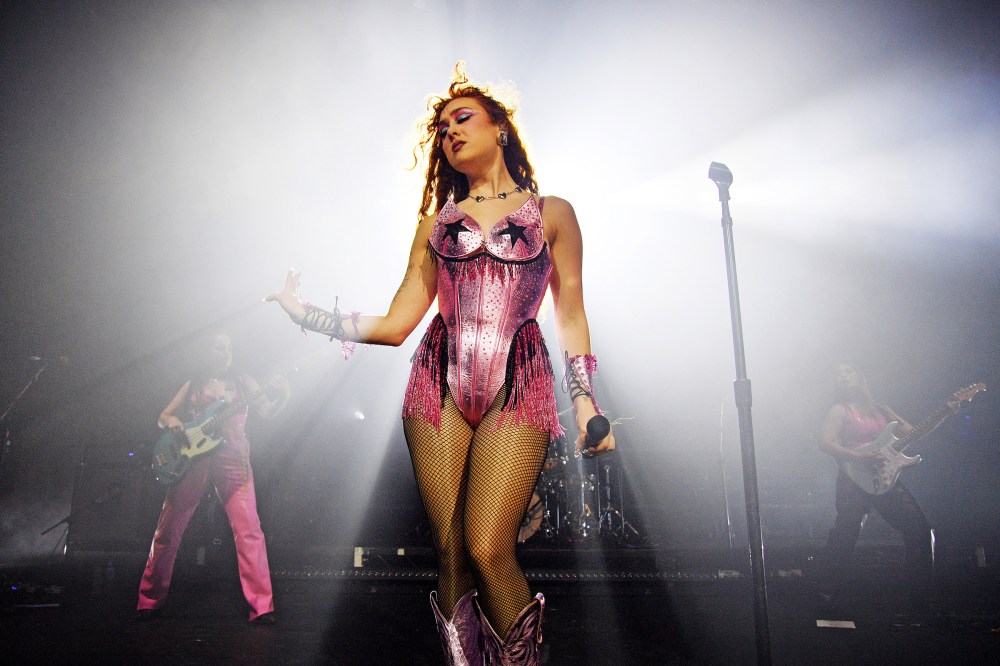
Last week, singer/songwriter Chappell Roan, dubbed a “pop supernova” at 26, canceled a pair of festival performances in New York and Maryland, citing the need to take care of herself after struggling openly to manage mass expectations, harassment and privacy concerns. Roan’s very public struggles have been much dissected in the press, and were even featured in a “Saturday Night Live” sketch (which is naturally now generating its own headlines). As someone who has studied the psychology of fame and fandom, I’m less interested in judging Roan’s actions than in unpacking their broader significance in our current techno-cultural moment.
The clarity and candor of Roan’s remarks are both noteworthy and sobering.
While the clarity and candor of Roan’s remarks are both noteworthy and sobering, the predicament she finds herself in is, unfortunately, not uncommon among the super famous. And indeed, many celebrities, such as Elton John and Lady Gaga, have apparently reached out to support and commiserate with her. Anecdotes regarding the striking disconnect between the fantasy of fame and the jarring reality abound. As Barbra Streisand reflected in her recent memoir, “Looking back, it was much more fun to dream about being famous than to actually be famous.” Beyoncé recently shared that “fame … can at times feel like prison.” And celebrities like Josh Radnor have been candid about how becoming famous can deepen, rather than assuage, feelings of insecurity and alienation.
But we don’t simply have to take celebrities’ words for it. Research has in fact shown that the pursuit of extrinsic goals such as fame or wealth has been associated with lower emotional well-being, whereas intrinsic goals such as personal growth and community engagement are associated with flourishing. This is not to suggest that all or even most famous individuals are merely chasing attention and glory. But studies suggest being primarily motivated by external rewards is not typically a useful strategy for mental health.
@chappellroan ♬ original sound – chappell roan
And while getting suddenly thrust into the media spotlight would be disorienting for most of us, adding any existing emotional vulnerabilities to the mix risks making the pressures of fame even more overwhelming. Roan has been open about her own struggles with mental health over the years and credits therapeutic intervention with helping her navigate her current challenges.
Yet, despite the myriad perils of fame, many still aspire to it. One explanation for fame’s enduring allure is that it plays into our very human need to belong. Being positively embedded in a social network confers both physical and socioemotional benefits. We can see these benefits throughout our evolutionary history, to say nothing of their impact over a single lifetime.
One need only to consider the potentially devastating toll of ostracism and/or bullying to appreciate the power of belonging. Beyond the tangible benefits that wealth and status confer (access to high quality homes, food, medical care), being famous may seem like the ultimate way to secure a place of value in society — belonging, but on steroids. Some research has even shown that fame and celebrity become more appealing when people confront their own mortality. If death is the ultimate form of exclusion, then fame may appear to offer symbolic immortality, or at the least, a reverential farewell.


Of course, some people are more likely to be enamored of fame than others. Research has shown that individuals with higher belonging needs or narcissistic tendencies are more interested in the pursuit and perks of fame. Those who are preoccupied with their social status, whether from insecurity and/or grandiosity — imagine thriving in the spotlight. Finally, beyond cultural or individual psychological draws, is the fact that we are living in a technological time that has both normalized and monetized the performance of self. It was not surprising that my son, at 5, said he wanted to be a YouTuber like Ryan when he grew up. He also wanted to invite Ryan over for a playdate. That impulse ties into one of the more serious side effects of fame, and one which Roan is clearly struggling with.
Earlier this summer, Roan called out what she alleged to be the very “creepy behavior” of ostensible fans, who aggressively pursued her in public and would become abusive if she declined to take a selfie with them. These fans, she said, were violating her privacy and seemed to think she owed them time and attention beyond her stage performances. “It’s weird how people think that you know a person just because you see them online and you listen to the art they make,” she said on TikTok.
Social media, of course, has enabled and facilitated both the explicit adulation as well as the denigration of celebrities.
If we pull back from the toxic edge of the continuum, however, the tendency to affiliate with media personalities is not necessarily as weird as she (or we) might think. As far back as 1956, scholars have been delineating the social psychological principals behind “parasocial” relationships. They identify the deliberate performances of authenticity and engagement that media personalities adopt, our natural tendency to respond in meaningful ways to other humans, and the emotional motivations (e.g., relational anxiety) that may render some of us particularly vulnerable to the imagined intimacy that parasocial fantasies afford.
Social media, of course, has enabled and facilitated both the explicit adulation as well as the denigration of celebrities. In fact, there is now research on “celebrity bashing,” with evidence that among adolescents, bullying celebrities online is associated with bullying one’s own peers online, as well as having peers or favorite celebrities who also engage in celebrity bashing. This underscores the power of social norms and the ways in which social media may blur the lines between social and parasocial behavior.
There appears to be a bit of a paradox at work. We embrace celebrity culture as a means to feel valued and connected, yet we know from anecdotal accounts and social media fueled controversies that being famous does not actually protect anyone from emotional pain or exclusion. Sometimes it does quite the opposite. In the end, we might take a cue from Roan herself, who has repeatedly asserted her own needs, values and artistic visions, even when that means swimming upstream against strong sociocultural currents.

Dara Greenwood
Dara Greenwood is an associate professor of psychology and the director of the media studies program at Vassar College. Her research is broadly focused on psychological tendencies that motivate media use and engagement, with additional interests in gender representation and humor.