





To find hope in the aftermath of this month’s election, I don’t have to look any further than the notes I took for the two novels I’ve published since 2019. My debut novel, “We Cast a Shadow,” follows a Black man in a futuristic America trying to protect his son from those who want to destroy his Black body. “The American Daughters,” published this year, is the story of an enslaved girl who joins a spy ring to fight the Confederates.
For everyone who denied the humanity of others, there was someone else who stepped up to defend them.
I spent two decades doing research for those novels, including interviewing elders and digging through archives in New Orleans’ French Quarter. After the last page was turned in, I learned one simple truth I believe speaks to this moment when an incoming president is promising to inflict pain upon our neighbors: For much of our dark past, for everyone who denied the humanity of others, there was someone else who stepped up to defend them. For that reason, frightening changes that initially seemed permanent were anything but.
A bill stripping away rights might be passed one year only to be struck down by a court the following year. Or, in the reverse, a negative ruling by a court might be superseded by a legislative act. Politics, history and culture are like a pendulum, held by a woman on a seesaw, which is itself perched on the back of a whale swimming across the sea. There’s too much motion to fully understand, but two things are certain: One, you’re moving toward something, and two, change is inevitable.
The people in my novels resist authoritarianism in the way that one group or another of Americans always has. Most Black Americans were treated as the property of the wealthy during the time when “The American Daughters” is set, but the characters vigorously fight for their freedoms despite the immense personal risk. In creating these fictional characters, I was inspired by a score of real-life freedom fighters: from Harriet Tubman and Sojourner Truth to more obscure figures like Juan San Maló (Jean St. Malo) who established a village for those who escaped slavery deep in the swamps east of New Orleans.
The narrator of “We Cast a Shadow” is a loving father who uses cunning to shield his son in a world where Black Americans are forced into fenced-in ghettos or deported altogether. The narrator’s wife, Penny, is white, but she is an even fiercer protester of inequality. And several other characters also defend the marginalized. These characters represent a variety of approaches to resistance, just as real-world figures such as Martin Luther King Jr., Malcolm X, Patty Hearst and Ida B. Wells had different ways of fighting back against oppressive systems.
Both novels, then, are informed by the many ways that people living in an oppressive police state resisted and fought back and didn’t give up hope but made plans for a brighter future.
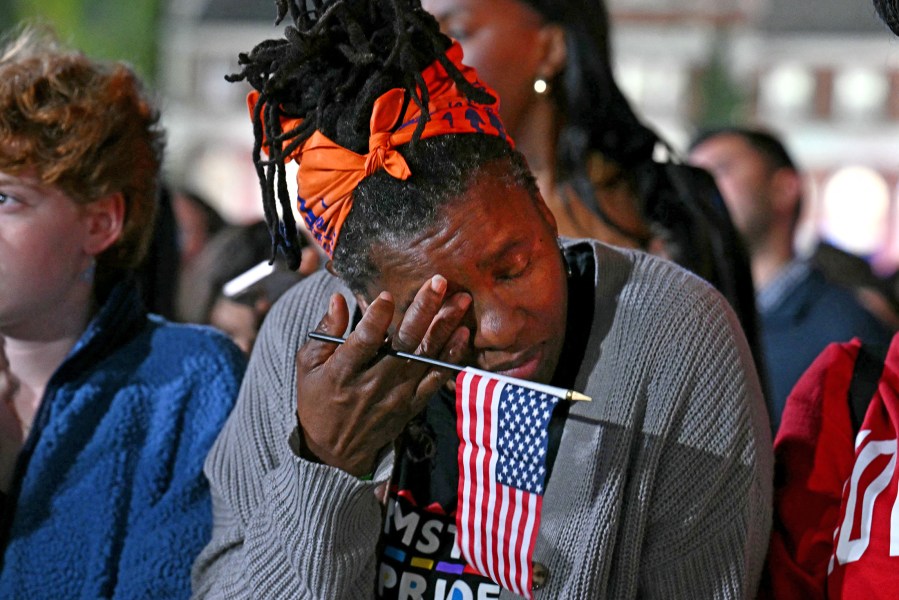
But we don’t have to go back to previous centuries for a reminder that bad times don’t always last as long as it looks like they might last. The day after the 2004 election, my best work friend sat in her office crying. President George W. Bush had just won re-election after he’d launched an illegitimate and brutal war in Iraq and after his party had strategically placed anti-marriage-equality measures on ballots across the country to help the party win that year. My friend was crying in part because at the time, the Bush coalition seemed permanent. On that day in 2004, we couldn’t have even conceived of a President Barack Obama or imagined that during his time in the White House the Supreme Court would make marriage equality the law of the land.
In “We Cast a Shadow,” African Americans are forced to live in a neighborhood surrounded by a wire fence. They can leave only with special permission, not unlike the Japanese Americans who were trapped inside internment camps during World War II. I’m unusual in that I always hope for the best. But I also believe people when they announce what terrors they plan to unleash. I’m disgusted that the new administration is promising to round up countless people and corral them into places that will most likely look very similar to those camps. If President-elect Donald Trump’s menacing promise is enacted, then children will lose their parents. People will die.


There were almost 77 million people who voted against the president-elect’s agenda, a fertile ground of opposition and defiance.
The characters in “The American Daughters” are trapped by patriarchal and racist forces that have plans for their bodies. The women in particular are motivated to fight their oppressors at every turn. We’re at such a place again. Given the Supreme Court justices he appointed (and is likely to support) and the anti-abortion foes in his orbit, we can expect Trump’s new administration to continue to eat away at women’s rights to control their own bodies. That can only result in deaths as doctors unwilling to risk their medical licenses refuse to provide treatment to women who need it. We can also expect that the new administration will do all that it can to end protections for trans and nonbinary people, which will cause incalculable pain and devastation.
But, according to the latest numbers, there were almost 77 million people who voted against the president-elect’s agenda, a fertile ground of opposition and defiance.

At some point the new administration will lose its momentum. Allies will use the courts to divert, delay and defeat the worst decisions of this president. The midterm elections will be here before you know it. And in 2028, despite some people’s worries, there will be an election.
The writer James Baldwin, speaking about how he dealt with bullies who threatened him when he was a child, said he’d say, “‘OK … but you gonna have to do it every day.’ You’d have to beat me up every single day. So, then the question becomes which one of us would get tired first. And I knew it wouldn’t be me.”
A friend from Asia told me after the results of the Nov. 5 presidential election that she felt like the U.S. the world loves had just died. But America is what it is in part because we’ve always had people like Baldwin, people who despite being battered refused to ever get tired and quit. To those who think the fight has been lost, I say not so fast. The real-life stories of America show us that we’ve been here before.

Maurice Carlos Ruffin
Maurice Carlos Ruffin is the author of the national bestseller "The American Daughters," as well as a short story collection, "The Ones Who Don’t Say They Love You." His debut novel, "We Cast a Shadow," was a finalist for the PEN/Faulkner Award, the Dayton Literary Peace Prize and the PEN America Open Book Prize. All three books were New York Times Editor’s Choice selections. He is the winner of the Iowa Review Award in fiction and the Louisiana Writer Award. Ruffin is an associate professor of creative writing at Louisiana State University.