




Going to college in St. Paul, Minnesota, I was always aware of the Hmong community — but only out of the corner of my eye. They were a substantial and segregated group in the city.
Caught up in America’s “secret war” in Laos, they were promised sanctuary after their defeat, but only a small number were ultimately allowed to make the journey to the United States, with the bulk settling in the Twin Cities area. Even here, they were marginalized and treated by a very white state as a curio and obligation; as if their presence was a symbol of American goodness, instead of a byproduct of an unjust, brutal war that displaced millions throughout Southeast Asia.

This context is part of what makes the ascension of newly minted Olympic all-around gymnastics champion Suni Lee so remarkable and so important, especially in a moment of heightened anti-Asian sentiment. Lee’s mother, Yeev Thoj, came from Laos as a child. Lee’s father, John Lee, also a Hmong immigrant from Laos, met Lee’s mother when Lee, born Sunisa Phabsomphou, was 2 years old.
Two years ago, Lee’s father, who built his daughter a balance beam in their backyard, was paralyzed from the chest down after falling out of a tree while helping a neighbor — just two days before Lee was supposed to leave for the national U.S. Gymnastics Championships. He insisted that she still compete, and they FaceTimed up until the moment she stepped onto the mat, coming in second to — of course — Simone Biles.
“I thought he was going to pass away when he was in the hospital, so I didn’t want to go to nationals and compete. But he told me to go, that he really wanted me to go. So I did,” Lee told The New York Times in an interview before the start of the Tokyo Games. “Now I realize that if he didn’t push me like that, I wouldn’t be in the spot I am right now with the Olympics so close.”

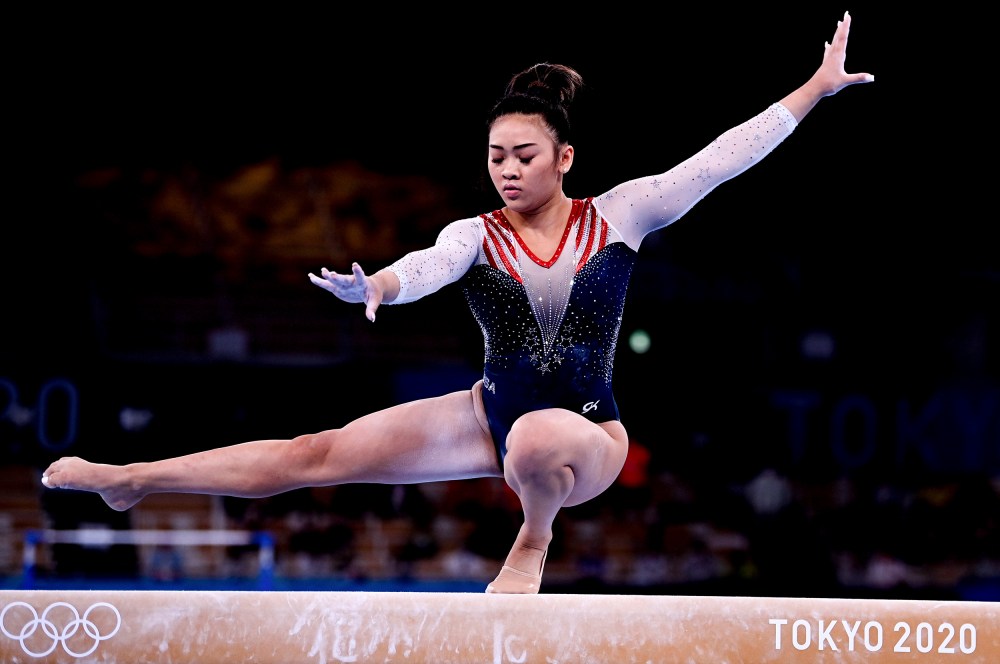
On Thursday morning, Lee’s “spot” was at the top of the medals podium in Ariake Gymnastics Centre, flanked by athletes from Russia and Brazil. Lee’s all-around performance was anchored by an uneven bars triumph (one of her specialties), in which she scored a huge 15.300. After an impressive save on balance beam, a solid floor routine secured her first (but not necessarily last) gold of the Games.


Lee was cheered on from St. Paul by her parents, friends and siblings — Shyenne, Evionn, Jonah, Lucky and Noah — who were unable to travel to Tokyo due to Covid-19 protocols. Her visibility and her utterly all-American story, in all its triumph and pain, should be seen as a godsend by USA Gymnastics, following years of scandal and cover-ups of sexual abuse. Lee also anchored Team USA’s silver-medal effort in the team competition, stepping up after the unapologetic and ineffably brave decision by Biles to not compete.
Crowd reacts as Suni Lee wins gold In the all around #TokyoOlympics pic.twitter.com/q6INDMT8y8
— Peter Cox (@peterncox) July 29, 2021
This has been a unique Olympic gymnastics finals. Indeed, it is impossible to celebrate Lee’s victory without acknowledging how the door was opened following Biles’ shocking withdrawal from competition. There will be a venal temptation — and in some corners a zeal — to bury Biles by comparing her to Lee, to say one buckled in the face of pressure while another rose to the occasion. This dichotomy should be rejected with the same ferocity and swiftness that attacks on Biles have been rebuffed by her own teammates.
We should also be prepared to see among those embracing Lee the very people who reject immigrants and their struggles. Far from sincere, such performative celebration may well be used as a cudgel to attack Biles, whose genius and self-advocacy rankles racists like nothing we’ve seen since a certain quarterback took a knee during the national anthem.
The hope is that we move away from the bigoted carnival profiteers who bray about courage while hiding from masks, who will embrace Lee only insofar as she can be used to demonize others. Both Lee and Biles should be lionized for their ability to look reality in the face under the brightest possible lights and be true to their health, their team and the moment.
Rather than divide them, here’s hoping they are bound for eternity: two young women who have been asked to do the near-impossible while dealing with entrenched racism; two young women who were true to themselves when it mattered most.

Dave Zirin
Dave Zirin is sports editor of The Nation. He is the author of 11 books on the politics of sports, including "The Kaepernick Effect." He is also the host of the "Edge of Sports" podcast.