




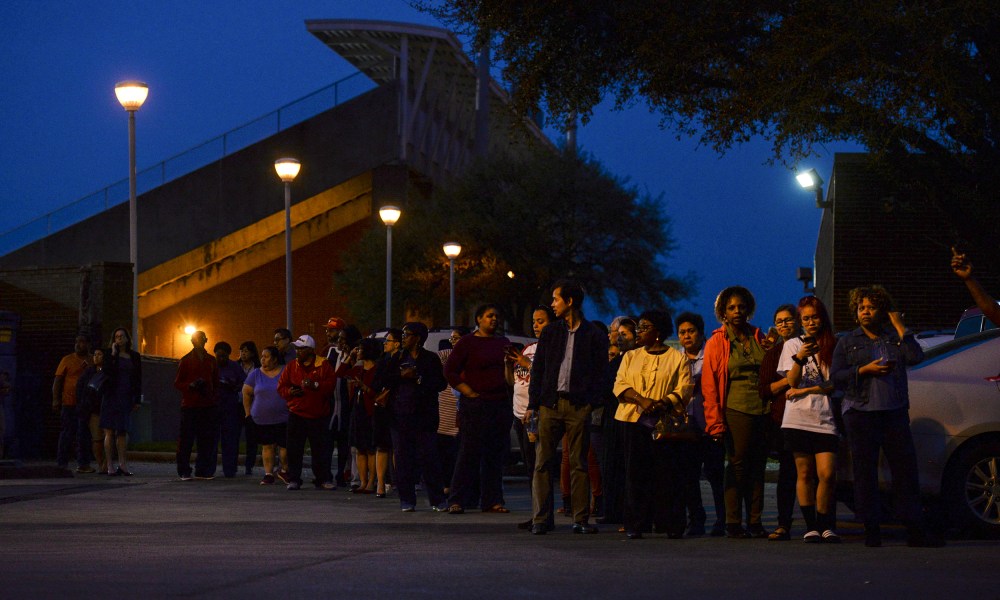
Hervis Rogers, a 62-year-old Black man, waited over six hours to vote in Texas’ Democratic primary in March 2020. “I figured like it was my duty to vote. I wanted to get my vote in to voice my opinion,” he told a CNN reporter at the time. “And I wasn’t going to let nothing stop me.”
Now, Rogers faces up to 20 years in prison for voting while on parole — despite not knowing he was technically ineligible to vote at the time.
Around the time of the primary, former President Donald Trump was already laying the groundwork to challenge the results of the 2020 election, casting doubt on the security of mail-in ballots. Culminating with a speech in Washington, D.C., on Jan. 6, Trump knowingly incited that day’s act of domestic terrorism, as the FBI has defined it, in an attempt to nullify the votes of millions of Americans. Yet, he is facing zero criminal charges.
There is, clearly, a disparity between the scope of both crime and punishment here.

This injustice is even more appalling when you look at the facts of Rogers’ case. His lawyer has stated that Rogers did not know it was illegal to vote while on parole. In fact, The Washington Post reported that in at least 20 states, it’s not a crime to vote while on parole. Also, Rogers was arrested the day before the Texas Legislature began its special session, which Texas’ governor called to enact sweeping voter suppression laws.
Texas Attorney General Ken Paxton, who ordered the arrest and himself is under indictment for felony fraud charges, tweeted after Rogers’ arrest: “Hervis is a felon rightly barred from voting under TX law. … I prosecute voter fraud everywhere we find it!” (But Paxton has said the allegations against him are politically motivated and has denied any wrongdoing, according to The Texas Tribune.)
Trump, however, is not the only Republican using his white privilege to avoid the same penalties Black Americans face for the identical — or lesser — conduct.
Trump, however, is not the only Republican using his white privilege to avoid the same penalties Black Americans face for the identical — or lesser — conduct.
For example, in Pennsylvania, Trump supporter Bruce Bartman completed a request for a mail-in ballot so his mother could vote in the 2020 election. The only problem was his mother had died 12 years before. But Bartman, 70, was so dedicated to helping Trump that he wanted to vote for him twice. (He actually tried to vote for Trump three times by also registering his mother-in-law as a Republican, despite the fact that she was also dead.)
In the end, Bartman was able to vote in his late mother’s name. An investigation followed, and Bartman was charged. He ultimately pleaded guilty in April to perjury and unlawful voting. His punishment for his intentional scheme of voter fraud: five years of probation.
This atrocious disparity is also clear in the recent case of Republican Edward Snodgrass, who serves as a local elected official in Ohio. After an election worker questioned the signature on a ballot submitted in the name of Snodgrass’ father, Snodgrass admitted his father had died before the absentee ballot had arrived and that he had forged his deceased father’s signature.


Snodgrass was initially charged with a fourth-degree felony that could have resulted in six months in jail, but instead he was offered and agreed to a plea deal of a $500 fine and serving three days in local jail.

Compare that to the case of Crystal Mason, a Black woman in Texas who in 2016 attempted to vote while on supervised release after serving five years in prison. After her mother urged her to vote, Mason headed to the polls not knowing she was ineligible. Mason’s name didn’t appear on the voting rolls, so she submitted a provisional ballot that was never even counted. What was her punishment for simply casting a provisional ballot that was never counted? Five years in prison. That case is now on appeal to Texas’ highest court for criminal cases while she is out of jail on bond.
Now stop to consider the even more mind-blowing fact that over 500 people have been charged for trying to “stop the steal” as Trump demanded of them — yet he walks free. And alarmingly for our nation, Trump is now back on the road spewing the same lies that incited the Jan. 6 attack and openly defending the terrorists who attacked the Capitol in his name.
As a lawyer this literally makes no sense to me. As an American, it outrages me to see this glaring injustice since we all know that if Trump was Black or Muslim (or both!) he would already be, rightfully, charged with various crimes.
Rogers and Mason may end up in prison for years for unknowingly voting while ineligible, while Trump knowingly incited an act of domestic terrorism to overturn the votes of millions of Americans and not only walks free but is being celebrated by the GOP.
This is beyond white privilege. This is dangerously toxic white supremacy that will very possibly lead to more violence unless Trump is brought to justice. So I have to ask: WTF type of criminal (in)justice system do we have?!
