




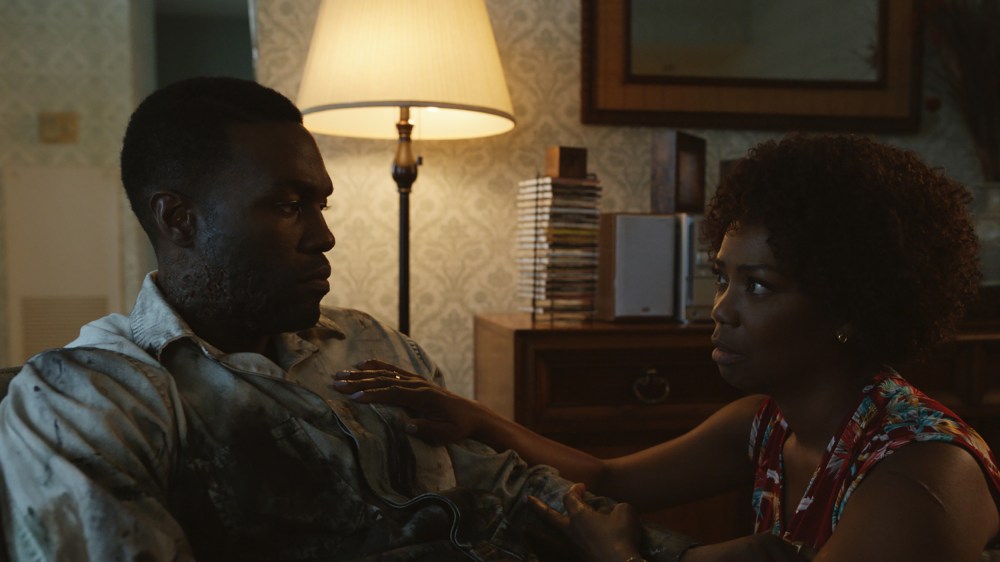
I know I’m not alone when I say the thought of watching a movie in theaters these days freaks me out. But if any flick could get me back to the cinema, it would be “Candyman,” the new sequel to the same-titled 1992 horror film. In the words of multihyphenate mogul Issa Rae, I went to root for everybody Black.
The plot, empty and bloated at the same time, confused me.
“Candyman” has a majority Black cast led by major Black stars. It’s a reimagined story centered on Black people through the sharp lens of modern social commentary, directed by Nia DaCosta, a 31-year-old Black woman filmmaker who I was sure would make Black history at the box office — and she has, as the first Black woman filmmaker to open at No. 1. So last Saturday, I masked up and settled in for the show.
Ninety-one minutes later, I concluded that “Candyman” is, in fact, a very Black movie but not a very good movie. The plot, empty and bloated at the same time, confused me, so much so that I spent the next couple of days trying to make sense of the banal ideas, fill in the gaping holes and extend each dead end. I have so many questions about the characters but don’t understand or care about them or their hazy motives enough to speculate anymore.

Perhaps worst of all, the scary moments weren’t even that frightening. The too on-the-nose dialogue and threadbare clichés earned more cringes than anything else. Yes, the blood and gore disgusted me, but to what end? I’m still not sure. I wanted “Candyman” to deliver, but like social media star Rolling Ray once said, it’s not even giving what the trailer said it’s supposed to gave — a smart, introspective follow-up to the cult classic and a cathartic, retributive rumination on Black pain and suffering.
At the same time, I enjoyed “Candyman” as separate parts. I’m not ashamed to admit I’m thirsty for varied representation, to see fictional dark brown-skinned Black people with coily, kinky hair navigate a horrifying, traumatic world meant to mirror one of my many realities as a Black woman living in Western society. For years, I’ve found myself choking down exploitive trauma and poor storytelling and filmmaking, desperate for a water line, conditioned to be grateful for even the most contaminated drops.


I drank in each beautifully composed shot, disregarding the nonsense.
Actors Yahya Abdul-Mateen II, who plays the protagonist, Anthony McCoy, and Colman Domingo, who plays a confounding key character, are undoubted supernovas whose talent manages to pierce the bleak clutter every now and then. But it was newcomer Daejon Staeker who proved to be the brightest star, as he carried his dialogue-lite scenes with so much of the nuance and emotion that the film’s story and direction lacked. This wasn’t one of Teyonah Parris’ standout performances, but that above-mentioned thirst helped me appreciate seeing someone who looks like her on the big screen, playing an art gallery director, living in a high-rise in a gentrified area, wearing a silk scarf to bed — droplets I eagerly lapped up, despite knowing better.
I drank in each beautifully composed shot, disregarding the nonsense. I considered the artful framing of the scenes. I considered what DaCosta’s heading this Jordan Peele-backed and -co-written project, which I accurately assumed would become a box office hit, meant for the countless other Black women directors long overlooked and disregarded by the largely white institution that is big-budget Hollywood. Still, “Candyman” deserves to be analyzed as seriously as any other film, particularly by Black critics, given that it comprises social commentary about Black people, Black bodies and Black trauma.

In May, Refinery29 senior editor and columnist Kathleen Newman-Bremang wrote an essay-review hybrid that I think about a lot. In “Black Criticism Is Always Good — Especially When Black Art Isn’t,” Newman-Bremang delivers straight bars as she breaks down the necessity of Black critics and their analyses of the merits and faults in work created and led by Black artists. “PSA: things aren’t inherently good just because they are Black — things aren’t inherently anything just because they are Black,” she wrote. “The thirst for white acceptance or the fear that white gatekeepers will never greenlight a Black project again if we say anything bad about one seems to have overridden a basic tenet of art: the ability to consume, appreciate, and evaluate it as we please.”
As a journalist who has celebrated Black excellence and written about the importance and power of Black representation for years, using that exact sentiment, only to become more disillusioned about the collective power of both, and as a Black woman who has become increasingly paralyzed by a mentally debilitating chronic bout of perfectionism, I’ve come to root for Black art, appreciating the merits and interrogating and accepting the faults but neither expecting nor hoping for validation in box office numbers or Academy Awards.
In retrospect, did “Candyman” deliver the ideal moviegoing experience I had daydreamed about at the start of the pandemic? No. But it still felt nice traveling to a made-up contemporary place where Black brown-skinned people lived and briefly laughed and loved. Even if it was a place founded in and constructed with faulty material, born of an industry and a society that routinely inhibit the creation of such fantastic Black escapes.

Patrice Peck
Patrice Peck is an MSNBC columnist; a journalist covering the intersection of race, identity and popular culture; and the creator of the Coronavirus News for Black Folks newsletter. Her bylines have appeared in The New York Times, BuzzFeed, Ebony and other publications. She holds a degree in Black studies from Amherst College and a master's in journalism from New York University.