




Republicans are in an advantageous position, albeit one that is not of their making.
Just under one year out from the midterm elections, Republicans find themselves with substantial advantages in polls asking voters which party they want to see in control of Congress. Democrats are in bad odor across the board, in part because they have set their sights on an agenda the public isn’t overly enthusiastic about while also failing to see to the basics of governance — little things like preserving a healthy economy, maintaining national security and delivering the nation out of a historic pandemic.
All Republicans have to be is something other than Democratic.
Because the party in power has turned in such a lousy performance over the last year, Republicans don’t have to be anything more than against Democratic governance. They don’t have to offer an alternative governing vision for the country. They don’t have to grit their teeth and rubber-stamp Democratic initiatives. All Republicans have to be is something other than Democratic.
That’s easy enough, for now. But it will not last.
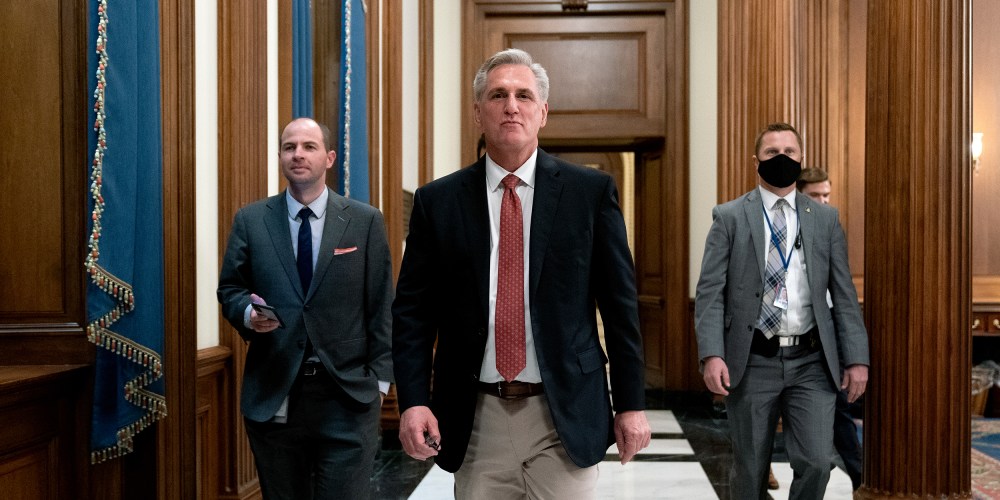
The GOP is benefiting from a lack of specificity. Right now, Republican governance is a hypothetical, and the party’s candidates are generic. But soon enough, those hypothetical candidacies will become flesh and blood. House Republican leader Kevin McCarthy of California has shown little ability to impose any kind of discipline on his conference. That is going to make it harder for Republicans to present themselves to voters as an unobjectionable vehicle of opposition to the Democratic president’s agenda. And if McCarthy thinks maintaining discipline in the minority is hard, just wait until he becomes speaker of the House.

In the majority, the House GOP will have to present a positive agenda to contrast with Joe Biden’s. That mission will be frustrated by the demands of the GOP’s base voters, who seem to want little from their elected representatives beyond the relentless trolling of their political opponents. McCarthy’s primary interest so far has been to give those base voters what they want.
For example, McCarthy has devoted inordinate attention to what he alleges is the persecution of his conference’s most irresponsible members: Reps. Marjorie Taylor Greene of Georgia and Paul Gosar of Arizona. Democrats removed both members from their committees after they repeatedly made odious spectacles of themselves. Greene was the subject of House Republican condemnations before the demands of negative partisanship made her into a GOP cause célèbre. Gosar spent his time flirting with Holocaust deniers before he landed himself in the dock for posting a cartoon featuring his caricatured likeness murdering a House colleague. According to McCarthy, the majority party is unduly punishing both. He promised to restore those members’ assignments as speaker. Indeed, he added, “they may have better committee assignments.”
McCarthy’s defiance in support of these unworthy members stands in stark contrast to the opprobrium he rained down on Rep. Liz Cheney of Wyoming — a reliable vote for Republican leadership’s legislative priorities — only because her conscience compels her to say out loud what McCarthy hasn’t allowed himself to say since the shock of the day wore off: That Jan. 6 was a stain on the country’s history, and that Donald Trump bears responsibility for it.


It’s entirely likely that Democrats will regret using their majorities to police the misconduct of minority members without a buy-in from GOP leadership.
It’s entirely likely that Democrats will regret using their majorities to police the misconduct of minority members without a buy-in from GOP leadership. Republicans are likely to use their power in the majority to impose similar consequences on the Democratic Party’s more contemptible members. But the sidelining of these two spotlight-hogging, addlebrained conspiracy mongers adds fuel to the populist persecution complex overtaking McCarthy’s party. Their presence in the media spotlight only makes it harder for Republicans to brand themselves as a generic vehicle of opposition to Democrats. McCarthy is not, however, obliged to lend credence to the notion that these members are being unfairly targeted. That was his choice.
But maybe McCarthy is just being a good steward of his conference? After all, as speaker, he would be responsible for maintaining the good faith of all his members. Herding 218 self-interested cats into corrals not always of their choosing is tough and thankless work. Sometimes pride or even prudence must take a back seat to the drudgework of legislating. But Republicans can’t have much confidence in McCarthy to keep his conference in line in the majority when he’s been unable to do that in the minority.

Despite his public admonitions against voting for the bipartisan infrastructure package, 13 Republicans bucked leadership and voted for that Democratic-sponsored initiative. It was always too much to expect that there would be no GOP defections when that bill received the support of 69 senators, including 19 Republicans. But the tactical incentives to deny Democrats a victory couldn’t compete with the interests of those members’ constituents, most of whom live in infrastructure-heavy states in the Northeast. As far as we can tell, the minority leader’s warnings weren’t a factor for the 13 defectors.
Nor could McCarthy keep his conference in line ahead of a vote on a proposal to create an independent commission to investigate the events leading up to the siege of the Capitol. “Given the political misdirections that have marred this process, given the now duplicative and potentially counterproductive nature of this effort, and given the speaker’s shortsighted scope that does not examine interrelated forms of political violence in America, I cannot support this legislation,” McCarthy said. Strong words — words that 35 Republicans summarily ignored when they voted in favor of the commission, preferring a framework deal hashed out on the sidelines by four-term Rep. John Katko, R-N.Y.
McCarthy’s style of leadership as minority leader has been to either ignore or defend his conference’s most embarrassing members and to play to the party’s pro-Trump base, even at the risk of reinforcing the general perception that the GOP remains captive to the former president’s cult of personality. At the same time, he has repeatedly failed to demonstrate the ability to keep his members in line. These are inauspicious signs for a party poised to hand him the speaker’s gavel. Maybe Republicans should start thinking about a Plan B.

Noah Rothman
Noah Rothman is the associate editor of Commentary Magazine.