





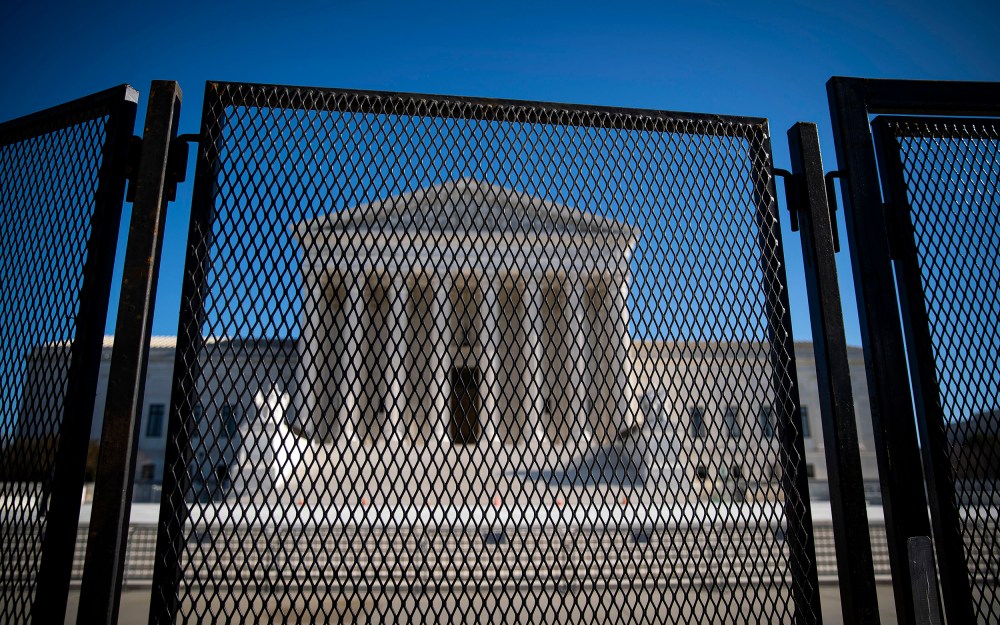

“What goes on behind the scenes at the Supreme Court after they have listened to oral arguments? Do they just close the doors to their offices and make up their minds about how to vote, or do they discuss issues and then decide? Do they try to convince each other?” — Karen
Hi Karen,
After the court hears oral arguments in a case, the justices privately vote on how they want to rule. If Chief Justice John Roberts is in the majority, then he’ll write the opinion himself or assign it to another justice in the majority. If he’s in the minority, then the senior justice in the majority plays that role.
All of this happens behind the scenes. The court doesn’t announce who’s drafting the opinions. We only see the final product when it’s published.
Of course, there was the leak ahead of the 2022 ruling in Dobbs v. Jackson Women’s Health Organization, which overturned Roe v. Wade. “Justices circulate draft opinions internally as a routine and essential part of the Court’s confidential deliberative work,” the court said in a press release after the Dobbs draft leak, adding that Justice Samuel Alito’s draft “does not represent a decision by the Court or the final position of any member on the issues in the case.”
The court’s statement underscores the fact that justices can change their minds during the drafting process, even if that didn’t happen in Dobbs. Along with publishing the leaked draft in May 2022, Politico reported that the other four GOP appointees aside from Roberts had voted with Alito in their private conference. That five-justice majority stayed the same in the opinion published the following month, with the chief justice adding a concurring opinion that didn’t fully side with the majority or the dissent.
That was to the delight of The Wall Street Journal editorial board, which had worried in an April 2022 piece (before the Dobbs leak was published) that Roberts was trying to “turn” another justice to his relatively milder position on abortion rights. The conservative board noted that if Roberts couldn’t pull another justice to his side, then Justice Clarence Thomas — the senior justice in the majority — “would assign the opinion and the vote could be 5-4. Our guess is that Justice Alito would then get the assignment,” the board wrote.
The “guess” was correct. The court never publicly accused any alleged Dobbs leaker or leakers, but The New York Times reported in 2023 that the effect of the leak was to “lock in the result, … undercutting Chief Justice Roberts and [dissenting] Justice [Stephen] Breyer’s quest to find a middle ground.”
Dobbs intrigue aside, justices have changed their minds in other cases. The late Justice Ruth Bader Ginsburg said in a 2009 lecture that sometimes “a dissent will be so persuasive that it attracts the votes necessary to become the opinion of the Court.” She recalled the “heady experience once of writing a dissent for myself and just one other Justice; in time, it became the opinion of the Court from which only three of my colleagues dissented.”
Less dramatically, justices can seek to influence the majority opinion writer to make tweaks to secure their votes. Justices’ papers released after they’ve left the court show them circulating internal memos that suggest changes as subtle as adjusting footnotes.
But we don’t have a real-time view into the court’s deliberations. Rare investigative reporting can shed light on the secretive institution, as the Dobbs case illustrates. Another big example was when Roberts reportedly flipped his vote to uphold Obamacare in 2012. Such sporadic reporting continues, including more recently on Alito’s reported loss of majorities in opinions he was assigned to write in other cases after Dobbs.
The internal drafting process is playing out in several important appeals this term. Rulings are expected by early July, the point by which the court typically issues the term’s final decisions. We may never know the full story of their creation, unless details leak out or emerge in justices’ papers years from now.
Please submit “Ask Jordan” questions through this form for a chance to have your question featured in a future edition of the Deadline: Legal Newsletter.
