




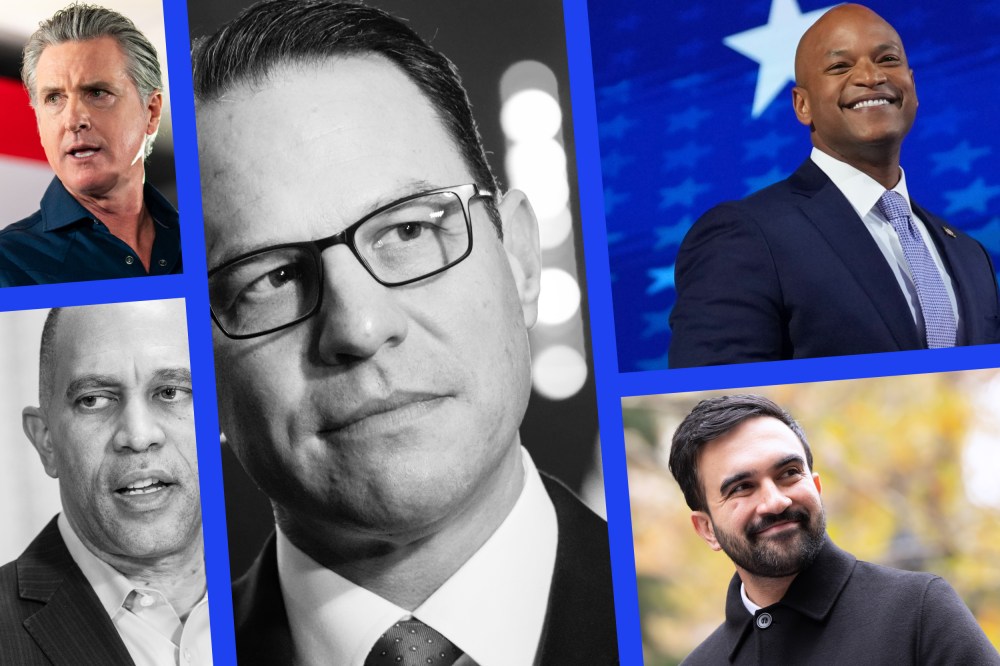
Democrats delivered a surprisingly strong performance across key contests nationwide in the 2025 elections, winning major races that gave the party fresh momentum heading into 2026.
And some of them already seem to have their eyes on 2028, when an open race for the White House will give Democrats a chance to define themselves in the post-Trump era. The contours of that presidential contest are already emerging even as the race for control of Congress in 2026 is only just starting.
Democrats head into the 2026 midterms with a strong hand after sweeping the most-watched contests in New York, New Jersey and Virginia in both liberal strongholds and more moderate, swingy areas. They succeeded with a message largely centered around affordability as the economic picture continues to wobble, with President Donald Trump calling the issue a Democratic “hoax” and having trouble finding his footing on topic.
The overall narrative from November was one of Democratic resurgence, offering the party strategic leverage and confidence as it prepares for a pivotal midterm fight.
As Democrats look ahead to 2026, a new generation of party figures — and a few familiar faces — are positioning themselves as national players. Some have continued to build profiles beyond their states, often framing Democratic approaches to economic growth, infrastructure and policies in ways aimed at swing voters.
Together, these Democrats represent the party’s broader challenge: balancing experience and fresh leadership while crafting a message that resonates with voters across an increasingly polarized political landscape.
Here are MS NOW’s picks for the Democrats to watch in 2026:
House Minority Leader Hakeem Jeffries

Jeffries, D-N.Y., more than almost any other Democrat, will be responsible for the minority party’s success in 2026. Democrats have a good shot of retaking the House majority and Jeffries is poised to become speaker if they succeed.
Jeffries must find a way to harness the desire from an angry base to fight Trump at every turn and win in contests in which independent voters make the difference. So far, he has leaned into the Democrats’ “affordability” mantra and opposition to rising health care premiums.
His position in the longest government shutdown in history was critical. As House minority leader, Jeffries consistently framed the government shutdown as Republicans having “zero interest” in making life better for the American people. Though Democrats didn’t exactly win the shutdown fight from a policy perspective, they did succeed in putting the Affordable Care Act premium extensions at the center of the political agenda.
The New York Democrat vehemently advocates for uniting his party around practical and bipartisan solutions, while pushing back against Republican priorities, in ways designed to appeal to moderates and swing voters. This tactic was on full display after four moderate Republicans unexpectedly joined a discharge petition launched by Jeffries to push for a three-year extension of the Obamacare subsidies.
Jeffries’ leadership is widely seen as pivotal for the party’s 2026 strategy, both in legislative fights and in framing the stakes of the midterms to voters across competitive districts.
New York Mayor-elect Zohran Mamdani

Mamdani secured a historic win and will become the youngest New York City mayor in more than a century, also making history as the first Muslim and South Asian to lead the city. Stepping into his role on Jan. 1, Mamdani embodies a new wave of Democratic leadership, blending policy initiatives with a readiness to challenge a Republican-controlled government.
The mayor-elect did more than perhaps any Democrat to bring “affordability” into the national political lexicon, framing his entire campaign around ways to make life more affordable for average New Yorkers. It’s a message that seems to have resonated more loudly with voters and cut across more divisive cultural issues that some argue have hurt Democrats in elections.
While defeating major challengers, including incumbent Mayor Eric Adams and former New York Gov. Andrew Cuomo, to win the mayoralty, Mamdani also openly contested Trump’s agenda and rhetoric, at times trading sharp public digs with the president.
After Mamdani’s victory, the mayor-elect and Trump held a highly watched meeting in the Oval Office in November, a rare engagement between the city’s incoming Democratic mayor and a Republican president in a second term. Their exchange, widely seen as a warm reception, may serve as a model moving forward for how local Democratic leaders can manage opposition on issues such as funding, public safety and immigration while continuing to advance their own agenda.
Trump’s allies have already sought to use Mamdani as a political foil for 2026, arguing that his progressive record could help Republicans fire up their base in closely contested races.
Maryland Gov. Wes Moore

Moore is among several high-profile Democrats up for reelection next year who could find themselves quickly pivoting to a presidential run.
He is seeking a second term in a deep-blue state even as the rising Democratic star sparks speculation about a potential 2028 presidential bid. Moore previously insisted during an interview with NBC’s “Meet The Press,” that he’s “not running” in 2028 and instead will focus on his upcoming campaign. “I’m really excited about going back in front of the people in my state and asking for another term,” he said.
The Democratic governor has made economic growth, public safety and middle-class affordability central to his campaign, and his leadership on budget and tax issues has been a defining feature of his time in office.
Notably, Moore also launched the Governor’s Redistricting Advisory Commission to explore congressional redistricting ahead of the midterms, an effort aimed at strengthening Democratic representation in Washington even as it creates debate within his own party.
Moore’s travel this year to key states has helped to fuel rumors of potential national ambitions. The Maryland governor visited Lincoln University, a historically Black college in battleground Pennsylvania, to deliver a commencement address in May. Moore also sparked attention by making a trip to South Carolina weeks later, a key early presidential primary state with a vital Democratic electorate.
California Gov. Gavin Newsom

Many argue Newsom is the current front-runner for the 2028 Democratic presidential nomination given his high-profile moves to take on Trump this year. Newsom, who is term-limited and will leave office in January 2027, has many asking what’s next for him, and he has been publicly vocal that a 2028 run is a possibility.
“Yeah. I’d be lying otherwise,” he said during an interview with CBS when asked if he is going to give a White House bid serious thought following the midterms.
Newsom has had a busy year, including challenging the Trump administration head on, both when the National Guard and ICE were deployed into Los Angeles. Additionally, he successfully championed Proposition 50, a ballot measure to adjust congressional districts in California in response to Republican redistricting efforts — a move that could help Democrats pick up five U.S. House seats and has boosted his standing among national strategists.
He has also widened his national reach by embracing media appearances and by launching a solo podcast earlier this year, in which he discusses a flurry of topics, including with MAGA personalities. He also has a memoir titled, “Young Man in a Hurry: A Memoir of Discovery,” set to release in February.
Pennsylvania Gov. Josh Shapiro

Shapiro is seeking a second term in one of the nation’s most consequential swing states, Pennsylvania, making his actions this year significant not only for his state, but also for the party’s overall direction. Kamala Harris seriously considered him as her running mate in the 2024 contest.
Shapiro won his 2022 campaign for governor by double digits, and a strong 2026 performance could help him stand out as a rising star in a potentially crowded 2028 field. He has pushed bipartisan budgets that cut taxes for families and invested in education and workforce initiatives, showcasing a sensible approach that appeals to moderates and independents — coalitions that could decide 2026 House and Senate races.
Working to expand his national profile, Shapiro will travel to several states starting in January to promote his new book, “Where We Keep the Light: Stories from a Life of Service.”

Ebony Davis is a breaking news reporter for MS NOW based in Washington, D.C. She previously worked at CNN as a campaign reporter covering elections and politics.