




This Black Friday, Americans officially kick off what analysts expect to be a record-breaking holiday sales season. But as inflation and supply chain woes potentially suppress lower-income households’ spending as the price of food and other essentials ticks upwards, wealthy Americans are expected to more than make up the difference.
If the House-passed version of the Build Back Better Act becomes law, it will cost $1.75 trillion dollars to overhaul America’s health care, childcare, education, and climate systems.
It’s not humbug to point out that this disparity in disposable income is no accident — if anything, it’s a choice that lawmakers have made again and again over the decades.
Policymakers and economists in America once agreed that a progressive tax system yields the best results. All that means is that the government imposes a higher percentage rate on taxpayers who have higher incomes. In other words: If you make more, you pay more, proportionately, in taxes. This isn’t a terribly controversial idea.
Nor is the idea that it’s actually economically beneficial to leave poor and low-wealth people with a greater proportion of the money they earn. Generally speaking, those earners will spend most, if not all of it, locally: at grocery stores, retail shops, small businesses, for car repairs and doctor’s visits. This in turn has a multiplier effect on each dollar.
That’s the taxation system the United States is supposed to be following. But you wouldn’t know it given the lengths some of our lawmakers go to protect the investment accounts of America’s ultra-rich.
And it’s particularly relevant right now because of President Joe Biden’s social spending plan. If the House-passed version of the Build Back Better Act becomes law, it will cost $1.75 trillion dollars to overhaul America’s health care, childcare, education, and climate systems. A major question still facing the Senate is whether the bill will ultimately be “paid for” by tax increases on the wealthy?
One last-minute proposal to pay for part of it is a new billionaire income tax, first proposed by Sen. Ron Wyden, D-Ore. The ultra-rich generate a lot of their wealth from assets, like stocks. But, as the tax code stands right now, the ultra-wealthy don’t pay taxes on those investments until they are sold. They’re instead allowed to accumulate what are called “unrealized gains”: they are wealthier on paper but, unless they sell the stock, the government doesn’t consider the wealth increase to be income.
Except for the ultra-wealthy, those unrealized gains function a lot like income, often acting as collateral against low or even zero interest loans, often from their own companies.
Tesla CEO Elon Musk is a prime example: he takes neither a salary nor a cash bonus from Tesla; he’d have to pay income tax on those. Instead, he gets stock options. As of the first week of November, his stock value was worth about $28 billion. And, in lieu of all the cash tied up in those stocks, he’s taken out loans from Tesla, using the stock as collateral to use for his expenses. (Try that at your local bank and see how it works out for you.)
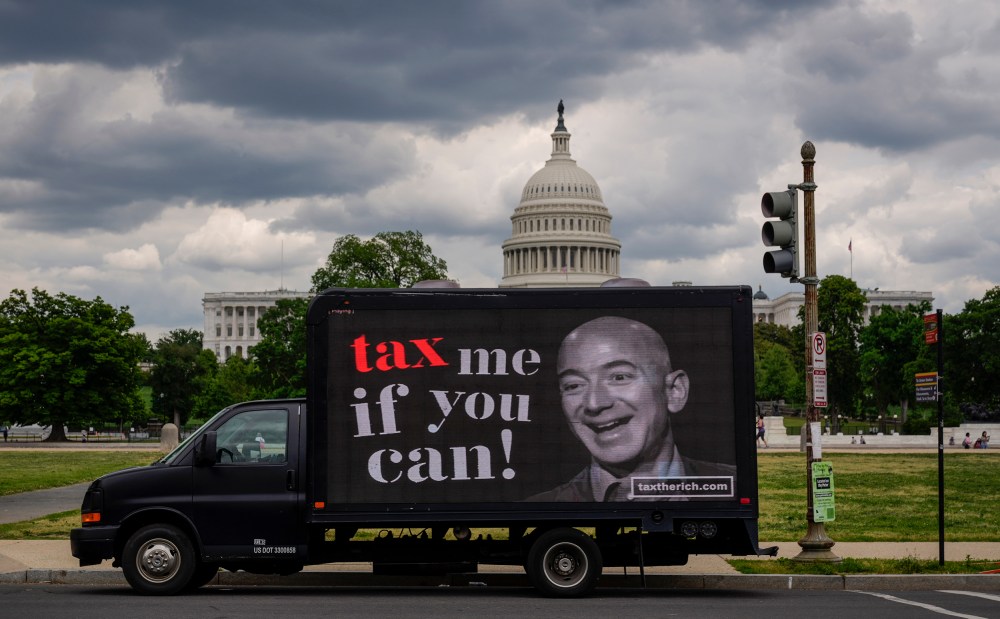
The billionaire tax isn’t some socialist hunt ahead of eating the rich. It would only apply to those with more than $1 billion in assets for three consecutive years, or anyone with more than $100 million dollars in annual income.
The billionaire tax isn’t some socialist hunt ahead of eating the rich. It would only apply to those with more than $1 billion in assets for three consecutive years, or anyone with more than $100 million dollars in annual income. To put a finer point on it, median household wealth in America is about $700,000, according to CNBC. This would result in increased tax on people with wealth that is 1,420 times as much as that.


This proposal targets about 700 people in America, a country in which, Census data tells us, about 37 million people live in poverty. Increasing taxes marginally on 700 of the richest people in America, each worth more than a billion dollars – would create transformational change for millions.
The proposal has the support of the White House, but it isn’t going over well with many in Congress — especially conservatives who say it’s unfair to those “poor” billionaires who have contributed the most to our economy. But here’s the rub: A deep dive by ProPublica identified at least 18 billionaires and another 252 really-rich-but-not-quite-billionaires who got stimulus checks under the CARES Act of 2020. They didn’t cheat to get it — it just so happens that lots of really rich don’t actually receive much of what the rest of us rely on as income. In the case of each of the 18 billionaires, none took an income greater than $75,000, which entitled them to taxpayer funded relief money.

In truth, our system of taxation favors the way rich people get richer off their assets over the way regular people earn a paycheck. Regular working people get their income through their labor, be it paid hourly or as an annual salary. And they might be able to take a deduction here or there but, working Americans pay taxes on that income. Really rich Americans though have options about how and when they translate their wealth into income. They can then manipulate that timing in ways that not only allows them to avoid taxation but, as we see above, benefit from the largesse of the, um, average taxpayer.
This perpetuates the wealth inequality that’s rampant in our country. The Gini Index gauges economic inequality in a nation, measuring how income is distributed among a population. (The index ranges from zero to one, with zero being perfect equality and one being perfect inequality.)
Last year, America’s Gini Index was at 0.49, a tie for the highest on record. It’s not the absolute worst rating but it’s definitely not up to standard for the greatest democracy in the world.
If you want to see who gets penalized by the system as it exists, it’s America’s workers. If you don’t fairly tax the rich because they make money differently than the poor do, you’re literally ensuring that our massive inequality continues to grow. Which is exactly what Republican resistance to a wealth tax is doing.

Ali Velshi is the host of “Velshi,” which airs Saturdays and Sundays on MSNBC. He has been awarded the National Headliner Award for Business & Consumer Reporting for “How the Wheels Came Off,” a special on the near collapse of the American auto industry. His work on disabled workers and Chicago’s red-light camera scandal in 2016 earned him two News and Documentary Emmy Award nominations, adding to a nomination in 2010 for his terrorism coverage.