




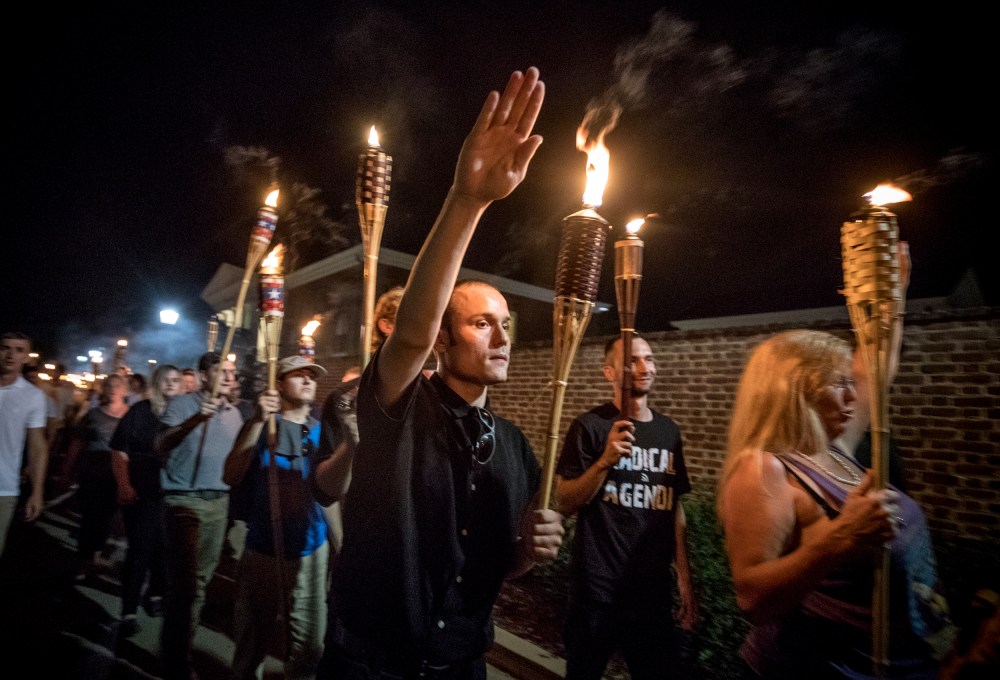
Despite a jury’s $25 million verdict against a group of white nationalists, neo-Nazis and organizers of the 2017 Charlottesville, Virginia, “Unite the Right” rally, Republican leaders, once again, will not take the opportunity to repudiate the alt-right.
Republican leaders, once again, will not take the opportunity to repudiate the alt-right.
By now, this is an old story with a familiar pattern: denial, silence and historical revisionism.
Four years ago, after former President Donald Trump referred to some of the participants in the deadly rally as “very fine people,” Republicans had a chance to make it clear where they stood.
Torch-carrying bigots chanted, “Jews will not replace us!” An avowed neo-Nazi drove his car into counterprotesters, killing 32-year-old Heather Heyer.
It was an easy call for a normal political party.
Republicans could have issued a historic denunciation of bigotry.
They could have denounced anti-Semitism.
They could have announced that there was no place for white nationalists in the party.
They could have drawn a bright, red line against political violence — and attempts to normalize violence.

Instead, for the most part, Republicans either looked the other way, kept quiet or went along with Trump’s gaslighting denials that he had, in fact, said what he said.
In many ways, the response to Charlottesville was a dress rehearsal for the right’s response to the Jan. 6 insurrection. The same group that adamantly denied that Trump had praised racists as “very fine people” are now pushing revisionist versions of what happened at the Capitol.
In the Charlottesville suit, we heard all the usual rationalizations and defenses: that it was about free speech, the violence was in self-defense and that no one could have known it would have a deadly outcome.
In the end, though, there was no glossing over the ugliness.
During the trial, one of the rally’s participants, Michael Hill, the president of the League of the South, was asked about a pledge he had posted online. He was asked to read it aloud in the courtroom: “I pledge to be a white supremacist, racist, antisemite, homophobe, a xenophobe, an Islamophobe and any other sort of phobe that benefits my people, so help me God,” he read.
Then he added: “I still hold those views.”
The response to Charlottesville was a dress rehearsal for the right’s response to the Jan. 6 insurrection.
For much of the alt-right, the trial became the focal point of their white supremacist race war. “Supporters of the far-right maintained a cheering section online full of expletive-laced rants against Black and Jewish people,” The New York Times reported, “while the defendants themselves weighed in with commentary.”
In the end, the Charlottesville civil suit will probably end up as a historical footnote, but it will nevertheless be a consequential one because it comes at a time of rising menace.
But this time, at least, there will be accountability for the leaders.
The white nationalists’ courtroom defeat came just days after the acquittal of Kyle Rittenhouse, the teenager who had shot and killed two men and wounded and third in Kenosha, Wisconsin.


White supremacist groups were quick to seize on the verdict as a victory and a call to arms. “White nationalist hate group has found ‘the hero we’ve been waiting for’ in Kyle Rittenhouse,” tweeted Michael Edison Hayden, a reporter for the Southern Poverty Law Center.
“In the communities of the far right, Rittenhouse has been ‘sanctified’ (joining the ranks of mass shooters like the Christchurch, El Paso, Norway shooters),” tweeted Alex Newhouse, deputy director of the Middlebury Institute of International Studies Center on Terrorism, Extremism and Counterterrorism. “The verdict is already being rallied around as justification for racial violence.”
On Telegram, a member of the Proud Boys exulted, “The left won’t stop until their bodied get stacked up like cord wood,” according to NPR.
Unfortunately, calls for violence are no longer confined merely to the far edges of the right’s fever swamps.
Just last month, at an event held by right-wing group Turning Point USA, an attendee asked, “When do we get to use the guns?” The audience applauded, The Atlantic reported. “How many elections are they going to steal before we kill these people?”
Prominent figures on the right have also penned fictionalized fantasies of racial violence. Kurt Schlichter is a columnist at the conservative website Townhall.com and fills in as a guest host on Hugh Hewitt’s nationally syndicated radio show. He has also written a series of books featuring what one critic called “white genocide paranoia and race war fantasy.”
Prominent figures on the right have also penned fictionalized fantasies of racial violence.
Schlichter’s self-published Kelly Turnbull series, Christian Vanderbrouk wrote, “imagines a red state/blue state split, the latter now a progressive dystopia called the People’s Republic of North America, where whites have been impoverished and left homeless by reparations taxes.” In the books, Schlichter describes a brutal and hyperviolent “all-out war.”
In Schlichter’s books — which are widely praised on the right — the body count of progressives, minorities and even police officers is extraordinarily high. This can be dismissed as hyperbole and lib-triggering lulz … at least until the shooting starts.
That’s the lesson of Charlottesville and Jan. 6. It’s all cosplay, bravado and make believe. Until it’s not.
A mature political party would sense the danger and dial down the rhetoric. A decent political party would expel the bigots and extremists. A responsible political party would purge advocates of violence.
Don’t expect that to happen anytime soon.
Last week, Republican Arizona Rep. Paul Gosar (who had tweeted an animated video depicting the killing of Rep. Alexandria Ocasio-Cortez, D-N.Y.) suggested giving Rittenhouse a Congressional Medal of Honor. Rep. Marjorie Taylor Greene, R-Ga., sponsored legislation to give the teen gunman a Congressional Gold Medal. Other GOP members of congress — including Rep. Matt Gaetz, of Florida; Rep. Madison Cawthorn, of North Carolina; and Rep. Lauren Boebert, of Colorado — vied with one another in offering him an internship.
And just days after Rittenhouse was acquitted of homicide charges, the former president hosted him at Mar-a-Lago. We see Rittenhouse with Trump, making a thumbs-up gesture — basking in the adoration and endorsement of MAGA World.
The rest of the GOP will go along — or simply pretend not to see.

Charles Sykes
Charles Sykes is an MSNBC contributor and author of "How The Right Lost Its Mind" (St. Martin's Press).