Monday’s closing arguments in the trial of former Minneapolis police Officer Derek Chauvin highlighted one universal truth about criminal jury trials: Not every case lends itself to a compelling defense. On Tuesday, the jury found Chauvin guilty on all three charges.
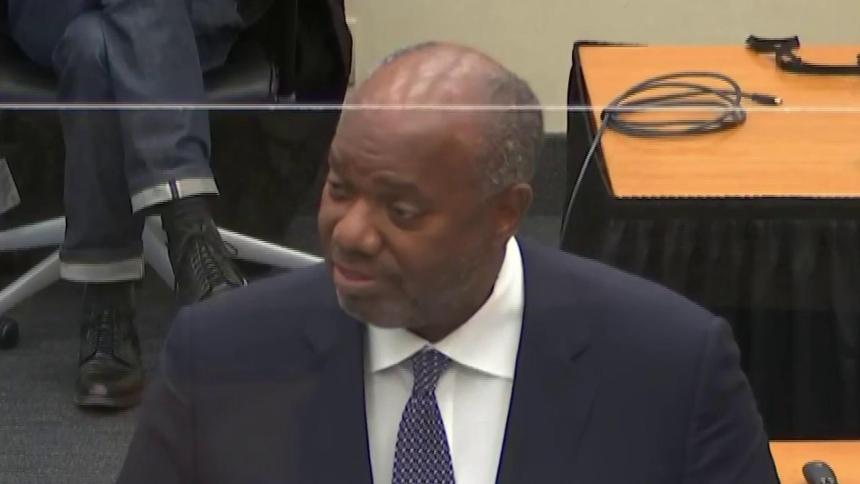
The prosecutors made their case to the jury in ways that were thorough, professional and infused with understated emotion. During the defense closing, attorney Eric Nelson struggled to find some kernel of doubt to deliver to the jury in hopes of finding a juror or two who would hold out for acquittal.

In criminal trials, the prosecution gives its closing argument, followed by the defense closing argument. Because the government has the extremely high evidentiary burden of proving the case “beyond a reasonable doubt,” the prosecution gets the final word with a brief rebuttal argument, giving prosecutors an opportunity to respond to points made by the defense in its closing argument.
Prosecutor Steven Schleicher made persuasive arguments for conviction, weaving together facts with some nice rhetorical flourishes. He commingled both information and emotion, with lines like, “the pavement beneath him was as unyielding as the men on top of him, pushing him down.”
He drove home to the jury how the evidence supported conviction on the most serious charge, second-degree murder. That charge does not require the jury to conclude Chauvin intentionally killed Floyd. Under Minnesota law, second-degree murder is an unintentional killing during the commission of a felony.
Prosecutor Schleicher reminded the jury of this, saying what Chauvin did to Floyd “was a straight-up felony assault, and that makes it a second-degree murder.” He also highlighted the evidence showing that Chauvin committed an act “eminently dangerous to others and evincing a depraved mind,” as is required to convict someone of third-degree murder. Schleicher argued that when a fellow officer said he thought Floyd was no longer conscious, Chauvin “didn’t let up and didn’t get up,” and when a fellow officer said he couldn’t find Floyd’s pulse, Chauvin still “didn’t let up, didn’t get up.” These circumstances not only supply evidence of a depraved mind but they also argue that Chauvin’s killing of Floyd seemed particularly sadistic.
Defense attorney Nelson had his work cut out for him. The evidence against his client was as strong as it was diverse: video of the incident narrated in real time by outraged, desperate citizens who watched Floyd die; Minneapolis Police Department top brass who told the jury that Chauvin violated police policy by engaging in excessive, deadly force; a smorgasbord of medical experts who testified that Floyd died from low oxygen as a result of asphyxiation; independent use-of-force experts condemning Chauvin’s tactics; and Floyd’s brother presenting gut-wrenching testimony on how Chauvin’s deadly force forever changed the Floyd family.
Unfortunately for Chauvin, his attorney took what little evidence he had and made even less of it. Representing an unpopular client in a horrific, high-profile case is extremely challenging for defense attorneys. But having tried more than 50 murder cases in the courts of Washington, D.C., I’ve seen defense attorneys navigate those difficult waters without insulting the witnesses or the common sense of the jurors. Nelson let the choppy tactical waters get the best of him.
Nelson had a real opportunity to use to Chauvin’s significant advantage Dr. Andrew Baker’s curious autopsy findings. Baker did not conclude Floyd died from low oxygen levels or from asphyxia. He ruled that the cause of death was “cardiopulmonary arrest complicating law enforcement subdual, restraint, and neck compression.”

That phraseology might seem a mangled mouthful, but it was an evidentiary goldmine from which Nelson could not extract the value. He could and should have argued the following:
Baker was the only medical professional who performed the autopsy. The only medical professional who has a firsthand, informed opinion about Floyd’s injuries, or lack thereof. And in Baker’s expert, informed opinion, George Floyd did not die of asphyxia. Rather, he died of cardiopulmonary arrest, which, by his own words, “complicated” the attempts by law enforcement to restrain him. And that is precisely why the prosecutors buried Baker way down in the trial batting order.
But Nelson chose another tactical path. He attacked the prosecution’s other medical expert witnesses, saying their testimony was “preposterous” when he simply could have said their opinions contradicting Baker were well intentioned but less important than the opinion of the man who actually performed the autopsy. Let’s be honest, as good as Dr. Martin Tobin, the lovable pulmonologist with the Irish lilt, was, it’s a tactical blunder to dismiss his testimony as “preposterous.” Rather, I would have argued that Tobin, while a great choice to evaluate my sick child, simply did not have the right experience. There’s a reason the medical profession doesn’t allow pulmonologists to make cause and manner of death determinations. Jerry Blackwell finished strong for the prosecution by using both facts and emotion to drive home to the jury Chauvin’s guilt. He highlighted that the video made the crime so obvious that even a child could see it. He then proved the point by reminding the jury that a 9-year-old girl who was on the scene did see it and even she told the officers to “get off him.” Blackwell then finished with a pitch-perfect argument, saying Floyd’s heart may have been enlarged, but he didn’t die because his heart was too big. He died because “Derek Chauvin’s heart was too small.” The verdict came quickly. I’ve had juries return verdicts in murder cases in 45 minutes and I’ve had juries deliberate for weeks. Any verdict, whether “guilty” or “not guilty” (there is no verdict of innocent), must be unanimous. Try getting 12 strangers to unanimously agree on anything — where to have lunch, for example. But try getting a dozen people to unanimously agree on the fate of a fellow citizen, a decision that will have enormous consequences for Derek Chauvin and his family, George Floyd and his family, the city of Minneapolis and indeed our nation? That is a tough row to hoe. Yet juries in America reach unanimous verdicts every day. We often hear some version of the question, “What message will the jury’s verdict send?” In wrestling with this question, it’s worth exploring how the legal and the practical diverge. On the legal front, juries are not permitted to consider what message their verdict will send. In fact, if a prosecutor argues to jurors that “their verdict should send a message to the community,” that could very well result in a mistrial or a reversal on appeal. A jury’s verdict must be based solely and exclusively on the evidence introduced during the course of the trial. Jurors may not take into account the broader consequences, symbolic or direct, of their verdict. For example, judges instruct juries every day, as did Judge Peter Cahill, that the question of sentencing or punishment of the offender in the event of a conviction is not the jury’s concern and must not factor into its decision regarding the verdict. But the practical? The jury’s guilty verdicts tells us much about the prospect of holding accountable a police officer who — before our very eyes — decided he had the power and authority to be judge, jury and executioner.
Glenn Kirschner
Glenn Kirschner, a former assistant U.S. attorney for Washington, D.C., is an NBC News and MSNBC legal analyst.