




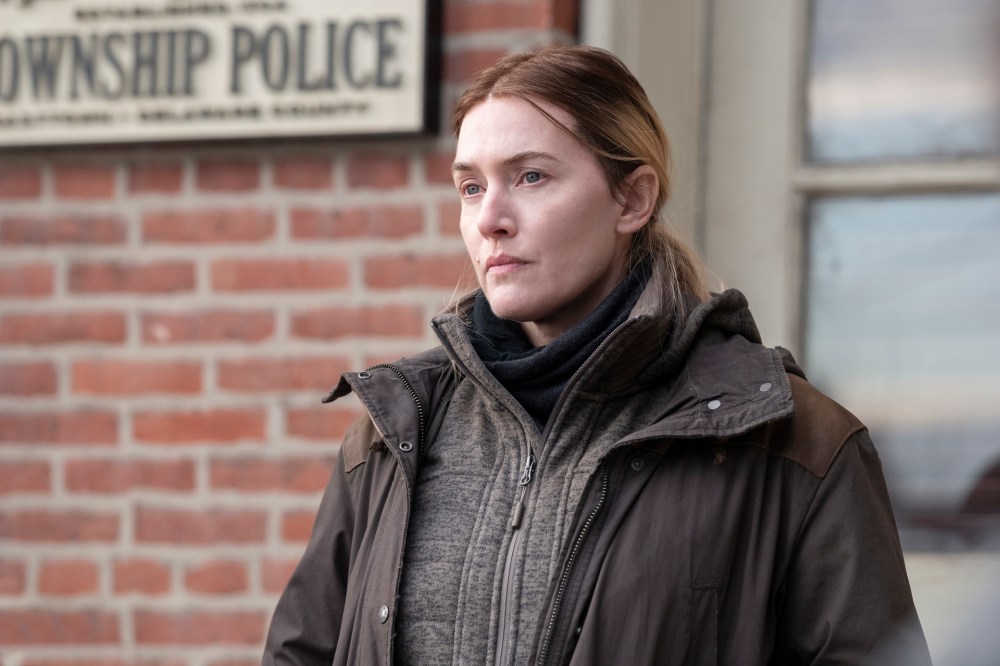
Three-quarters of the way into the riveting finale of HBO’s “Mare of Easttown” on Sunday night, I turned to my friend Katelyn, a little weepy.
“Mare of Easttown” turned out to be a Trojan horse of sorts.
“I need them to get back together,” I said. “It’s the only relationship I care about!”
I wasn’t referencing any of the romantic relationships the show briefly explores; I was talking about the relationship between Kate Winslet’s damaged Delaware County lady detective Mare and her best friend Lori, played by Julianne Nicholson. If the finale of “Mare of Easttown” belonged to anyone, it was these two.

When I first embarked on this journey, I thought I was sitting down to watch a fast-paced whodunit that would come to an inevitable fiery conclusion — to find out who “murdured the durdur!” But “Mare of Easttown” turned out to be a Trojan horse of sorts. Wrapped up in the package of a thrilling prestige crime drama was a beautiful, slow-burning meditation on female friendship, motherhood, grief and intergenerational trauma.
After six episodes of uncertainty about who killed teenager Erin McMenamin (played by Cailee Spaeny) and why, the killer is finally revealed in the seventh and final episode. But where most shows in this genre center on keeping the audience guessing until the last second — or at least end in a tense shootout — “Mare of Easttown” takes a quieter approach. Even when we eventually find out the identity of the killer, it isn’t necessarily that revelation that drives the story, but rather how the central characters receive and process that information.
In Easttown, it’s the women who keep things moving — albeit imperfectly — even in the face of trauma and despair.
In the end, the answer to the show’s mystery is more destructive than relieving. The impact of the final reveal is ultimately less about satisfying the viewers with a final bleak twist and more about forcing Mare and Lori into the darkest possible places a relationship can go, before hinting that together they might be able to walk through their individual, all-encompassing grief.
In Easttown, it’s the women who keep things moving — albeit imperfectly — even in the face of trauma and despair. While the men often propel the drama (and trauma) forward, it’s the women, particularly the mothers, who are left to pick up the pieces and soldier on. As Nicholson told TV Insider, the show is much more than “a murder mystery.” It’s ultimately “about this community and these women: Mare, her mom, her daughter, her best friend and how strong they are.”
Mare is still grappling with the death-by-suicide of her son, Kevin, and the guilt over inadvertently sending her daughter, Siobhan (Angourie Rice), to discover his body. Lori is raising two children and dealing with the aftermath of her husband’s (first) affair.
Even the supporting female characters are hardened from trauma: Mare’s mother, Helen (played by the near-perfect Jean Smart), dealt with a strained marriage and still struggles over the way her anger impacted her daughter. Dawn Bailey (Enid Graham) is trying to keep the town’s attention on the disappearance of her daughter, Katie, who has been missing for a year when the show opens. Kevin’s ex-girlfriend Carrie (Sosie Bacon) is trying to get clean, hold a steady job and get custody of her son, Drew, Mare’s grandson. Erin’s best friend Jess (Ruby Cruz) is struggling to figure out how to do right by her dead friend.
Women are so often tasked with caring for everyone around them, expected to perform benevolence and care without practice and with perfection.
For most of the series, these women largely operate in isolation, each holding her cards close to her chest for fear that exposing her soft underbelly will leave her vulnerable to more hurt.
Mare and Lori’s relationship seems like an exception at the beginning of the miniseries. When Mare acts recklessly, and even cruelly — accusing her ex-husband, Frank, of being the father of Erin’s baby in front of his new fiancée, or planting drugs on Carrie to prevent her from getting custody of Drew, or dragging her ill-fated partner (Evan Peters’ Colin Zabel) to a suspect’s home while she’s on suspension — it’s Lori who is always there to talk her down and offer her a shoulder to lean on.


This makes it all the more painful when Mare is ultimately faced with a devastating decision in the finale.
Ultimately, #MareOfEasttown was a show about grief and generational trauma and female friendship, dresses up in a prestige crime drama
— Emma Gray (@emmaladyrose) May 31, 2021
While male protagonists set the series’ central tragedy in motion, it’s Mare who is forced to deal the worst blow and either bury her knowledge to protect someone she loves or stay loyal to her duty as an officer whose job it is to solve a murder. She does the latter, and the fallout is gutting. As Mare later tells her therapist, if she hadn’t solved the case, her best friend would still have an intact family.
This is by no means a perfect show. There are too many red herrings, too many ancillary characters (I’m still trying to figure out why Guy Pearce was there), too many loose ends to try and tie up in a satisfying manner, too much copaganda. But what it does remarkably well is use a recognizable format — Tortured Lady Detective in an Overcast Town Solves a Murder — to explore themes that are often coded as feminine and therefore soft or unimportant: motherhood, care work, healing and the value of women having a soft place to land in their friends’ arms.
Women are so often tasked with caring for everyone around them, expected to perform benevolence and care without practice and with perfection. But what does it look like when they do it poorly and at the expense of their own healing? And what does it look like to move forward when seeking a state-sanctioned form of “justice” for one family means potentially destroying another? The relationships women have with each other and with their children in real life are often as fraught and twisty and as fascinating to untangle as any whodunit. If there’s anything about “Mare” that’s worth taking away after we’ve finished watching, it’s that.
In most prestige crime dramas, the story ends with the solve. We might get a glimpse of a character like Lori’s fury at her friend, or Mare’s pain, but we wouldn’t get to see the ripple effect that traumatic events like the ones depicted in Easttown might have on a community, nor would we watch the healing process begin.
But in this particular crime show, we get glimpses of both.
In the final minutes of the finale, Mare and Lori begin to find their way back to one another. Months after the crime is solved, Mare walks over to Lori’s house and finds her sitting in silence on her couch. Lori puts a kettle on the stove to make tea and Mare stands behind her. No words are exchanged. Mare puts a hand gently on her friend’s shoulder. The friends look at each other, and then they tepidly embrace. And then Lori lets the grief out. The tears come freely and she collapses into Mare’s arms.
“I’m here,” says Mare, gently kissing her best friend’s head. “I’m here.”
In the face of absentee male partners and impossibly painful choices, the one thing the women of Easttown have is each other.

Emma Gray
Emma Gray, a freelance journalist focused on the intersection of gender, culture and politics, is the author of "A Girl's Guide to Joining the Resistance." She is a co-host of the podcast “Love to See It” and a co-author of the newsletter “Rich Text,” and she has spent the last 10 years as a senior reporter and editor at HuffPost.