




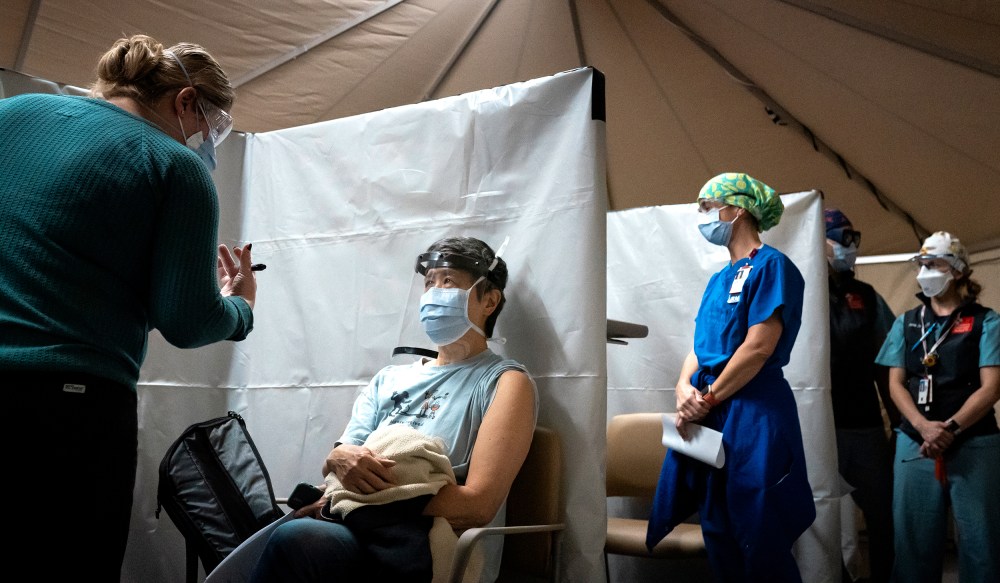
Like everyone else, I’ve spent the past few weeks mesmerized by images of health care workers receiving the first doses of the vaccine. I’ve rejoiced at social media posts announcing a sibling, a partner or a best friend who’s first in line. “My sister, who’s been treating Covid patients this year and is spending the holidays alone to keep the rest of us safe, just told our fam group chat she’s getting the vaccine this week,” journalist Connie Wang tweeted. “The collective relief and joy we feel is inexplicable.”
My sister, who’s been treating COVID patients this year and is spending the holidays alone to keep the rest of us safe, just told our fam group chat she’s getting the vaccine this week. The collective relief and joy we feel is inexplicable.
— Connie Wang (@conniewang) December 15, 2020
We’re nearing the end of a movie whose driving narrative has been “get a vaccine!” The trials were successful, the FDA issued emergency use authorization, the world rejoiced, the first doses were administered in a flurry of joy — and then the credits rolled. Presumably, life goes back to normal. But when, and how?
Placing faith in an organized, efficient, timely distribution of the vaccine doesn’t just feel like folly. It feels psychologically reckless.
We’ve got not just one, but two viable vaccines (with a third reportedly pending). But like everything else related to the government’s handling of Covid-19, the plans for the vaccine’s distribution are opaque, piecemeal and largely delegated to the discretion of individual states. After the initial distribution to front-line health care workers, the next few months are poised to be a “veritable land rush for Covid shots” as various industries and employers lobby for their employees to be next in line.

You can use a tool like this one to try to figure out where you are in the prioritized list, but it’s all relative. If you live in my hometown of Lewiston, Idaho, and are over 65, there is a lot that depends on whether your health conditions qualify you as “high risk.” And then there’s all the mitigating factors: Will there be adequate refrigeration? How will we reach the population that isn’t already calling their doctors, eager to be first in line? Is there even a plan, let alone the sort of detailed, dynamic plan that a massive distribution requires? What about the equally important distribution of the second dose? As the writer Zeynep Tufekci recently put it, will the U.S. “snatch defeat from the jaws of vaccine victory?”
“Few people across the country have a clear idea of how exactly the Covid-19 vaccine supply chains will be organized,” Bruce Y. Lee, who has worked in vaccine distribution for over 15 years, recently wrote in StatNews. “Vaccine chains have historically been neglected and underappreciated.”
When I try to fast-forward the tape of this pandemic, I can’t make the scenes of the future into anything coherent.
Yes, a new administration will be in charge at the federal level. It’s comforting, even thrilling, that they believe in science — and have a comparatively detailed plan for how to combat the pandemic moving forward. But like so many other Americans, my faith in our government’s ability to successfully execute any plan in relation to the pandemic isn’t just compromised. It’s gone.
On the federal, state and local level, we’ve bungled testing and messaging. We’ve repeatedly privileged businesses over human life. Congress has failed to pass substantive, lasting relief for the millions of families who are suffering, experiencing food insecurity, or facing eviction. It’s taken months for people to access unemployment benefits through an understaffed, labyrinthian system.

Just recently, the public learned that the U.S. government had previously refused the option of purchasing an additional 100 million doses of the Pfizer vaccine, raising questions of a potential “vaccine cliff” in which millions would wait — perhaps for months — for supply to catch up.
But to those with power, money and influence, rules can always be bent. California’s stern messaging about serving the neediest first hasn’t stopped the rich from trying to leap ahead of teachers, farmworkers and firefighters.
Dr. Jeff Toll, who has admitting privileges at Cedars-Sinai Medical Center, one of the first hospitals to stock the vaccine, recalled a patient asking: “If I donate $25,000 to Cedars, would that help me get in line?’” Toll said no.


I know the pandemic will end. But I’m also mentally exhausted.
I believe in the vaccine. I will absolutely take it the second it’s available to me. I know the pandemic will end. But I’m also mentally exhausted. I have no room for dashed hopes, no tolerance for even more changed plans, other than my current plan, which is “have no plans.” Placing faith in an organized, efficient, timely distribution of the vaccine doesn’t just feel like folly. It feels psychologically reckless.
I’d love to speak cheerfully to my mom, who hasn’t been in a public space since March, about the future. I want to tell my friends who’ve been trying to juggle working from home with kids that relief was coming their way — or tell other friends that their restaurant jobs would be coming back soon. I wish I could feel even slightly confident that the trail race that just announced plans to be in-person in July would come to pass.
But more than 3,000 Americans are dying every day, in part because we still cannot agree, as a society, to adhere to guidelines as simple as wearing a mask or limiting the number of people in social gatherings. When protesters gather outside the homes of health officials in Boise to protest a mask mandate, even as the state’s hospitals face the prospect of rationing care, what cause do I have for hope or trust?
As the vaccination rolls out, we’ll have new guidelines to follow, new best practices to observe. But faith in the CDC and local health officials has been dangerously eroded. What stats should we follow, and where should we find them? Even epidemiologists have pretty wildly disparate ideas about risk, or when things will go back to normal, or what “normal” will even look like. And we’re only just beginning to grapple with the profound physical and psychological aftereffects of this pandemic.
Which helps explain why, when I try to fast-forward the tape of this pandemic, I can’t make the scenes of the future into anything coherent: Will we be wearing masks in public spaces for the foreseeable future? When’s the first time I’ll get on a plane? Eat dinner at a restaurant? When will I be able to forgive the people in my community who’ve behaved so recklessly, so selfishly, for so long? How will we reckon with our collective grief over more than 300,000 dead?
Our brains do their best to keep us going, day after day, week after week, through grave disappointment, trauma and failure. Right now, they’re trying to keep us going just a few months more. And the best way to keep us safe, at least in this moment, is to keep the future as blurry — but still bright — as possible.

Anne Helen Petersen
Anne Helen Petersen is an MSNBC columnist and the author of Culture Study, which you can subscribe to here. She wrote "Can't Even: How Millennials Became the Burnout Generation." Her Instagram is filled with her two pretty good dogs, Peggy and Steve.