




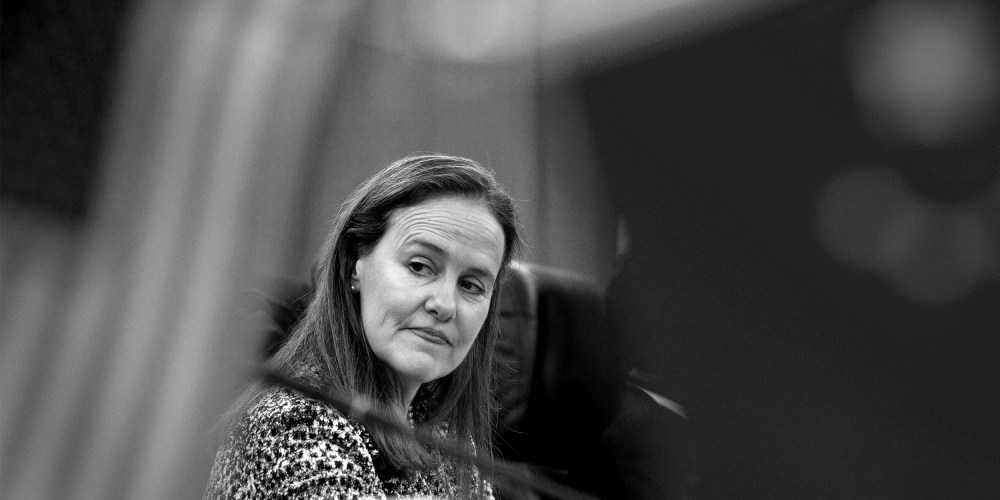
As we’re waiting for President-elect Joe Biden to select a secretary of defense, Washington is playing its favorite parlor game: Why shouldn’t it be the perceived front-runner, Michèle Flournoy? After all, Flournoy has been widely regarded as the most qualified candidate for the job in the Obama administration, for the Clinton administration, and now for those speculating on a Biden cabinet.
In evaluating who is qualified for the job of secretary of defense, it’s important to recognize what the job is.
In what is sure to be a closely divided Senate, ensuring support for Biden administration appointees means that any controversy could derail a nominee. Some arguments will be made in good faith, and others as pretextual claims for those who would have never said yes.
Critics from the left have criticized Flournoy’s ties to the defense industry, her long service in the Pentagon and her policy views, which have been squarely within the mainstream of national security thinking in the United States. At the same time, new candidates have emerged, including former Homeland Security Secretary Jeh Johnson and retired Gen. Lloyd Austin, a former CENTCOM commander. Other candidates have been floated and then faded, like Sen. Tammy Duckworth, D-Ill., an Iraq War veteran who lost her legs in service to the country.

But in evaluating who is qualified for the job of secretary of defense, it’s important to recognize what the job is. The Department of Defense has been named the largest employer on the planet, with specialized health care and human capital needs. It runs a logistics and transportation enterprise that dwarfs any commercial shipper, commissioning and building its own ships, planes and ground vehicles.
It is also one of the largest consumers of fuel on the planet. It runs a communications infrastructure that runs from the depths of the oceans to outer space. The Department has been involved in every major national security crisis from Russian nuclear standoffs to hunting down the mastermind of 9/11 to maintaining peace on the Korean peninsula. And even trickier, the secretary of defense must navigate an increasingly partisan political environment.
On a positive note, the president-elect has made commitments to having a government that reflects the diversity of America, including in his national security appointments.
Picking someone for this job is a truly consequential task. Over time, U.S. presidents have considered, nominated and parted ways with a range of candidates. Understanding what has and has not been disqualifying can shed some light on the current debates over the candidates under consideration by Biden.
First, what kinds of things are truly disqualifying? Rarely has someone been formally nominated for the position and then been rejected, or had to withdraw their nomination. In 1989, George H.W. Bush nominated John Tower, a senator from Texas, to be secretary of defense. The Senate, in a rare rebuke to one of its own, rejected the nomination over allegations of drunkenness, womanizing and, the final straw, receiving millions of dollars in campaign contributions from defense industry. Recently, President Donald Trump nominated Patrick Shanahan, the sitting deputy secretary of defense, for the top job, but had to withdraw his nomination in the face of credible allegations of domestic abuse.
Historically, there were concerns about using one’s position for self-enrichment. Rules are in place to ensure that nominees do not have conflicts of interest with their personal finances, from requiring disclosure or divestiture, to the practice of placing one’s investments in a blind trust. Some potential candidates would take themselves out of consideration to avoid the scrutiny of their financial and business doings. In the Clinton administration, respected former Adm. Bobby Inman angrily withdrew his nomination, purportedly over criticism he received from conservatives, though it was speculated that he was actually trying to avoid scrutiny over some of his corporate activities.
But more recently, the disqualifying criteria come in the vetting process for the nominee and are informally set in reaction to past controversies. For example, at the beginning of the Obama administration, former Department of Defense Comptroller William Lynn was nominated to be the No. 2 leader at the Pentagon, but the choice drew criticism because Lynn had served as a senior executive for Raytheon and had registered as a lobbyist for the company. As a result, the Obama administration stopped appointing lobbyists.
With all these criteria, it’s hard to imagine that anyone would qualify. For many Democrats, partisan affiliation also matters, in large part because Democratic presidents have called on Republicans to lead the DOD. From 1997 to 2015, the secretary of defense was Republican, with the exception of Leon Panetta, who served for nearly two years in the Obama administration. For many in the national security community, this lack of consideration for qualified Democrats has been incredibly frustrating. And on a more positive note, the president-elect has made commitments to having a government that reflects the diversity of America, including in his national security appointments, a sector that has been historically dominated by white men. Over time, we have seen the integration of minorities and women into the armed forces. We saw the highest post in the military held by a Black man, then-Gen. Colin Powell as chairman of the Joint Chiefs of Staff. But we have yet to see a woman in either of the top two positions at the Department of Defense, civilian or military. Biden has also made a point of choosing people for his other national security appointments with reputations as good managers, who are kind and show strong mentorship. With all these criteria, it’s hard to imagine that anyone would qualify, which may explain why Flournoy has been the front-runner for so long. It is true that presidents are entitled to pick Cabinet secretaries with whom they get along and who will provide them honest counsel, and that relationship may win out over the other considerations. But the question remains: When the president gives clear direction, will the secretary of defense execute that direction capably and effectively, even if the secretary would have personally chosen a different approach? In Washington, unless you are the president, you’re generally serving at someone else’s pleasure. It comes down to which candidate is most able to anticipate that and carry it out. Flournoy has a long history of being able to carry out the president’s will, even as that approach has changed over time. The question for the president-elect is whether he trusts she would do so for him.
Mieke Eoyang
Mieke Eoyang is the senior vice president of the National Security Program at Third Way, a Washington, D.C. think tank. She had previously served as a congressional staffer on the House Permanent Select Committee on Intelligence, the House Armed Services Committee, and as the Defense Policy Advisor to Sen. Edward M. Kennedy. She is an MSNBC national security contributor. 

