Boeing achieved a rare feat in Washington on Wednesday, as the company was the subject of not one, but two hearings in the Senate. In January, one of the door panels blew out of a Boeing 737 Max mid-flight, creating a near-fatal explosion that was visible to those watching from the ground. In March, flames erupted from a 737-900’s engine, and a tire fell off a 777-200 taking off from San Francisco. And a few days ago, part of an engine covering fell off a Boeing 737-800 plane during takeoff and hit the wing flap.
But the problems around Boeing’s planes are not just the failings of one company. They’re the failings of regulators and the supposed “free market” system.
Under pressure from politicians being lobbied by the airline industry, the FAA moved to a system of ‘self-regulation.’
Not that Boeing’s failings aren’t considerable by themselves. This year’s developments come just a few years after two 737 Max planes crashed in Indonesia in 2018 and in Ethiopia in 2019, killing 346 people. In the wake of the first crash, Boeing tried to shift the blame onto the pilots. But investigations later revealed that the problem was a piece of software — the maneuvering characteristics augmentation system (MCAS) — that the pilots weren’t even aware existed, as Boeing had omitted it from the flight manual. This obscure-sounding piece of software had caused the nose of both planes to dive down, propelling them toward the earth at astonishing speeds.
The MCAS’ stated purpose was to automatically ‘pitch down’ the plane’s nose when a sensor affixed to the wing detected a stall. Its real purpose was to boost the company’s bottom line. The MCAS was a “software fix” to allow the company to put huge engines on the 737 Max, allowing the planes to fly farther with more passengers. Reference to the MCAS was carefully concealed from the pilots, because it would have cost the airlines money to train them on how to handle this new piece of software. And Boeing had made a deal with some of its clients that its new plane would require no new pilot training.
Many of the problems at Boeing can be traced back to its merger in the 1990s with failing aviation firm McDonnell Douglas, infamous for its cost-cutting and corner-cutting culture. McDonnell’s former CEO, Harry Stonecipher, became the CEO of Boeing in 2003. He became a darling of Wall Street as he sought to implement a ‘cultural revolution’ at Boeing, denigrating engineering expertise, undermining experienced union employees, and empowering middle managers to ruthlessly cut costs.

Between 2010 and 2020, Boeing distributed $24.6 billion in dividends and bought back $43.4 billion worth of its own shares. As the New Yorker’s John Cassidy put it, ‘Boeing’s management prioritized the company’s profitability and stock price over everything else, including passenger safety.’
Where, you might ask, was the regulator in all this? In preceding years, the Federal Aviation Administration had fallen victim to the same regulatory philosophy as that which had taken hold among financial regulators in the run-up to the 2008 financial crisis. Under pressure from politicians being lobbied by the airline industry, the FAA moved to a system of “self-regulation.”
Even when its executives make a mistake, Boeing can rely on its political relationships and its size to protect itself.
The idea was that the airline manufacturers knew far more about their business than the government, and they would never want to make shoddy planes for fear of reputational damage. So, the argument went, these companies should effectively be allowed to regulate themselves. By the time the 737 Max disasters came around, much of Boeing’s regulatory oversight was being undertaken ‘within a company unit inside Boeing’ whose staff were paid by the company.
The FAA still managed to predict the problems with the MCAS, estimating that the system could cause as many as 15 crashes over 30 years. But they did nothing. In his book on the debacle, “Flying Blind,” Bloomberg reporter Peter Robinson cites a Boeing manager who stated that ‘people will have to die before Boeing will change things.’
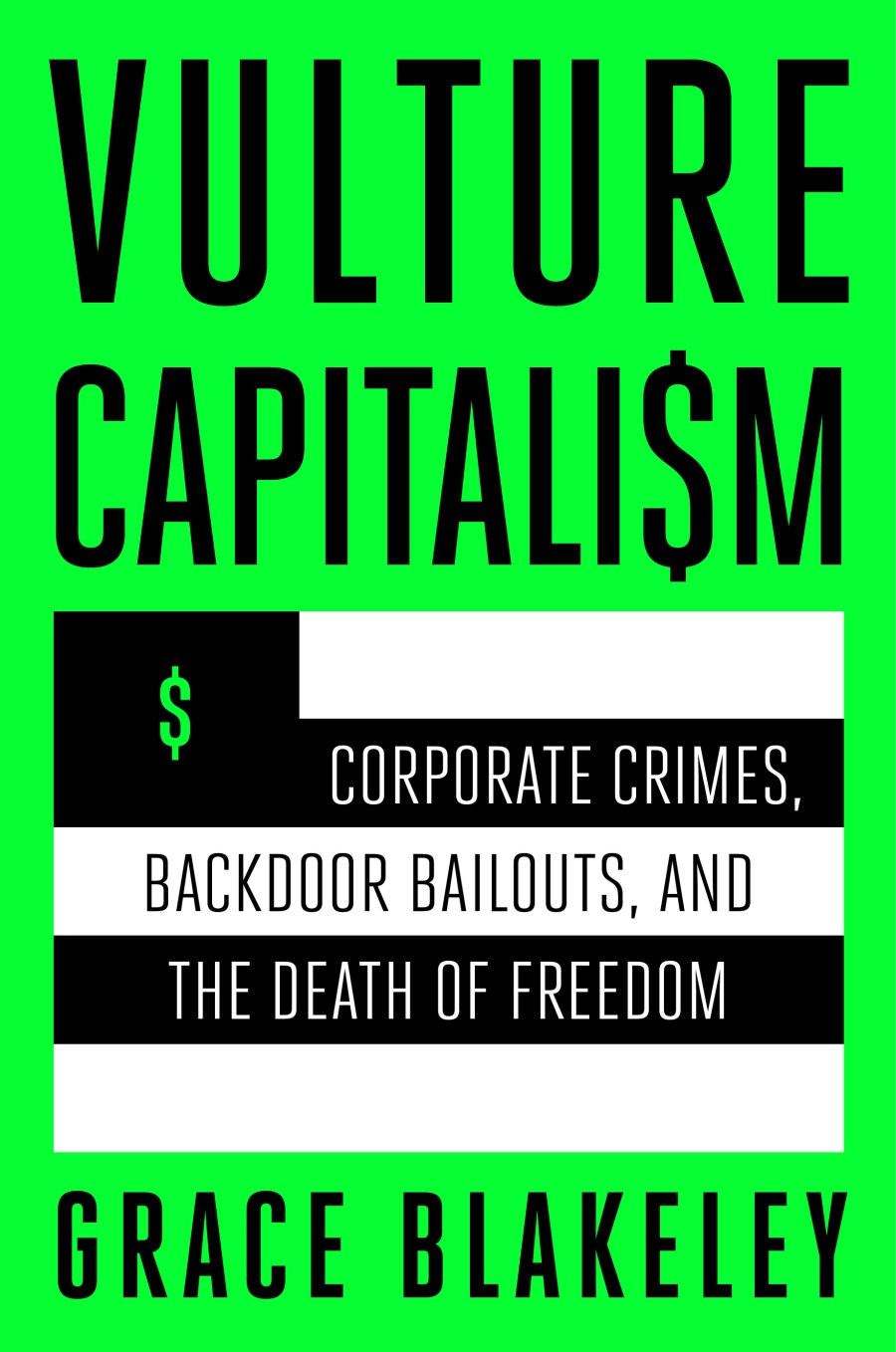
But this wasn’t simply an issue of a greedy corporation and a government asleep at the wheel. Many people reading this piece will have grown up in an era when the primary axis of political debate juxtaposed oppressive statism against “free-market” capitalism. As I argue in my new book “Vulture Capitalism,” Boeing is just one example of how, in fact, the latter system is far less “free” than its devotees are willing to admit.
Remember that merger with McDonnell Douglass? The U.S. government encouraged it, despite anti-trust concerns, in part because the Pentagon wanted more consolidation among contractors. Over the course of the development of the 737 Max, federal and state governments dished out billions of dollars in tax breaks and subsidies to Boeing, making it one of the largest recipients of corporate welfare in the country. There was also a revolving door between Boeing and the upper echelons of the federal government. Then-President Donald Trump made senior Boeing executive Patrick Shanahan his acting defense secretary, before Shanahan left the Pentagon amid an ethics probe of allegations that he “improperly advocated” on behalf of Boeing. And Boeing named Nikki Haley — Trump’s former ambassador to the United Nations, well before she ran against him — as a board member shortly afterward. Under a free-market system, corporations like Boeing are supposed to be constrained by the market mechanism. But in reality, even when its executives make a mistake, the firm can rely on its political relationships and its size to protect itself. Disasters like Boeing’s can’t simply be chalked up to the problems of unregulated, ‘free market’ capitalism, because capitalism is not actually a ‘free market’ system. Rather, it is a system defined by the domination of society by capital and based on a toxic fusion between public and private power in service of the interests of those at the top. Rather than opposing one another, governments and large corporations frequently work together to plan who gets what in the American economy. And this often means subverting free market competition to augment the power of the largest firms. The planning is at its most obvious and deliberate during emergencies, such as the bailouts during the 2008 financial crisis. But outside of those times, it is still very much present, as companies lobby governments to let them limit competition and workers’ power. This system is not, as libertarians might argue, a perversion of ‘true’ capitalism. Nor is this some shadowy conspiracy. It is how capitalism has always worked — all the way back to the British East India Company. As I put it in my book, ‘life under capitalism means living in a planned economy, while being told that you are free’. What matters, then, is how those decisions are made, and in whose interest. If the heroic whistleblowers at Boeing had had more power within the firm, the development of the 737 Max would have looked very different. The only way out is to radically reinvigorate our democracy, giving decision-making power to ordinary people, not just unaccountable bureaucrats and greedy executives.
Grace Blakeley
Grace Blakeley is an author, journalist, and commentator whose writing has appeared in Tribune and the New Statesman. She is the author of "Stolen," "The Corona Crash," and "Vulture Capitalism."