




In the heady days after the Civil War, Black Californians came together in Sacramento to debate their state’s refusal to allow African Americans, whether formerly enslaved or born free, to testify in court. But equally important as the right to be seen and believed by the courts, they said, was the right to have their children educated, a right that state officials in California had been actively fighting against.
“In a free country, the blessings of education should be diffused on all, irrespective of rank or station.”
“By the present unjust and partial laws, many of our children are growing up in ignorance, deprived of all advantages of education,” the attendees at the California State Convention of Colored Citizens said in statement to Californians. “We are not content with primary schools alone, we want the higher advantages of education to produce in the rising generation the highest development of mind. These advantages are open to others, and in a free country, the blessings of education should be diffused on all, irrespective of rank or station.”
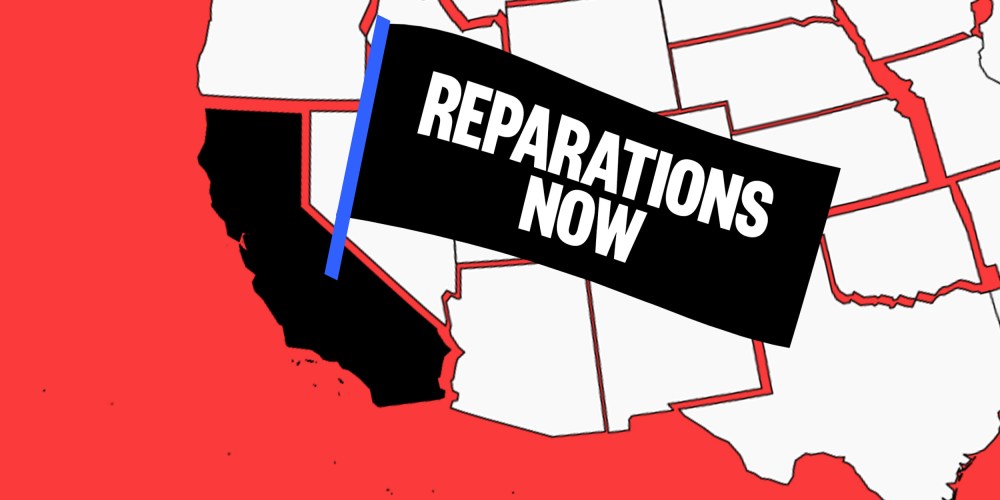
California, one of the top economies in the world, not just the United States, is discussing reparations to African American descendants of slavery. Its decision to do so through wide-ranging discussions on how slavery still affects African American education, finances, home-ownership and more — and how governments should compensate descendants of that “particular American institution”— will presage how the rest of the country and perhaps even the rest of the world considers reparations when the increasingly popular movement reaches new arenas.
For those in favor of reparations, the importance of these debates in California cannot be overstated. Wednesday, California’s Task Force to Study and Develop Reparation Proposals for African Americans will look at how the education of African Americans is even today affected by slavery; such connections have been tracked for decades, but little has been done to correct the inequities.

What does education have to do with reparations, beyond the fact that enslaved Africans were used to build several prestigious universities in slave and free states?
Plenty. While California is one of the unlikeliest states to begin the conversation about reparations — it entered the Union as a “free” state — it has much to atone for when it comes to its sins against the children of newly freed African Americans. A series of redundant or overlapping state and local laws is an example.
As part of its Fugitive Slave Law in 1852, California banned Black children from public schools. In 1854, Black students in San Francisco became the first children segregated in California’s public schools. In 1860, public schools were prohibited from admitting “Negroes and Mongolians” under threat of losing all funding. By 1864, California law required that districts had to open separate schools for Negro children, provided there were at least 10 “colored” families in a town. It was a law that Black Californians complained bitterly about.
“The law should be amended so as to give to every child the privileges of education,” a resolution from the 1865 Colored Citizen convention said. “If they were not to have a separate school, let them be admitted to those already established.”
California remains one of the most segregated states when it comes to schools, according to the Civil Rights Project.
Not until 1880 did California eliminate its anti-minority education laws, but California remains one of the most segregated states when it comes to schools, according to the Civil Rights Project, which correctly identifies segregation as “one of the central mechanisms for perpetuating inequality in American society.”
Task force members will hear testimony on how state- and local-driven inequities have harmed the descendants of American slavery. These are arguments that reparations advocates in other states should be paying close attention to because as goes California, so goes the nation.
While it’s unlikely the federal government will seriously take up reparations any time soon, smaller entities including cities and universities already are making long overdue moves toward reconciling with their past.

Evanston, Illinois, last year became the first U.S. city to make reparations available; Providence, Rhode Island, announced a city commission in February; and Boston is considering a commission. Georgetown University created a reparations fund for the descendants of 272 slaves whom the university sold in 1838 to save it from bankruptcy.


And when California acts? It’ll be like a pebble starting an avalanche.
Remember when Texas came up with a novel way to evade the Supreme Court, enacting a strict abortion restriction and inspiring other states to craft similar laws without having to fund legal research and court challenges? Expect the same with California’s reparations effort. Whatever the state decides will most likely be copied by subsequent states when the dominos fall and the idea of reparations for their African American residents can no longer be avoided.
The task force has decided that whatever reparations emerge from this effort, they will be accessible only to African American descendants of slaves.
Thanks to California, one of the major issues around slavery reparations may already have been decided: the question of who’s eligible. The task force has decided that whatever reparations emerge from this effort, they will be accessible only to African American descendants of slaves, not all Black Californians, disqualifying nearly 200,000 Black immigrants.
The task force is planning to recommend “appropriate remedies of compensation, rehabilitation, and restitution” to the state Legislature by June 1. But whatever it suggests won’t be the end. The state Legislature will then weigh in, and what is decided there will likely become the blueprint for the rest of the country. It’s unlikely, for example, that other states will relitigate the issue on whether all African Americans or only those who can prove lineage to African Americans slaves should get reparations.
While some may argue that all African Americans deserve reparations because all have lived with racism, limiting reparations to those who can prove they are American descendants of slavery may be the best idea. California and other jurisdictions are considering reparations for one specific thing: to help ameliorate the long-term effects of the American system of slavery, not to try to solve every single problem caused by racism more generally.
If Americans think reparations are owed for racism, sexism, homophobia or other sins, that’s a conversation that should follow the slavery reparations debate. Trying to have it at the same time would only further delay the momentum for slavery reparations, which has been demanded for almost the entirety of this country’s existence. Belinda Sutton, in a petition to a Massachusetts court, demanded payments from the estate of her former slave master, Isaac Royall Jr., in the 1780s.
California’s serious discussion of reparations is to be commended by all who agree that this country owes something to the descendants of those who built the generational wealth for white Americans but were denied the fruits of their own labor.
While California’s process is just a first step, here’s hoping that other states — I’m looking at you, coastal, deep and Colonial Southern states whose entire infrastructure and political and economic systems were built on the back of Black slavery — will begin studying reparations for slavery as a way to move this country forward.

Jesse J. Holland
Jesse J. Holland, an award-winning author, professor and journalist, teaches journalism at the School of Media & Public Affairs at George Washington University and was a longtime congressional, Supreme Court and White House reporter with The Associated Press. He is the author of two African American history books about Washington, D.C., and has written for major entertainment franchises, including Lucasfilm’s "Star Wars," DC Comics’ "Superman" and Marvel’s "Black Panther."