




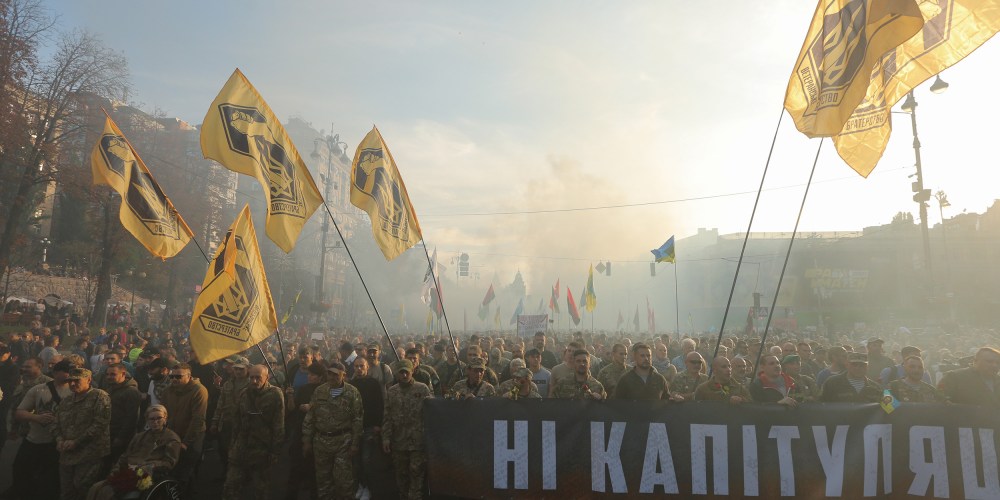
In early March, one of the world’s leading intelligence experts sounded the alarm about a Ukrainian militia’s public invitation to foreigners to join its ranks and fight against Russia. That call, from the Azov Battalion, triggered a surge of volunteers from across Europe and the U.S., including in neo-Nazi chat rooms and channels. Warning of the risks of extremist mobilization among foreign fighters, terrorism analyst and founder of Search International Terrorist Entities Intelligence Group Rita Katz warned that we haven’t seen “such a flurry of recruitment activity” since ISIS.
“Volunteer battalions” — pro-state militias organized by private citizens — have played an unusual and outsized role in Ukraine since they first organized in the fight against pro-Russian separatists nearly a decade ago.
The warning follows Russian President Vladimir Putin’s misguided and deeply false claims of “denazifying” Ukraine via his offensive. It also brings into sharp relief the impact that volunteer militias in Ukraine can have on violent movements far outside the boundaries of the conflict for which they originally mobilized.
“Volunteer battalions” — pro-state militias organized by private citizens — have played an unusual and outsized role in Ukraine since they first organized in the fight against pro-Russian separatists nearly a decade ago. Inadequate military infrastructure at the start of the conflict with Russia inspired bands of private citizens to organize to defend the state in ways that were largely welcomed at that time as a useful and necessary form of patriotic support. Most private militia groups in Ukraine were subsequently legally subsumed into state entities.

This is also the case for the Azov Battalion, which emerged as a volunteer regiment in 2014 during the earlier phase of the Ukraine-Russia conflict. Congress passed a resolution to block U.S. military funding for Ukraine from being used to support the Azov Battalion in 2015, although the ban was lifted in 2016. And in 2019, the U.S. tried but failed to have the Azov Battalion declared a “foreign terrorist organization.”
At the time of its founding, Azov had explicit extremist ties to neo-Nazi and ultranationalist groups, including the Social National Assembly and the Patriot of Ukraine. The Azov regiment fought on the front lines in eastern Ukraine against pro-Russian separatists, was rapidly incorporated into the National Guard of Ukraine, and was later recognized by then-president Petro Poroshenko as the country’s “best warriors.”
Once it became an official part of the state, the Azov Battalion distanced itself from neo-Nazi and white supremacist ideology, and its far-right leadership left the regiment. But interviews with individual members, its use of insignia that was also used as a Nazi symbol, assessments from experts and recent social media video posts from the group clearly show continued anti-immigrant, anti-Muslim, antisemitic and white supremacist views among its fighters.


Any and all propaganda about the need for “de-nazification” must be denounced; but to ignore the presence of groups like the Azov Battalion will be at our own peril.
And although it is a relatively small battalion, estimated at only 900 volunteers, Azov’s reputation and global reach is far bigger. The group has recruited foreign fighters from at least half a dozen countries and has globally become “a larger-than-life brand among many extremists,” according to Katz. U.S.-based militants from the now-defunct Rise Above Movement, along with members of the terrorist group Atomwaffen Division, have been cultivated by Azov.
Azov’s progression illustrates just one of the unintended outcomes of private militia mobilization in Ukraine. Another is the risk of radicalization for national recruits who join ultranationalist volunteer battalions that have white supremacist extremist or neo-Nazi ties. The Azov Battalion developed extensive recruiting tactics within Ukraine, including for youth, establishing a fight club in Kiev as well as “youth camps, recreation centers, lecture halls and indoctrination programs” that teach children as young as 9 years old “military tactics and white supremacist ideology.”
It’s important to remember that white supremacist extremist groups and scenes in Ukraine are still a marginal and fringe part of the political spectrum. The presence of a small minority of extremists, including in the Azov Battalion, has been grossly exaggerated by Putin in claims that Ukraine needs to undergo “denazification.” But while Putin’s propaganda is patently false, the presence of ultranationalists among Ukrainian regiments remains a thorny issue that must be carefully monitored.

And there are other risks to guard against. Militias that are authorized to use force on behalf of a state in emergency circumstances may later turn on those same governments. In 2017, armed protesters who were members of volunteer battalions used “violence and threats” to force the Ukrainian government to ban imports of anthracite coal from separatist-controlled territory, prompting analysts to warn that while the volunteer militias may have saved Ukraine in 2014, now “they threaten” the country’s democracy and stability.
Whether state-incorporated or unlawful, militia mobilization from private groups of citizens and global volunteers creates an unpredictable and volatile situation. The need for tactical and skilled soldiers to fight against Russia has meant a rapid national and global mobilization in Ukraine, including the intentional mobilization and authorization of private citizens to fight on behalf of the state. But the bedfellows we choose as partners today may come back to haunt us in unexpected ways down the road. Yes, any and all propaganda about the need for “denazification” must be denounced; but to ignore the presence of groups like the Azov Battalion will be at our own peril.

Cynthia Miller-Idriss is an author and expert on extremism.