




Journalists frequently employ a technique known as the “exemplar,” in which one ordinary person’s story is used as a vehicle to explain a complicated issue. A human story is much more compelling than a list of statistics or an abstract description of events, and once you realize how exemplars are used, you’ll see them everywhere in the news.
Smart politicians of all ideologies look for exemplars too, people who can embody their policies or their critique of the other side. Most of them wind up as an anecdote a candidate tells on the campaign trail. If they’re particularly compelling, they might get featured for an evening at a convention or in a State of the Union address. But few, if any, received the lasting renown of Samuel Joseph Wurzelbacher, aka “Joe the Plumber,” who died Sunday at 49.
Wurzelbacher’s story was a case study in the conflict that now defines our politics.
Wurzelbacher’s story was a case study in the conflict that now defines our politics, in which culture and class are combined to create lines of division between Us and Them — and in particular, the Republican Party’s need to shift attention away from policy disputes toward questions of identity.
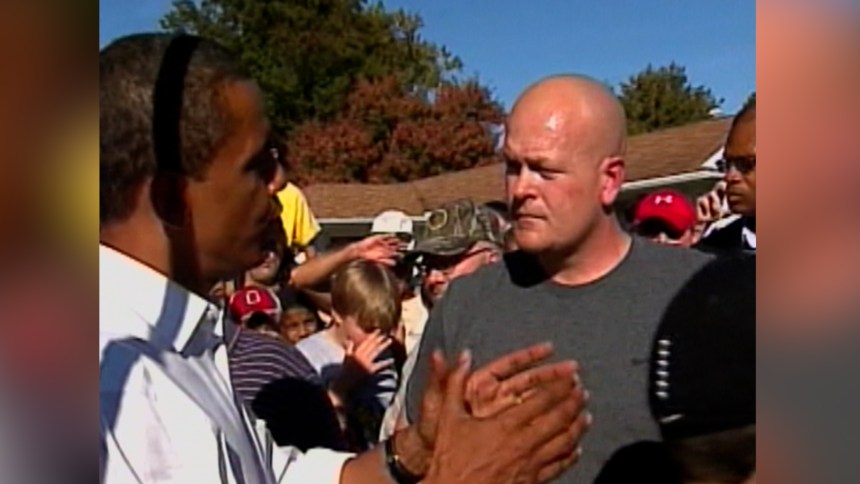
In October 2008, Wurzelbacher walked up to a campaigning Barack Obama on a street in Ohio and told the candidate he worried that if he bought his boss’s plumbing business, it might push him into a higher tax bracket. Wurzelbacher feared that Obama’s plan to increase the top marginal rate would raise his taxes. Obama tried to disabuse him of this notion, and they went back and forth for a few friendly minutes, ending with a smile and a handshake. “Joe the Plumber” — less a person than a character — was born.
The truth was that Wurzelbacher almost certainly would not have paid higher taxes under Obama’s proposals. He was positing for the candidate a scenario in which he would someday buy a company, with money he didn’t yet have, and would then start making fantastic profits.

But the facts were irrelevant; what mattered was the symbolism. From the moment Obama became the Democratic nominee, Republicans worked to characterize Obama as alien from most Americans — with his erudition, cosmopolitan upbringing, and, yes, his race. Joe the Plumber was a perfect contrast, a white tradesman from the Midwest with a bald head and a linebacker’s build. So John McCain’s campaign made Wurzelbacher famous, peppering the candidate’s speeches with mentions of Joe the Plumber to assert that regular, hardworking, blue-collar Americans were repulsed by Obama and his schemes. McCain’s running mate, Sarah Palin, was particularly taken with Wurzelbacher. At his final debate with Obama, McCain brought up Joe the Plumber repeatedly.
Wurzelbacher later ran unsuccessfully for Congress as a far-right Republican; in one of his campaign ads, he blamed both the Armenian genocide and the Holocaust on gun control. But in the meantime he became disillusioned with the whole affair. “McCain was trying to use me,” he said. “I happened to be the face of middle Americans. It was a ploy.”


If politicians are presumptively phony, someone like Joe the Plumber is supposed to confer upon them a little of that magical quality of “authenticity.”
Of course it was. Wurzelbacher was a tool, a way of arguing that despite its zeal for corporate deregulation and tax cuts for the wealthy, the Republican Party was actually on the side of those who work hard every day and come home with dirt under their fingernails, while Democrats were snooty elitists who look down on regular folks. And if his drafting by the McCain campaign felt like a performance he wasn’t prepared for — including criticism from Democrats who pointed out that his story didn’t quite add up — he wasn’t exactly an unwilling participant.
A similar scenario played out in recent weeks with musician Oliver Anthony, whose song “Rich Men North of Richmond” became a viral hit with the help of conservative pundits and politicians who embraced its right-populist message. Anthony quickly grew disillusioned, saying, “It’s aggravating seeing people on conservative news try to identify with me, like I’m one of them.” After the moderators of last week’s Republican presidential primary debate used his song as the launching pad for their first question, Anthony objected: “I wrote that song about those people.”
But that’s the whole point: When Republicans seize upon people like Anthony or Wurzelbacher, it’s precisely to convince voters that the GOP is a collection of regular fellas just trying to help out other regular fellas, rather than what they actually are.
In the years since the creation of the Joe the Plumber character, that project has enjoyed a certain degree of success. One Republican politician after another now claims theirs is “the party of the working class” (they don’t say “white,” of course) and though there is precious little they do in office that improves the lives of those Americans, they do offer a steady diet of cultural resentment at “elites” who supposedly look down on ordinary people. Donald Trump won 65% of the votes of whites without college degrees in 2020.
While there hasn’t been an exemplar since who became as famous as Wurzelbacher was in 2008, campaigns will keep hunting for characters like him. If politicians are presumptively phony, someone like Joe the Plumber is supposed to confer upon them a little of that magical quality of “authenticity,” a bit of realness amid a campaign built on artifice. But exemplars quickly end up seeming inauthentic too. Once you’ve been turned into a political product, you’re no longer just an ordinary person. And those who find themselves in that position often wish it had never happened.

Paul Waldman is a journalist and author focused on politics and culture.