




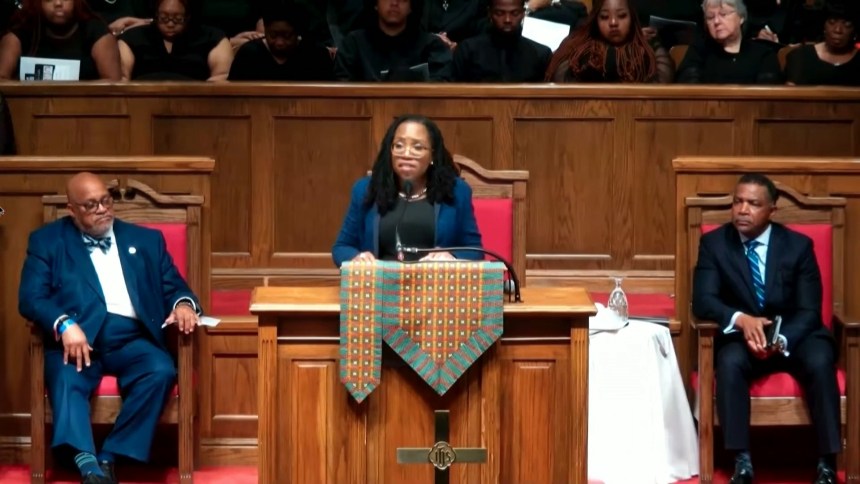
Standing in a church that white supremacist terrorists dynamited in 1963 — inside a state where some lawmakers appear unwilling to let teachers blame such crimes on white supremacist terrorists — Supreme Court Justice Ketanji Brown Jackson correctly defended the remembrance of such history as a public duty Friday. “If we are going to continue to move forward as a nation,” she said, “we cannot allow concerns about discomfort to displace knowledge, truth or history.” She said, “It is dangerous to forget.”
Supreme Court Justice Ketanji Brown Jackson correctly defended the remembrance of history as a public duty Friday.
Jackson spoke from the pulpit of the 16th Street Baptist Church in Birmingham, Alabama, on the 60th anniversary of the day that 14-year-olds Addie Mae Collins, Denise McNair and Carole Roberston, and 11-year-old Cynthia Wesley were killed in a dynamite attack on the church. The event was more than a remembrance of the children murdered by a Ku Klux Klan-affiliated group.
It was a rebuke to those working to sanitize the past. Her speech embodied the spirit of “Ain’t Gonna Let Nobody Turn Me Around,” a Civil Rights-era song she said she learned as a child, in that it served as an announcement that Black people aren’t going to comply with the pervasive attempts to keep America’s schoolchildren from learning the breadth and depth of racist violence and oppression.
“Knowledge of the past,” Jackson said, “is what enables us to mark our forward progress.”
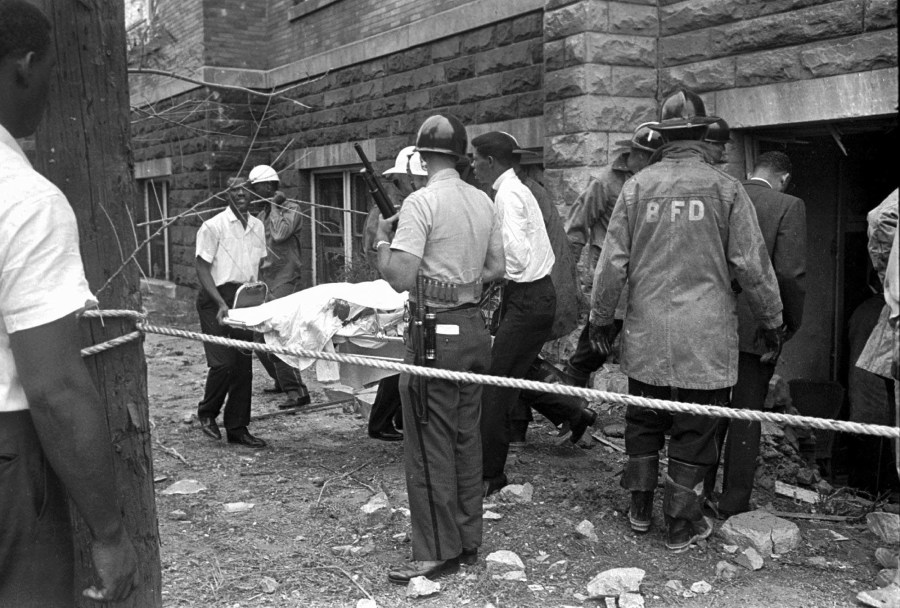
Jackson, who was born in Florida in 1970 and is the only Black woman ever to serve on the Supreme Court, said that when she was a small child, her educator parents made sure she knew the details of what had happened in the two decades before she was born. When she was a girl of 4 or 5, she said, she would impress adults by telling them the month, day and year Rosa Parks was arrested for protesting segregated seating on a Montgomery bus. A young Kentanji knew enough about the Civil Rights movement that she could look at a black-and-white photo and pick out John Lewis’ face from a crowd on the Edmund Pettus Bridge in Selma.
And she knew what had happened at the 16th Street Baptist Church. Describing herself as the mother of “young women” who will always be “my little girls,” Jackson said, “I can imagine no greater horror than to lose a child this way.”


The four little girls were in the basement of the church for Sunday school. They were about to go up for a church service in which children their age were going to participate. The people who placed the dynamite at the church were affiliated with a Ku Klux Klan offshoot called Cahaba River Group. And they targeted that church because it was where Civil Rights activists had planned so many public demonstrations. It would be 14 years before there was a murder conviction in that case. After nearly 24 more years had passed, a second bomber was convicted of murder in 2001. A third was convicted in 2002. But one of the suspected church bombers died a free man.
“Tough stuff for a child,” Jackson said of the “darker moments” that her mother and father required her to know, “but my parents never lied to me.”

In debates over the teaching of history, too much attention has been focused on whether accurate history makes white children feel bad, and if they should be spared these bad feelings. Not nearly enough attention has been given to the philosophy embraced by Jackson’s parents — and, indeed, embraced by so many Black parents across generations — that Black children need to know their history, not for academic attainment but to survive and to succeed.
Her parents’ goal, Jackson said, was to do their best to make sure she was “prepared for life in America.” She said, “I had to know those hard truths in order to expand my horizons.” In other words, she wouldn’t be who she is or where she is if she hadn’t been taught the harsh, unvarnished truth of American history.
And with that argument, Jackson asks us to consider that the opposition to teaching accurate history isn’t about protecting white children’s feelings but about thwarting Black children’s futures.

Jarvis DeBerry is an opinion editor for MS NOW Daily. He was previously editor-in-chief at the Louisiana Illuminator and a columnist and deputy opinion editor at The Times-Picayune.