




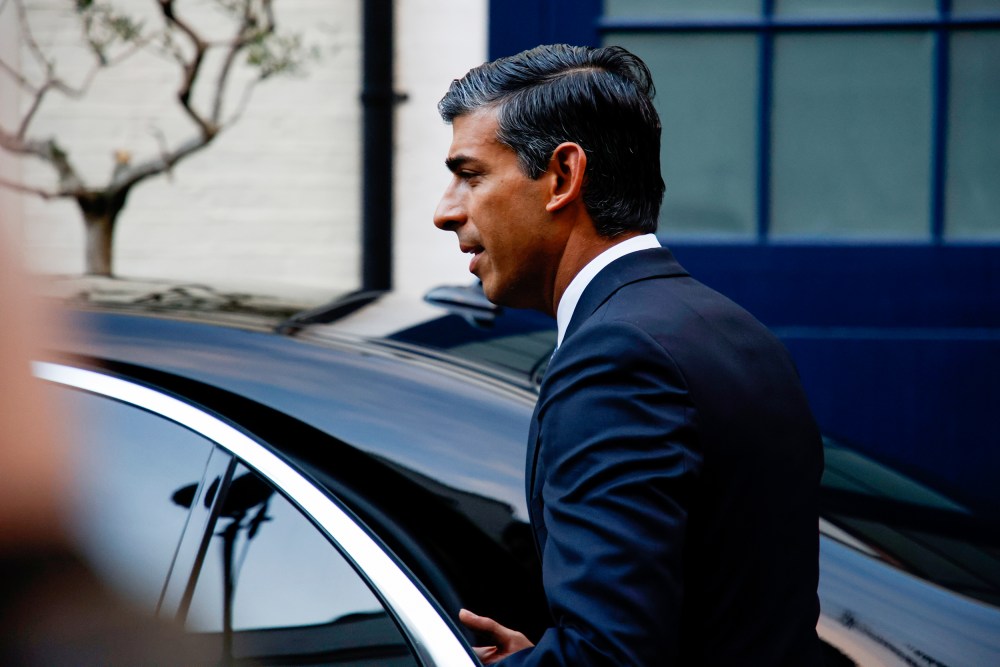
UPDATE (Oct. 25, 2022, 10:05 a.m. ET): This article has been updated to reflect that Rishi Sunak was appointed British prime minister Tuesday, becoming the United Kingdom’s third leader in seven weeks.
Rishi Sunak became Britain’s first prime minister of color Tuesday after winning the Conservative Party contest for head of government Monday. His win followed the resignation of his embattled predecessor, Liz Truss, who crashed and burned as prime minister in a record-breaking 44 days.
The political ascension of Sunak is anything but a win for minorities.
But the political ascension of Sunak — who is of Indian descent and whose parents emigrated from East Africa — is anything but a win for minorities.
Sunak is not your average minority. For context, Black and ethnic minority Britons are two times more likely than white Britons to live in extreme poverty. Sunak and his wife have a combined net worth just shy of a billion dollars and made it onto the Sunday Times Rich List 2022 (a ranking of the 250 wealthiest people in the U.K.)
But even if Sunak weren’t so wealthy, it is imperative that we problematize “representation” and not take the reductive stance that political representation is always a win for minorities. In fact, such representation can create more damage in that it distracts us from the harmful reality on the ground.
Figures such as Sunak operate within a larger political system predicated on patriarchal white supremacy and with normative views on gender and sexuality. Simply installing brown people who peddle the same ideology of a system that exploits minority populations doesn’t undo this damage. Further still, Sunak is to be the head of a right-wing party that has itself perpetrated harmful policies against minorities and vulnerable populations. It is not only disingenuous to describe Sunak’s ascension as a win for minorities, but it also is dangerous — as it obscures the reality of many minorities and perversely paints a picture of meritocracy and inclusion that often does not exist.

There has been a fair bit written about tokenism in recent years, but representation is not its antithesis. I would suggest that tokenism exists on a messy continuum with representation, where meaningful inclusivity and equity (achieved by disrupting the status quo) sit on the opposite end. Under the umbrella of political representation, it can be helpful to make the distinction “between descriptive representation (for example, minority office holders) and substantive representation (the advancement of a minority political agenda,”) as law professor Grant M. Hayden explains in his paper “Resolving the Dilemma of Minority Representation.”


Sunak’s policy priorities make it clear that he falls into the former bucket of descriptive representation. Immigration was a central feature of his bid for prime minister this summer, when he was in a runoff against Truss. His fearmongering and reactionary stance are akin to Republican rhetoric and policies in the U.S. Sunak has been an ardent proponent of the “Rwanda scheme,” which seeks to fly immigrants who enter the U.K. illegally to Rwanda. The controversial policy would include an initial payment to Rwanda of £120 million in exchange for sending any asylum-seeker of Britain’s choosing (the pilot program proposes starting with 1,000 people); the lump sum would be supplemented as the country accepts more migrants. Conservatives have thus far been unable to enact this policy only because the European Court of Human Rights has intervened. (If Britain weren’t an island, Sunak would likely be chanting a version of “build the wall.”)
Tokenism exists on a messy continuum with representation, where meaningful inclusivity and equity sit on the opposite end.
“Law-abiding citizens are dismayed when they see boat after boat full of illegal immigrants,” he said on Twitter in July, “with our sailors and coastguards seemingly powerless to stop them.” That same month, he posted a video that opens with an ominous soundtrack and a lone TV playing a supercut of asylum-seekers seemingly invading the U.K. “Every year thousands and thousands of people come into the U.K. illegally,” Sunak warns. “Often we don’t know who they are, where they’re from and why they are here. These are not bad people, but it makes a mockery of our system and it must stop. The current chaotic, free-for-all is simply no way for a serious country to run itself.”
His 10-point immigration plan, which he released around that time, proposes withholding aid for poor countries that don’t comply with his immigration policy and “cooperate on returns,” using language that sounds more befitting a department store’s return policy than an immigration policy dealing with human beings.

The irony of his immigrant background is apparently lost on him. Or, rather, he, like many of his Conservative Party peers, believes money and privilege exempt one from laws that apply to the average brown person. That’s exactly the point. This is the crux of descriptive representation’s limitations.
We need to dismantle the discourse that frames representation as a causal factor for inclusivity and equity, rather than the other way around: the product of a fundamentally inequitable system that seeks to distract from its shortcomings by tokenizing minorities and privileges and rewards them for upholding the values of exploitation.

Noor Noman is a writer focused on culture, race and LGBTQ issues.