




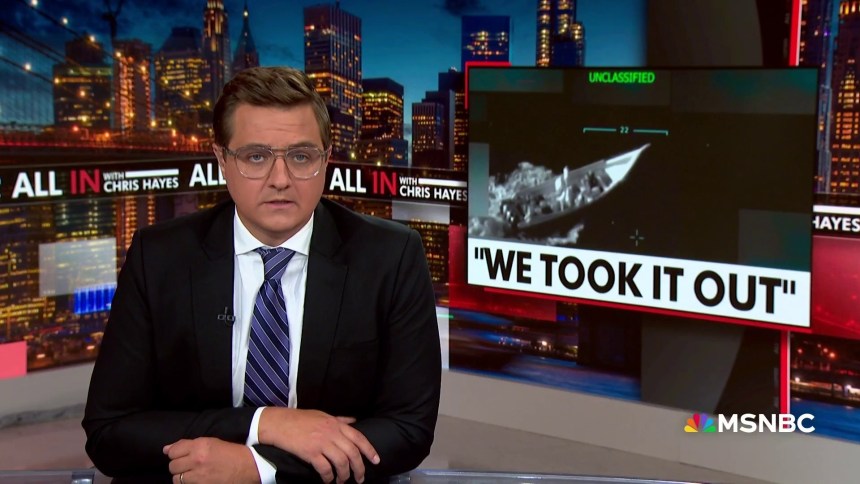
On Tuesday, President Donald Trump said the U.S. military blew up a vessel in the Caribbean, killing 11 people. The administration said the boat had departed from Venezuela and described the operation as a narco-trafficking bust against Tren de Aragua gang members. To anyone who knows the tragic history of U.S. interventionism in Latin America, it was an act of war.
This isn’t the first time a mysterious explosion at sea has been used to shape American public opinion and drum up pro-war sentiments. In 1898, the battleship USS Maine blew up in Havana Harbor, killing more than 260 sailors. The cause was never proven, but American newspapers exploited the ambiguity to blame Spain, stoking outrage that fueled the Spanish-American War. Within months, the United States had radically recast power in the Caribbean, a grip it has maintained ever since, even when such power was challenged during the Cold War.
The timing of the attack, which experts are calling a violation of international law, is no coincidence.
The strike on what U.S. officials insist was a drug boat carries the same kind of ambiguity. The Trump administration quickly produced a blurry video of the explosion, but the images don’t prove who was aboard, what they were doing or whether drugs were even present. The White House has offered no hard evidence that the dead were members of a gang. “Pentagon officials were still working Wednesday on what legal authority they would tell the public was used to back up the extraordinary strike in international waters,” The New York Times reported.
But for a president who has promised to “pursue our manifest destiny,” this is part of a larger script already in motion. “In the Trump era, a new manifest destiny is here, accelerating protectionism and expansionism at the cost of the powerless,” I wrote at the start of Trump’s second term. This worldview, shaped by a 19th-century ideology that also fueled the war against Spain 127 years ago, treats the Western Hemisphere as territory still to be controlled.
Under Trump, as in recent decades, the so-called war on drugs provides the cover. Never mind that America remains an incredibly lucrative drug market — fighting trafficking has been good for American interventionism. Plan Colombia poured billions into militarization that fueled displacement and bloodshed. The Mérida Initiative coincided with record homicides and human rights abuses in Mexico. In the Caribbean, counternarcotics has long served as the rationale for an expanded U.S. naval presence, including the current deployment of warships off the coast of Venezuela.

The timing of the attack, which experts are calling a violation of international law, is no coincidence. Trump has built his return to power on projecting American strength abroad, and Venezuela offers a ready stage. The United States has deployed more than 4,500 sailors and Marines, along with seven warships, in the Caribbean. Casting the South American country as a narco-state justifies force, rallies his base and signals to the region that Washington still wants to dictate the rules to Latin America.
And the messenger matters. Fully supporting Trump is Marco Rubio, the country’s first secretary of state of Latino descent. Defending the decision to reporters in Mexico City on Wednesday, Rubio said that “instead of interdicting it, on the president’s orders, we blew it up — and it’ll happen again.” He argued that ordinary seizures don’t deter traffickers, adding, “What will stop them is if you blow them up. The president is going to wage war on narco-terrorist organizations.”


Maduro isn’t popular, but the left-wing authoritarian knows history and how to use it.
Rubio’s words were less a policy blueprint than a posture. They reflected Cuban exile politics that have long pushed Washington toward confrontation in the region and that Rubio, as a longtime senator from Florida, is deeply familiar with. And that posture does have an audience, particularly among U.S. Latinos. Social media analysis from the Digital Democracy Institute of the Americas (DDIA) notes that “online discourse among U.S. Latino communities this week continues to be dominated by escalating U.S.-Venezuela tensions, with prominent social media accounts driving narratives of imminent military action and growing calls for [Venezuelan President Nicolás] Maduro’s Venezuela to be designated a narco-terrorist state.” In fact, Venezuela doesn’t really produce that much cocaine, although The New York Times reports that “U.S. indictments and leaked Colombian records describe Venezuelan security forces as overseeing drug shipments worth billions of dollars.”
As expected, Venezuela has made sure to paint Trump and the United States as Yankee imperialist warmongers. Maduro isn’t popular, but the left-wing authoritarian knows history and how to use it. He said the U.S. buildup “threatens the entire region,” and warned he would declare a “republic in arms” if American troops crossed into Venezuelan territory.
As far-fetched as that may seem, the Trump administration is ramping up the tension, instead of toning it down. History shows how quickly moments like this can escalate. The Maine in 1898, U.S. troops in the Dominican Republic in 1965, Grenada in 1983, Panama in 1989 — each framed as defensive, each ending in military intervention. This week’s strike carries the same risk, wrapped in similar justifications.

The question isn’t whether a corrupt, authoritarian figure leads Venezuela. It’s whether the United States is again using a familiar script to justify actions that will destabilize a hemisphere, with Latino communities in the U.S. now serving as both amplifiers and targets of the narrative.
This week’s strike was an act of war. To pretend otherwise is to ignore history and to blind ourselves to what the United States has done time and again in Latin America and the Caribbean. If we are serious about learning from the past, we should call it what it is.

Julio Ricardo Varela is the founder of "The Latino Newsletter" and co-editor of "Pressing Issues from Free Press."