





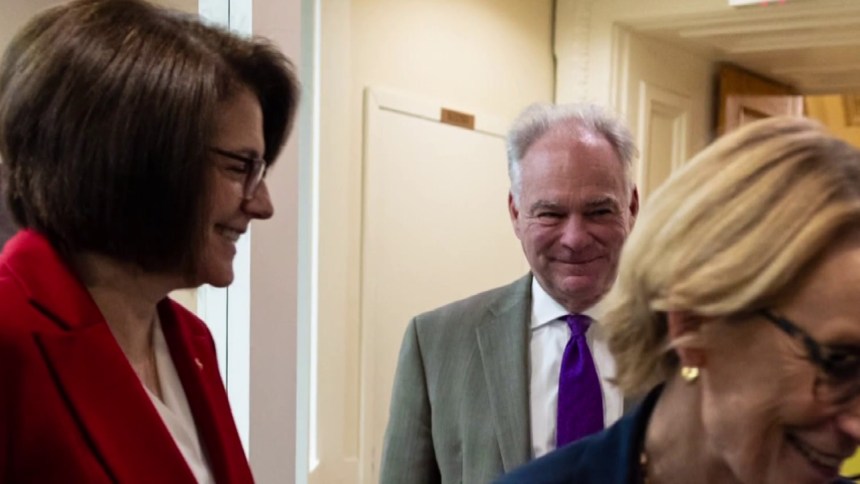

As the ongoing government shutdown was poised to begin in late September, three members of the Senate Democratic caucus — Nevada’s Catherine Cortez Masto, Pennsylvania’s John Fetterman and Maine’s Angus King — broke party ranks and voted with the Republican majority to prevent the breakdown. That gave GOP leaders 55 votes, five short of the 60-vote threshold.
At that point, the Republican plan, in a nutshell, could be summarized in one word: wait.
GOP leaders, in the White House and on Capitol Hill, assumed that just enough Senate Democrats would cave under pressure. Those assumptions proved true. MSNBC reported overnight:
After nearly six weeks of a painful shutdown, a critical number of Senate Democrats backed a Republican funding bill to reopen government — with little to show for holding out so long. The breakthrough, which came together suddenly on day 40 of the shutdown, offers Democrats few new concessions beyond what Republicans had already proposed.
There’s quite a bit to this, so let’s unpack the details.
Is the shutdown over?
Not yet. The Sunday-night vote in the Senate was a procedural vote to advance a bill intended to end the shutdown. It received 60 votes, but the underlying legislation still needs to pass.
Who caved?
In addition to Cortez Masto, Fetterman and King, who’ve consistently voted with Republicans to end the shutdown, five other Senate Democrats sided with the GOP on the procedural vote: Dick Durbin of Illinois, Maggie Hassan of New Hampshire, Tim Kaine of Virginia, Jackie Rosen of Nevada and Jeanne Shaheen of New Hampshire. (Durbin and Shaheen, it’s worth noting for context, are retiring at the end of their current terms.) Republican Sen. Rand Paul of Kentucky, meanwhile, voted with most Democrats against the package.
Did they get anything in exchange for their votes?
Not much. The deal, to the extent that it can fairly be described as such, includes three full-year appropriations bills to fund some federal departments through the end of the fiscal year and money to fully fund the Supplemental Nutrition Assistance Program (SNAP). It also reverses Donald Trump’s shutdown layoffs (also known as “reduction in force” notifications, or RIFs).
What about the Affordable Care Act, which was largely the point of the shutdown?
Republicans promised Democrats there will soon be a vote on extending the expiring ACA subsidies.
For health care advocates, does this offer some reason for hope?
Not really. Even if there is a vote, there’s no reason to assume it will pass the GOP-led chamber. And even if it were to pass, there’s no guarantee that the Republican-led House would care.
So why in the world did these eight senators cave?
According to King, it was time to surrender because the status quo “wasn’t working.”
Was he right?
No. The public has blamed the president and his party; Democrats received a dramatic boost from the electorate five days before the Sunday-night vote, which should’ve stiffened spines; Trump’s approval rating is sinking; and GOP officials were increasingly divided against one another. The pieces, in other words, were in place for Democrats to stand firm in support of a popular cause. Eight of them folded anyway.
So what happens now?
In the coming days, the Senate will vote on the underlying agreement, which is likely to pass. It would then move to the House, which hasn’t done any work whatsoever in almost two months.
If all goes according to plan, we won’t have to worry about any more government shutdowns for a while, right?
Wrong. As MSNBC’s report added, “Even if, as expected, both chambers pass the bill and President Donald Trump signs it, most of the government will only be funded through that stopgap bill going until Jan. 30.”
In other words, this new agreement funds the government through a temporary spending package known as a continuing resolution (also known as a CR). If signed into law, it will expire in 11 weeks, at which point most of the federal government will face the prospect of another shutdown. Watch this space.
