





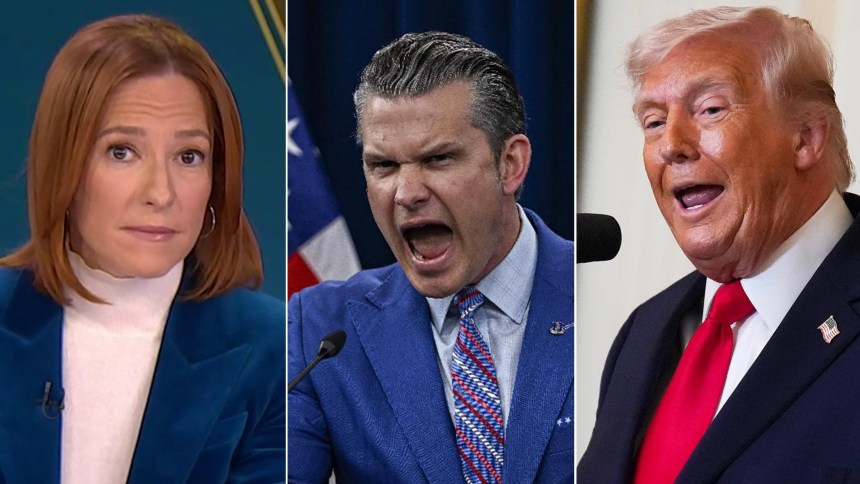

As the second week of the war in Iran neared its end, Defense Secretary Pete Hegseth held a press briefing that reminded everyone that the former Fox News host is simply in over his head. The beleaguered Pentagon chief peddled tiresome cliches, struggled with important questions, sidestepped inquiries about U.S. casualties and generally acted as if the key to successful combat operations is chest-thumping rhetoric.
But most important, Hegseth devoted much of his Friday briefing to chastising journalists for covering the war in Iran in ways the administration didn’t like — including whining about on-screen chyrons that used the same language and phrasing that the Defense Department had used in the preceding days.
A day later, a different controversial figure in the administration went considerably further. MS NOW reported:
President Donald Trump’s Federal Communications Commission chairman is threatening to revoke the licenses of news broadcasters over their coverage of the Iran war.
Brendan Carr, the head of the agency, warned broadcast news organizations on Saturday to ‘correct course,’ following the president’s rants over news coverage of his war with Iran, including stories about U.S. aircraft tankers sustaining damage in a strike.
In a social media message that neglected to refer to any specific media outlets or real-world examples, Carr wrote, “Broadcasters that are running hoaxes and news distortions — also known as the fake news — have a chance now to correct course before their license renewals come up. The law is clear. Broadcasters must operate in the public interest, and they will lose their licenses if they do not.”
Donald Trump wasted little time expressing support for the unsubtle threat. “I am so thrilled to see Brendan Carr, the Chairman of the Federal Communications Commission (FCC), looking at the licenses of some of these Corrupt and Highly Unpatriotic ‘News’ Organizations,” the president wrote on his own platform.
In the same online tirade, the Republican suggested that independent news organizations that published reports he didn’t like “should be brought up on Charges for TREASON for the dissemination of false information!”
Soon after, during a brief Q-and-A with reporters on Air Force One, Trump went on to suggest that reporting on the war in Iran that he disapproved of deserves to be seen as “pretty criminal.”
It came on the heels of the president also promoting an online graphic in which he claimed credit for “reshaping” American journalism.
To be sure, Trump and his team have targeted the nation’s free press many times, and there isn’t yet any evidence to suggest that American journalists will actually face criminal charges for running reports at odds with the White House’s wishes or that American broadcasters will lose their licenses because their aired segments are at odds with Carr’s political worldview.
In an online statement, the FCC’s lone Democratic commissioner, Anna Gomez, explained, “The FCC can issue threats all day long, but it is powerless to carry them out. Such threats violate the First Amendment and will go nowhere. Broadcasters should continue covering the news, fiercely and independently, without fear of government pressure.”
But that doesn’t make the saber-rattling irrelevant.
For one thing, it’s hardly a stretch to think that news organizations, especially those with corporate parents eager to curry favor with the GOP administration, might be intimidated by the threats.
For another, there are broader principles related to the First Amendment and democratic governance at stake. Responding to Carr’s statement, Democratic Sen. Chris Murphy of Connecticut commented online, lambasting the federal government for “telling news stations to provide favorable coverage of the war or their licenses will be pulled. A truly extraordinary moment. We aren’t on the verge of a totalitarian takeover. WE ARE IN THE MIDDLE OF IT. Act like it.”
But stepping back, there’s another element to this that’s worth keeping in mind as the third week of the war advances: When wars are going well, administrations tend not to find it necessary to whine incessantly about media coverage and threaten independent news organizations.
If Trump and his team were feeling confident and optimistic about the mission and its objectives, the president and his acolytes probably wouldn’t be engaged in the kind of hysterical press complaints we’re seeing now.
