




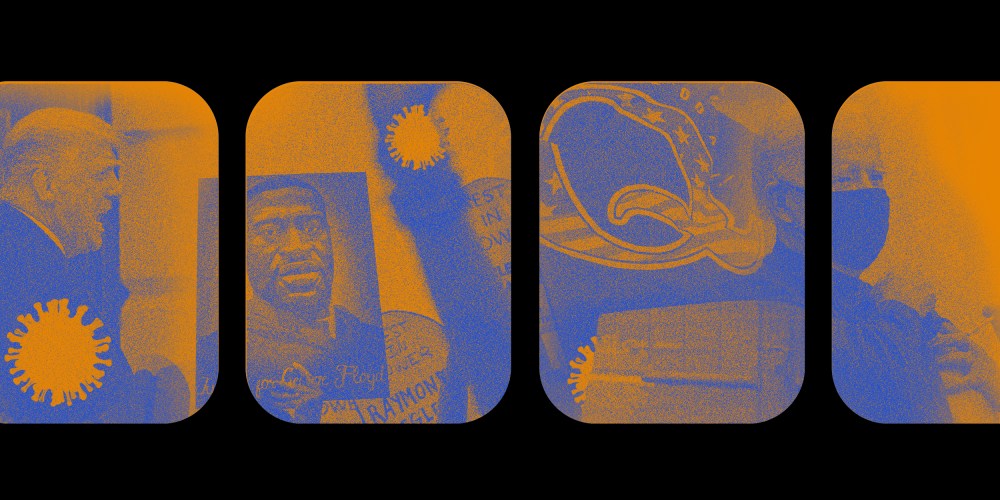
2020 was supposed to be better. Twelve months ago, the clock was winding down on a year that could only have been described as chaotic — as a small sample, the Amazon was on fire, Notre Dame Cathedral in Paris nearly burned down, Jeffrey Epstein died in prison before we had the answers we needed, and the president was impeached on charges of bascially extorting a foreign country’s leader.
It turns out “better” is a moving target. If anything, 2020 has finally exposed the fallacy of the way we think about what a “better” next year looks like.
Because in the end, 2019 didn’t differ much from the also bad 2018, which itself didn’t exactly improve on 2017. And let’s not even talk about 2016. Each year brings with it its own piquant bouquet of tragedies. The way time can flow in seeming ebbs and starts keeps those tragedies artfully arranged to leave the deepest impression in our minds of the horrors we’ve just experienced.

This year in particular has managed to challenge us in ways that’s made it feel like the culmination of an unpleasant stretch of time, culled together from our memories into a freakish amalgam designed to counter our hopes and expectations. This terrible sense of familiarity was woven into some of the year’s lowest moments. The six-year gap between the protests in Ferguson, Missouri, over the police killing of Michael Brown and George Floyd’s death at the hands of the Minneapolis police in May shrunk and collapsed on the streets of America’s cities this summer, punctuated with the hashtags of other Black men and women killed by police along the way.
Likewise, the political drama that’s marked this era has managed to continuously ooze over the border between years. The cliffhanger we ended on in 2018 — a 35-day government shutdown, if you can’t remember that far back — wasn’t resolved until almost a full month into the new year. The House of Representatives passed articles of impeachment against President Donald Trump in mid-December of last year, only for Speaker Nancy Pelosi to withhold them from the Senate for weeks.
Worse than the rollover crises was the one that seemed to come out of nowhere.
Today, we’re faced with the reality that Trump’s attempts to steal the election won’t fade into nothingness, that there will always be some new enabler. Rather than dying at the Supreme Court or with the Electoral College’s vote, Trump’s ego-driven attempt to subvert democracy will stretch into January as well. (Sen. Josh Hawley, R-Mo., announced on Wednesday that he plans to contest President-elect Joe Biden’s Electoral College win next week, bolstering a similar bid in the House.)
Worse than the rollover crises was the one that seemed to come out of nowhere. I remember discussing a weird new disease with co-workers on Slack as late as mid-February. We felt wise in our confident prediction that there might be worries about a global recession, but that Covid-19 wouldn’t become a pandemic. It hurt to look back at those logs just a month later.
The pain and suffering that the coronavirus has brought, and the lack of an effective response to its spread, have made 2020 particularly hellacious. More than 330,000 Americans are dead, millions more sickened, and while two vaccines have been approved, their distribution is lagging. Millions more Americans are unemployed than this time last year, and the gap between the billionaires and corporations, who profited handsomely, and the average worker is more galling than ever.


Even the absurdities of the year have felt tinted with malice — the U.S. was already a month and a half into the pandemic when The New York Times’ first article about the “murder hornet” went viral. For all the wackiness of QAnon’s mass delusion tenets, its supporters have enmeshed themselves in popular corners of the internet and spread its influence offline. And remember the mystery seeds from China? I’m still not entirely sure what was up with those.
If you insist on your rubric for “better” requiring “no more bad things,” well, that way lies madness.
As this chapter finally closes on Friday, none of the underlying issues that have made the year feel so isolating and frustrating will go away in a puff of smoke. Trump will be out of office soon, but his anti-democratic legacy and support for white supremacy will live on. Covid-19 will eventually wane as the vaccine is administered, but there may be no new normal. There will always be some new series of unfortunate events waiting for us in the time stream, whether they’re new ways for old pains to flare up or brand-new surprises like the pandemic.
So, while very few people will be sad to see 2020 in the rearview mirror, perhaps it’s worth recalibrating our thinking about how to judge the new year before it dawns. I think that the answer can’t depend on things outside of most of our control. We’ve spent the last half a decade reassuring ourselves each December that things will calm down next year, that chaos will fall to order, and been sorely disappointed each time.

If you insist on your rubric for “better” requiring “no more bad things,” well, that way lies madness. Instead, our hopes for 2021 can’t be built around a sudden utopia springing up when the clock strikes 12 and 2020 ends. There needs to be room to accept events as they come — even the negative ones — without letting them overwhelm us, a prospect that seems achievable for the first time in years.
This in turn leaves the definition of “better” up to each of us. It will be a better year if we take the lessons we’ve learned in this last 12 months and build on them, rather than succumbing to them. The rage and heartbreak of Breonna Taylor’s killing won’t render unarmed civilians impervious to the police’s bullets in 2021 — but the fight against qualified immunity and police unions can move forward. The time we’ve lost to the pandemic won’t be restored to the top of our personal hourglasses, but we can find joy in renewed connections.
It’s impossible to foresee what’s around the corner. That doesn’t mean that we have to set ourselves up for disappointment like Charlie Brown and his football each New Year’s Eve. Let’s say farewell to 2020 and leave ourselves open to whatever this next spin around the sun brings.

Hayes Brown is a writer and editor for MS NOW. He focuses on politics and policymaking at the federal level, including Congress and the White House.