




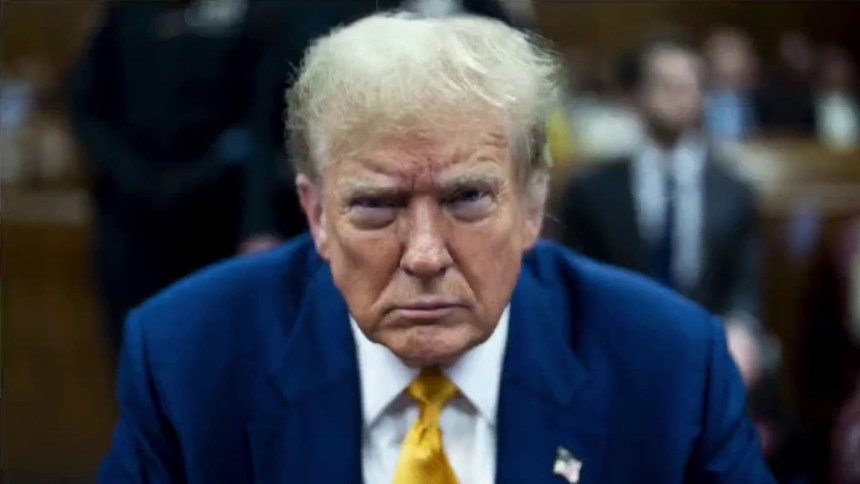
Overlooked in the furor over former Donald Trump aide Hope Hicks’ testimony in the former president’s New York criminal trial Friday was a quieter but no less important event. It came in Judge Juan Merchan’s soft-spoken but forceful reprimand of Trump for spreading a false claim. Merchan politely but firmly deflated Trump’s latest misleading spin and, in so doing, offered the dozens of journalists in the courtroom some pointers on how to deal with Trump’s incessant lies.
Trump has refrained from attacking witnesses and the jury since last week, when he was first found in contempt of court for nine violations of the gag order in the case. (On Monday, Merchan found Trump guilty of a 10th violation that took place before he was initially found in contempt.) But the former president is not holding back on attacking the truth. After proceedings ended on Thursday, Trump was asked whether he would appear as a witness in his own defense. “I’m not allowed to testify,” he stated. “I’m under a gag order — I guess, right?”
Trump most likely knew his claim was a lie on several levels. His attorney certainly did.
At this point he turned to his attorney, Todd Blanche, who nodded in confirmation. Trump continued, “This judge — who’s totally conflicted — has me under an unconstitutional gag order. Nobody’s ever had that before.”
Trump most likely knew his claim was a lie on several levels. Blanche certainly did. First, gag orders are common practice in high-profile criminal cases to prevent the parties from making extrajudicial statements that may affect the integrity of the proceedings. Second, the appellate division reviewing Merchan’s work declined to stay trial proceedings as it reviews the constitutionality of the gag order, suggesting its agreement with its contents.
Third, and most important, the gag order does not bar Trump from testifying. Defendants have an absolute right in criminal cases to testify in their own defense. In fact, New York provides even more rights to defendants than most jurisdictions. For example, state law requires what are known as Sandoval hearings to make defendants aware of what the prosecution will use against them and help them decide whether it is in their best interests to testify.

What was really going on Thursday was obvious. Trump has publicly promised to take the stand, but as one of the co-authors (Eisen) writes in a new book, the former president no doubt recognizes that testifying would be a disaster for him. Prosecutors’ Sandoval motions made it clear that if Trump testifies, they will raise his civil trials involving E. Jean Carroll and the civil fraud trial involving him, his sons and the Trump Organization. He would be discredited on cross-examination, both because of his penchant for lying and because of the apparent lack of any lawful explanation for the allegations in this criminal trial.
Trump needs someone to blame for his not taking the stand, so he was pointing the finger at the gag order and by extension the judge. He wants his supporters to believe that the only reason he did not testify is that the gag order prohibited him from doing so. This is a deceptive tactic from the former president, who has established himself as a merchant of disinformation.
The judge did not quote or even paraphrase Trump’s falsehood, which would have risked amplifying it.
Disinformation is the deliberate spread of false information with bad intent, as one of the co-authors (McQuade) discusses in her new book. Trump’s behavior, and indeed Blanche’s, as well, fits this definition precisely. It is clear they know this information is false, and they spread it to try to manipulate the electorate’s perceptions to their advantage.
Indeed, even Trump may have realized he had gone too far. Asked again about the gag order before court began Friday morning, he said: “The gag order is not to testify. The gag order stops me from talking about people.” Perhaps he meant it was not about testifying, or perhaps he had some other unfathomable meaning in mind. Be that as it may, the waters had been muddied by the disinformation shared Thursday, and Merchan’s response was a clinic in how to deal with it. First, he reaffirmed the law: “I want to stress to Mr. Trump: You have an absolute right to testify at trial.” Next, the judge did not quote or even paraphrase Trump’s falsehood, which would have risked amplifying it and spreading it further. Instead, he focused on the truth, noting correctly that the gag order has nothing to do with his testimony. Finally, the judge made his remarks in an even-tempered fashion that maintained order in the proceedings. Disinformation is designed to inflame emotions, but Merchan refused to take the bait. The judge then moved on matter-of-factly to decide other routine evidentiary matters before the court, ruling in Trump’s favor on one of them — further proof that he had been unaffected by the disinformation. Merchan showed wisdom in keeping his cool, deciding legal issues fairly and refusing to tolerate Trump’s efforts to taint public confidence in the proceedings. With Trump and so many others constantly spewing disinformation, others can learn from Merchan’s example.
Barbara McQuade is a former Michigan U.S. attorney and legal analyst.
Norman Eisen
Norman Eisen is a co-founder and board member of Democracy Defenders Action and publisher of The Contrarian. Eisen previously served as a U.S. ambassador and in senior White House and congressional staff roles.
Samara Angel
Samara Angel is a researcher and analyst. 


