





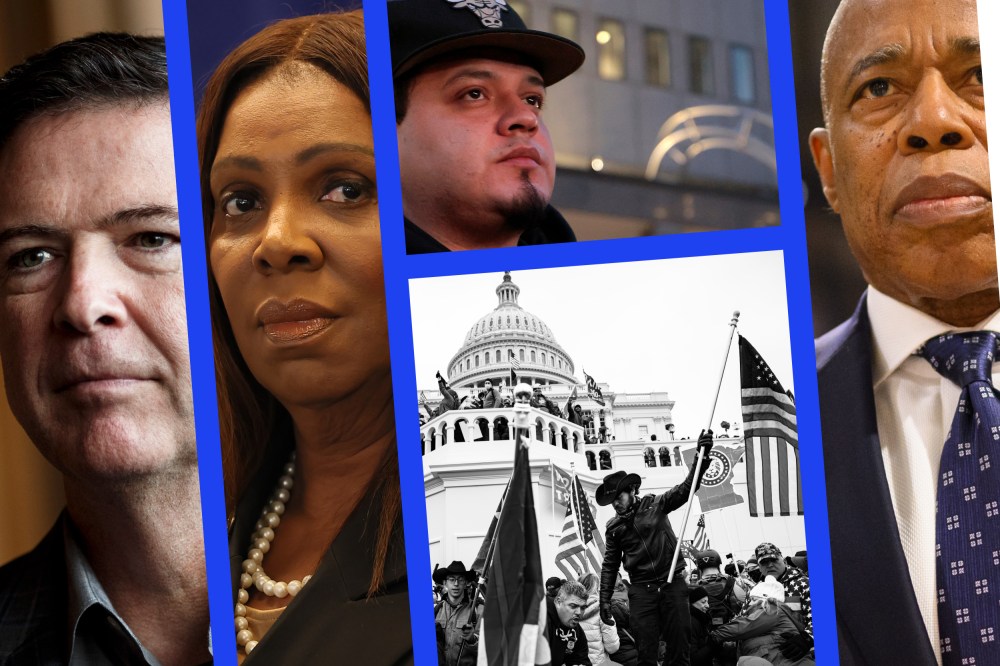

One of the government’s most awesome powers lies in its use of criminal law. How an administration uses that power — or chooses not to — reveals its priorities.
Here are five cases that showed the Trump administration’s crime and punishment priorities this year:
‘For my friends, everything’: The Jan. 6 purge
Setting the tone for his second term, one of President Donald Trump’s first actions was ordering blanket clemency for defendants convicted of charges related to the riot at the U.S. Capitol on Jan. 6, 2021, including people who assaulted law enforcement and several who were convicted of seditious conspiracy. Trump also ordered the attorney general to dismiss pending Jan. 6 indictments.
In reaction to Trump’s first days in office, my colleague Steve Benen cited a phrase attributed to an authoritarian leader from another era: “For my friends, everything; for my enemies, the law.”
The quote might have been a guiding principle for Trump and his Department of Justice, which spent much of 2025 working to deliver on the president’s vow to prosecute his political opponents.
Corruption: Eric Adams
Remember him? The outgoing New York City mayor was charged during the Biden administration, in a corruption case that was dismissed after the Trump administration intervened.
Trump’s DOJ requested to only temporarily toss the Democrat’s case, which would have given the government political leverage over Adams if he was uncooperative on immigration enforcement or anything else. The bid was led by former Trump defense lawyer-turned-DOJ enforcer Emil Bove, who’s now a judge himself.
The charade was too much to bear for Republican prosecutors on the case, and they resigned rather than do Bove’s dirty work.
The judge refused, too.
“Everything here smacks of a bargain,” Biden-appointed Judge Dale Ho wrote in April when he dismissed the case permanently.
Injustice: Sidney Reid and Sean Dunn
One of the most remarkable — and embarrassing — developments for the Trump administration this year was a stunning string of cases in which the DOJ failed to obtain indictments. These prosecutorial failures (or grand jury successes) loomed large in cases of alleged assault against officers amid the Trump administration’s immigration enforcement campaign.
Two of the starkest examples come from the nation’s capital, where grand jurors refused to indict Sidney Reid — accused of “forcefully” pushing an FBI agent’s hand against a wall — three separate times, and refused to indict Sean Dunn, who became a folk hero after throwing a sandwich at an immigration agent. Despite failing to secure indictments, prosecutors in both cases plowed forward to trial on misdemeanor charges, which don’t require grand jury approval. But trial juries picked up where grand juries left off, acquitting both defendants.
Reflecting on her experience in an MS NOW column, Reid wrote, “This is our country. We are greater and stronger than this administration.”
Revenge: James Comey and Letitia James
Speaking of grand jury rejections and ill-fated prosecutions, the Trump-backed campaigns against New York Attorney General Letitia James and former FBI Director James Comey have been two of the most blatantly vindictive outings for the administration thus far.
A judge dismissed both indictments on the grounds that the Trump-installed prosecutor who secured them, Lindsey Halligan, was unlawfully appointed. Halligan obtained the indictments over the objection of career prosecutors in the U.S. Attorney’s Office for the Eastern District of Virginia, whose prior head was ousted for refusing to bring the cases.
Since the dismissals, the DOJ has twice failed to reindict James and has separately faced litigation over evidence it wants to use against Comey. Yet the government presses on: The DOJ mounted an appeal of the dismissals, seeking to revive the cases and Halligan’s role.
If the cases return, they’d put Halligan — formerly a personal lawyer to Trump with no prior prosecutorial experience — back in the position of litigating several other pretrial motions to dismiss, including the defendants’ claims that their charges were unconstitutionally vindictive.
So even if the DOJ revives the cases, the prosecution would face an uphill battle making it to trial, where it would need to convince jurors of the defendants’ guilt beyond a reasonable doubt. That’s a much more demanding standard than proving probable cause to a grand jury — which, as we’ve already seen this year, can be a difficult bar for the Trump DOJ to clear.
Desperation: Kilmar Abrego Garcia
Kilmar Abrego Garcia is another administration target who has claimed vindictive prosecution. The government illegally sent him to El Salvador in March, where he was held in the country’s notorious Terrorism Confinement Center, even though he hadn’t been charged with, much less convicted of, any crime. Trump officials resisted his court-ordered return to the U.S. until they finally relented in June, when they had a criminal case waiting for him.
The administration is still trying to deport Abrego, which could make his criminal case moot. But the government is struggling on the deportation front, too. U.S. District Judge Paula Xinis, the Obama-appointed judge who initially ordered his return to the U.S., ordered his release from immigration custody this month because the government lacked a lawful order to remove him. Xinis wrote that while officials “may eventually get it right, they have not as of today.”
Subscribe to the Deadline: Legal Newsletter for expert analysis on the top legal stories of the week, including updates from the Supreme Court and developments in the Trump administration’s legal cases.
