





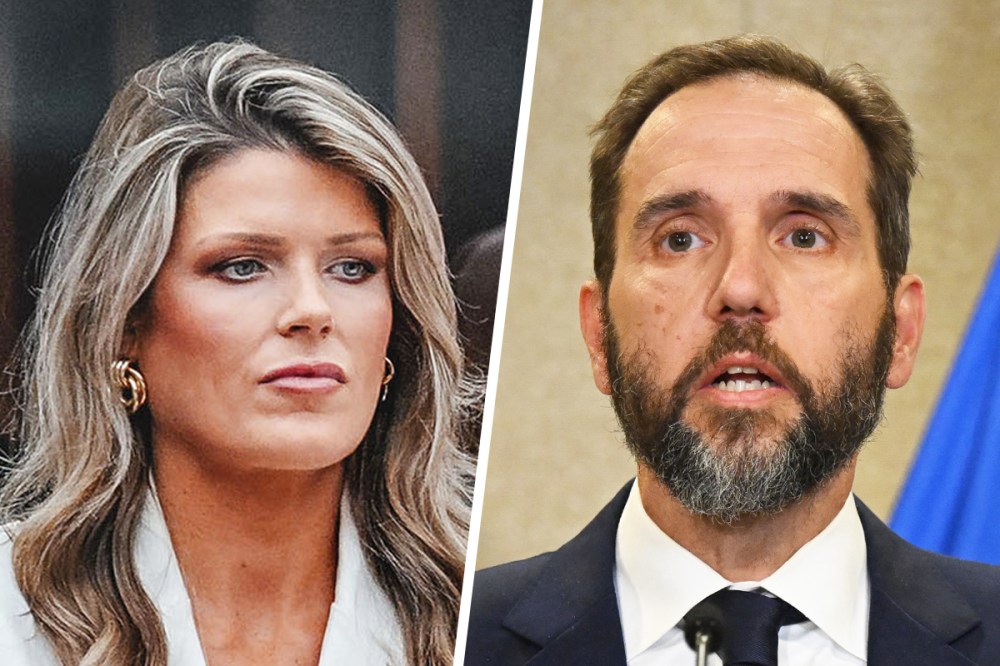

“Judge Aileen Cannon dismissed Donald Trump’s classified documents case because she said special counsel Jack Smith was unlawfully appointed. How can the Justice Department argue that Lindsey Halligan was lawfully appointed to prosecute the James Comey and Letitia James cases?” — Lori
Hi Lori,
Although federal judges found that both Smith and Halligan were unlawfully appointed, their reasons for doing so were somewhat different.
The backdrop of both cases is the Constitution’s appointments clause, which requires Senate confirmation for certain government positions. There are long-running disputes in the law about whether particular officials fall under that confirmation requirement and how much authority presidents have to install their preferred personnel without Senate approval.
When Cannon dismissed Trump’s Florida case last year, she wrote that federal laws didn’t give then-Attorney General Merrick Garland the authority to appoint a special counsel like Smith, who, Cannon wrote, “does not assist a United States Attorney but who replaces the role of United States Attorney within his jurisdiction.” She wrote that approving Smith’s position “would displace the Senate from its ordinary and longstanding role of confirming United States Attorneys and give to the Executive seemingly unchecked power.”
In its brief defending Halligan’s appointment before a judge rejected it last month, the Justice Department sought to distinguish Trump’s case on the grounds that Cannon found Smith’s appointment “unconstitutional and irremediable because there was no ‘statutorily created office to fill in the first place’. … Even on its own terms, that reasoning has no application here, where the office of U.S. Attorney plainly exists; the question is just whether Ms. Halligan properly filled it.”
U.S. District Judge Cameron McGowan Currie found that Halligan didn’t properly fill it.
Examining the federal law permitting temporary 120-day appointments of U.S. attorneys, Currie wrote that the clock began running on Jan. 21 with the appointment of the prior head of the Eastern District of Virginia office, Erik Siebert, who was forced out for resisting bringing charges against Comey and James. “When that clock expired on May 21, 2025, so too did the Attorney General’s appointment authority,” Currie wrote. “Consequently, I conclude that the Attorney General’s attempt to install Ms. Halligan as Interim U.S. Attorney for the Eastern District of Virginia was invalid and that Ms. Halligan has been unlawfully serving in that role since September 22, 2025.”
So, the analysis is somewhat different with Halligan, who wasn’t a special counsel like Smith, though both judges reached the same bottom-line conclusion under the appointments clause that both prosecutors were unlawfully serving.
We may never know what the Supreme Court would have said about Cannon’s conclusion, because Smith’s appeal of her ruling was cut short when Trump won the 2024 election. Given the legal differences in the Smith and Halligan situations, one could hold the view that Smith was lawfully appointed while Halligan was not. With Trump’s case in the rear view, Smith’s tenure is more a matter of historical debate at this point.
Halligan’s tenure is still in play, though it’s unclear how aggressively the DOJ wants to attempt to revive it. The administration said it would appeal after Currie’s ruling came down. But it hasn’t done so yet.
The DOJ this week has been attempting to revive the James case, at least, by seeking another indictment (though Currie dismissed both the James and Comey cases, she left open the option to bring them again with a lawful prosecutor). MS NOW has also reported that the DOJ is considering seeking another indictment against Comey, too.
The DOJ could still appeal the Halligan ruling, which raises an issue extending beyond the Comey and James cases and even beyond the Eastern District of Virginia. Judges across the country have been deeming prosecutors installed by the administration without Senate confirmation to be unlawfully serving. An appeals court this week rejected Alina Habba’s attempt to lead the New Jersey office.
Regardless of what happens in the James and Comey cases in Virginia, the Supreme Court could have the final word on the legality of Trump-installed prosecutors across the country. If the high court eventually weighs in, it won’t necessarily have to grapple with the legality of Smith’s appointment to decide the present controversies.
Please submit “Ask Jordan” questions through this form for a chance to have your question featured in a future edition of the Deadline: Legal Newsletter.
