





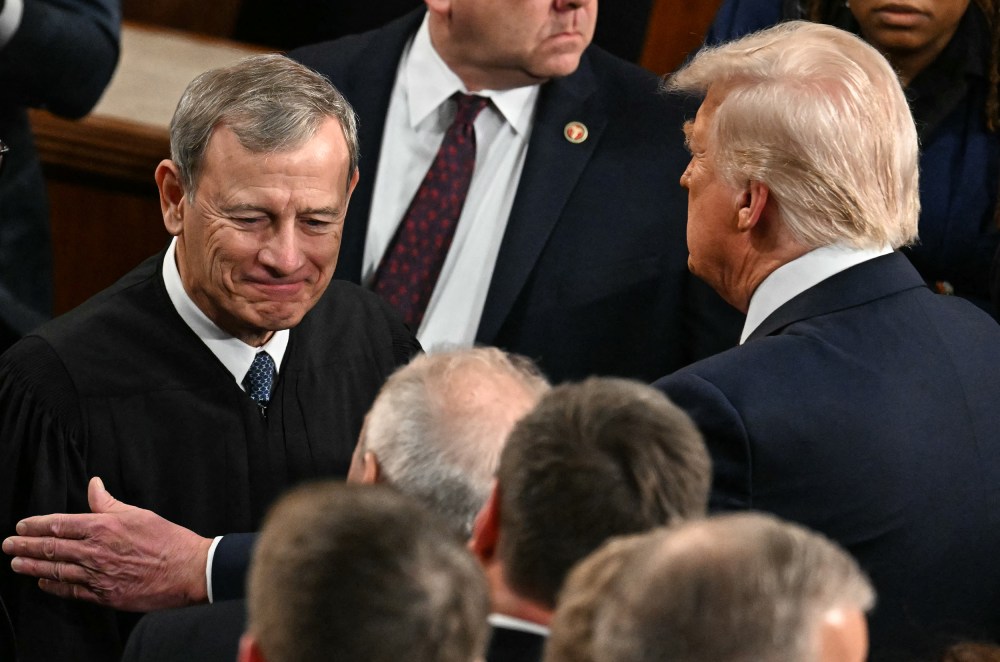

Welcome back, Deadline: Legal Newsletter readers. I hope you all had better things to do on New Year’s Eve than read Chief Justice John Roberts’ year-end report on the federal judiciary — unless you’re into that sort of thing.
The annual offering typically consists of the chief relaying a historical anecdote or theme that leaves room for speculation over its intended application to the present day. There’s also the question of how much his views matter these days, anyway, on the court with five other Republican appointees who don’t need his vote to form a majority.
But that was the high-court meal we were served this week, so let’s dig into this year’s fare, set against the backdrop of the Declaration of Independence’s 250th anniversary.
The first line caught my eye, where Roberts referred to Thomas Paine as a “recent immigrant” to the North American colonies in the late 1700s. Though it’s a straightforward description of the man who inspired American independence, the word “immigrant” is a dirty one for the nativist Trump administration, whose gravest legal violations have come in the immigration context.
On that note, the justices are set to rule by July on the administration’s misbegotten bid to upend birthright citizenship, in what could be one of the Roberts Court’s most important decisions yet. The chief justice’s normal phrasing is hardly a promise to reject the appeal that flies in the face of the Constitution, but it struck me as a notable word choice in any event.
I was also thinking about birthright citizenship when reading Roberts’ recitation of the Reconstruction Amendments — the 13th, 14th and 15th Amendments that abolished slavery and guaranteed due process, equal protection and “the right to vote to Black men,” as Roberts wrote, correctly casting the post-Civil War provisions as part of a progression toward the promise of equality made at the nation’s founding.
The reason that passage made me think of the citizenship case (in addition to the voting-rights rulings to come this year) is that it revolves around one of those amendments: the 14th. The administration argues that the amendment was solely concerned with citizenship for “newly freed slaves and their children,” not for “the children of aliens temporarily visiting the United States or of illegal aliens.”
That claim cuts against history and precedent going back more than a century. And, as I have written, the way that the government has litigated the case — by not pressing for a quick ruling on the issue when it has run to the high court on many others — suggests even the administration’s lawyers might understand that they’re pressing a losing argument. But time will tell whether the court vindicates it this year, nevertheless.
It’s unclear if Roberts tried to hint at anything specific in his report in terms of rulings to come. He didn’t mention the birthright citizenship case or any other pending decisions, though he wouldn’t be expected to do so in a report like this. But it’s worth recalling that in one of his reports a few years back, he lauded the court’s landmark 1954 school desegregation ruling in Brown v. Board of Education, before leading the court’s gutting of affirmative action later that term.
That’s all to say that Roberts views the country’s promise of equality differently than some other Americans. Of course, that’s inevitable in a nation whose people hold different views.
Still, while the chief justice properly celebrates the country’s break from a king, it’s hard not to think of the vast power his court has handed Donald Trump. On top of granting him broad criminal immunity before he returned to office, the court has expanded presidential power since his return — with a notable exception being the court’s recent refusal to let his administration immediately deploy the National Guard in Chicago. But even that was over the dissent of three of Roberts’ GOP-appointed colleagues.
Thus, as we enter a year of crucial Supreme Court rulings, it’s an open question whether the guarantees of our founding charters “remain firm and unshaken,” as Roberts pledged at the end of his report. That uncertainty is due partly to the fact that the chief justice isn’t always in control of where the court is going. But, as decisions like the presidential immunity ruling he authored show, it’s also because he sometimes is.
Have any questions or comments for me? Please submit them through this form for a chance to be featured in the Deadline: Legal Blog and newsletter.
