




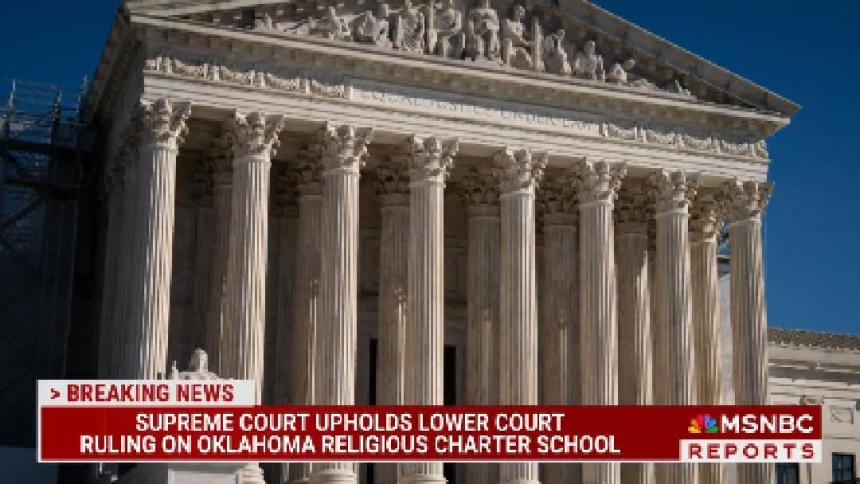

With Justice Amy Coney Barrett recused, an eight-justice Supreme Court split 4-4 on an appeal seeking to approve the country’s first public religious charter school. The tie keeps an Oklahoma state court ruling against the school in place, resulting in a rare non-win for such a religious claim at the high court, but perhaps only a temporary one given the Trump appointee’s absence.
While technically considered an opinion, Thursday’s high court action didn’t contain any explanation, only noting the stalemate and Barrett’s recusal. It said: “The judgment is affirmed by an equally divided Court. JUSTICE BARRETT took no part in the consideration or decision of these cases.” The judgment refers to the state court ruling against the school.
The issue could come back to the justices in a future case in which Barrett isn’t recused.
The opinion didn’t list the justices’ votes, but the tie suggests that one of the Republican appointees sided with the court’s three Democratic appointees. The issue could come back to the justices in a future case in which Barrett isn’t recused.
Oklahoma’s Republican governor, Kevin Stitt, signaled that possibility after Thursday’s split. He said that the issue is far from settled and predicted there’ll be “another case just like this one and Justice Barrett will break the tie” in favor of a religious school.
Notably, it was Oklahoma’s Republican attorney general who argued that drastic consequences would follow if the justices approved the nation’s first public religious charter school. In a brief to the high court, Gentner Drummond said doing so would eliminate critical funding and create “chaos and confusion for thousands of charter schools and millions of schoolchildren nationwide.”
But St. Isidore of Seville Catholic Virtual School, and the state charter board that wanted to approve it, pointed to First Amendment protections that the justices have cited to side with religious claims in recent years. And though charter schools are publicly funded and Oklahoma law prevents sectarian control of public schools, they argued that prohibition shouldn’t apply to St. Isidore because it’s a private entity and not a public school.
Yet, Oklahoma’s Supreme Court ruled that, under state law, charter schools are public schools that must be nonsectarian. The state court noted that St. Isidore would evangelize the Catholic faith as part of its state-sponsored curriculum, which, the court said, would violate Oklahoma law and the state and federal constitutions.
The Trump administration backed the school.
Barrett didn’t explain why she recused. But the fact that she did so meant that the school needed at least five votes to win at the eight-member court. Because the state court had ruled against the school, Thursday’s tie effectively upheld the state court ruling.
At the April 30 hearing, Justice Brett Kavanaugh, another Trump appointee, raised the concern of treating religion as “second-class.” He told a lawyer for the state that “when you have a program that’s open to all comers except religion, no, we can’t do that, we can do everything else, that seems like rank discrimination against religion, and that’s the concern that I think you need to deal with here.”
Raising a different concern, Obama appointee Sonia Sotomayor told a lawyer backing the school that “[w]hat you’re saying is the [First Amendment’s] Free Exercise Clause trumps the essence of the Establishment Clause because the essence of the Establishment Clause was we’re not going to pay religious leaders to teach their religion. That was, is, and has always been the essence.”
In a statement Thursday, the Oklahoma attorney general said the Supreme Court result means the state won’t have to fund “radical Islamic schools,” and he said he’ll “continue upholding the law, protecting our Christian values and defending religious liberty.”
With Thursday’s tie at the Supreme Court, the status quo remains for now, and the spotlight will be on Barrett if another case comes to the justices trying to alter it.
Subscribe to the Deadline: Legal Newsletter for expert analysis on the top legal stories of the week, including updates from the Supreme Court and developments in the Trump administration’s legal cases.
