




The 2014-2015 school year marked a milestone for public schools: according to a report by the National Center for Education Statistics last fall, the majority of minority schoolchildren was projected to make up 50.3% of the public school population. But is this shift in demographics reflected in the materials inside the classroom?
“When my son, who’s half-Dominican, turned four-years-old I started looking for children’s books that featured characters that were like him,” NBC New York reporter Ida Siegel said on Monday’s Rundown. “I soon found out there was almost nothing.”
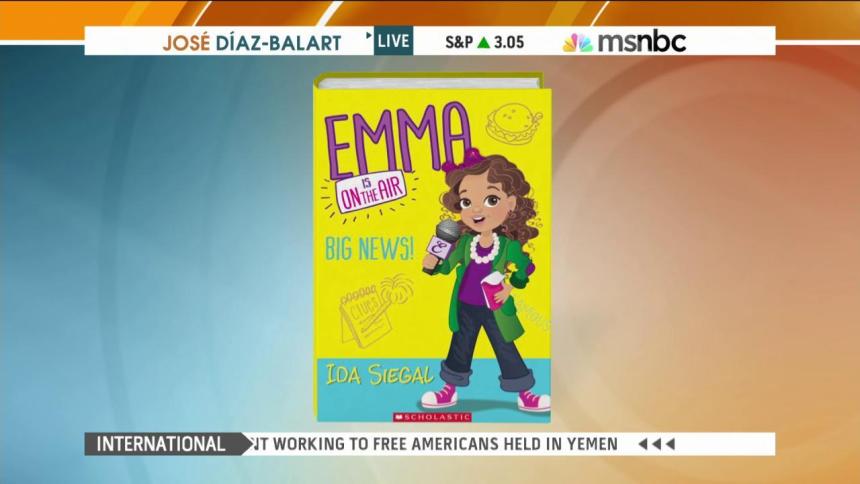
After taking notice of the issue, Siegal decided to contribute to a solution: with a children’s book series of her own called Emma is on the Air, which features a young Latina girl who dreams of being a reporter.
“Since [kids are] so fascinated with what I do [as a reporter] I thought: I need to find a way to engage them on their level and bring them into my world,” Siegal said.
But instead of modeling Emma after her “freckled, red-headed” young self, she took a different approach.
“Why am I creating a character based on me when I should be creating characters based on my children?” Siegal asked herself, and decide dto change her lead character to a half-Dominican, eight-year-old girl who speaks Spanish, has long curly hair, and calls her father “papi,” just like her own children do.
Although there are TV shows for children that feature Hispanic characters, such as Dora the Explorer and Handy Manny, these often portray traditions from Mexican culture or inspired by an ambiguous mixture of Latin American cultures—such as Disney’s Latina Princess Elena of Avalor, who is set to debut next year and whose character is “inspired by a mixture of diverse Latin cultures and folklore.” Having children’s books that feature characters with different Latino cultures, could ease school’s efforts to incorporate the new majority’s heritage into the classroom.
The growth of minority students in the public school system is mainly driven by Latinos. In Miami-Dade, more than half of the student population is Hispanic. Now, school districts across the country face new challenges as they try to find out ways to connect with these students.

Nicole Acevedo
I am a bilingual national reporter specializing in issues affecting Latino communities in the U.S., the Caribbean and Latin America. Experience I have produced hundreds of stories across digital, radio and broadcast platforms throughout my career — reporting on everything from elections, natural disasters and immigration to pop culture trends, social justice issues and breaking news. I'm best known for my coverage of the crises affecting Puerto Rico, including its reconstruction process after Hurricane Maria, the island’s financial crisis and more. After graduating from the Newhouse School of Public Communications at Syracuse University with a bachelor's degree in broadcast and digital journalism in 2016, I joined the inaugural cohort of students who helped launch the Spanish-language bilingual journalism master’s program at the Craig Newmark Graduate School of Journalism at CUNY. Awards I was a 2024 finalist for the NAHJ/University of Florida award in investigative journalism for my reporting uncovering the challenges Puerto Rican families face in caring for their elders, given that the island’s population is aging faster than most places on Earth and fragmented by migration. I served as the lead reporter and writer of NBC News' 2022 Hispanic Heritage Month project “Who’s Latino? Amid growing numbers the definition is expanding,” which was awarded an NAHJ Ñ Award for best Latino issues story for print/digital.