




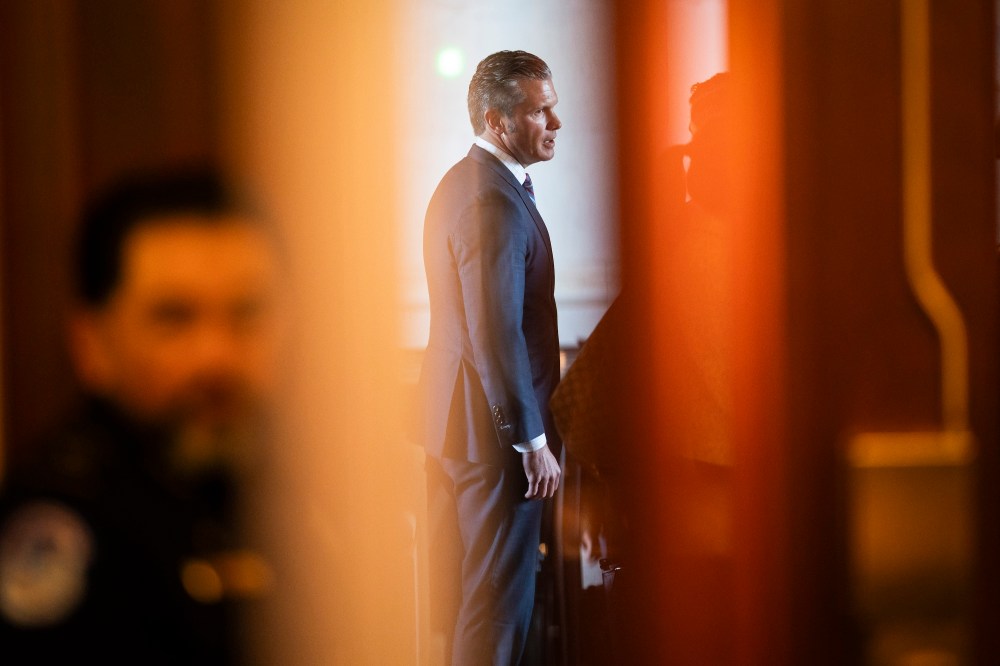
Secretary of Defense Pete Hegseth violated Defense Department policy and put troops at risk by using his personal cell phone to share sensitive military information in a group chat, according to a report released Thursday by the Pentagon’s Office of the Inspector General.
The 84-page unclassified report details a March incident in which Hegseth shared what the inspector general described as “sensitive, nonpublic, operational information” in a Signal group chat with 19 people, including Cabinet officials and a journalist. The journalist, Jeffrey Goldberg of The Atlantic, was inadvertently added to the conversation by Mike Waltz, then the national security adviser.
Waltz eventually left his role in the president’s inner circle to become the ambassador to the United Nations, with Hegseth coming out of the scandal relatively unscathed — until now.
The full classified report was reviewed by members of the House and Senate Armed Services Committees before its public release, and is the most detailed official account yet of the security breach.
Here are four key takeaways from the public report’s findings — including why action won’t be taken against the secretary.
Hegseth shared information considered classified
Despite Hegseth’s authority to declassify information, the inspector general found that his claim to have shared only “non-specific general details” was contradicted by the evidence.
The report concluded that some of the information Hegseth sent “from his personal cell phone” on March 15 “matched the operational information” that U.S. Central Command had classified as secret and restricted to American personnel only. By comparing Central Command emails and Hegseth’s Signal messages, investigators determined that he had transmitted details about “the means and timing of strikes, aircraft type, and weapon systems employed,” including a message stating, “THIS IS WHEN THE FIRST BOMBS WILL DEFINITELY DROP.”
A Central Command official confirmed to the inspector general that the operational information was marked “SECRET//NOFORN,” and that “no request had been made to declassify the information, which remained classified.”
While Hegseth holds the power as an “original classification authority” to determine whether classified materials no longer require protection, the investigation did not find any evidence that he exercised that authority in this case.
Hegseth was uncooperative
The Office of Inspector General reported that Hegseth declined to be interviewed for its investigation and refused to provide his personal phone for examination.
Instead, Hegseth submitted a one-page written statement on July 25 accusing the office of partisanship. The Defense Department provided the inspector general with only a partial copy of the Signal messages from Hegseth’s personal phone, leaving investigators to rely on records of the chat as published by The Atlantic.
Five officials told investigators that Hegseth had participated in “multiple additional Signal group chats,” but the inspector general could not verify their existence or content without access to the secretary’s personal phone.
Hegseth’s actions put military troops and mission at risk
The report concluded that Hegseth’s actions risked harm to military personnel and mission objectives by transmitting details about the number and timing of airstrikes over hostile territory just hours before they were carried out.
Hegseth wrote in his July 25 statement to the inspector general that “there were no details that would endanger our troops or the mission” if they had fallen into the hands of U.S. adversaries. But the report found that if the information had reached adversaries, Houthi forces could have repositioned personnel and assets in time to avoid the planned strikes or taken steps to counter American forces.
“Even though these events did not ultimately occur, the Secretary’s actions created a risk to operational security that could have resulted in failed U.S. mission objectives and potential harm to U.S. pilots,” the report said.
Hegseth was not exonerated — but he likely won’t face consequences
The Pentagon’s chief spokesman, Sean Parnell, asserted that the inspector general’s review was a “total exoneration” of Hegseth, and said it concluded that no classified information was shared.
However, that assertion is contradicted by the report, which found that Hegseth transmitted information designated as secret — including the information from Central Command that he shared in the group chat. The report notes that nonpublic DOD information designated “SECRET” falls under the “classified” umbrella.
Moreover, the report concluded that Hegseth violated Defense Department policy by using Signal on his personal phone and failing to properly retain records of his communications. The inspector general did not recommend disciplinary action against Hegseth for those violations, characterizing them as part of broader “DoD-wide” issues rather than problems unique to the secretary.
The inspector general’s only recommendation was for Central Command to review its classification procedures “to ensure proper portion marking of classified information.” A separate report recommended the Pentagon improve training for senior officials on the proper use of electronic devices.

Julia Jester covers politics for MS NOW and is based in Washington, D.C.