




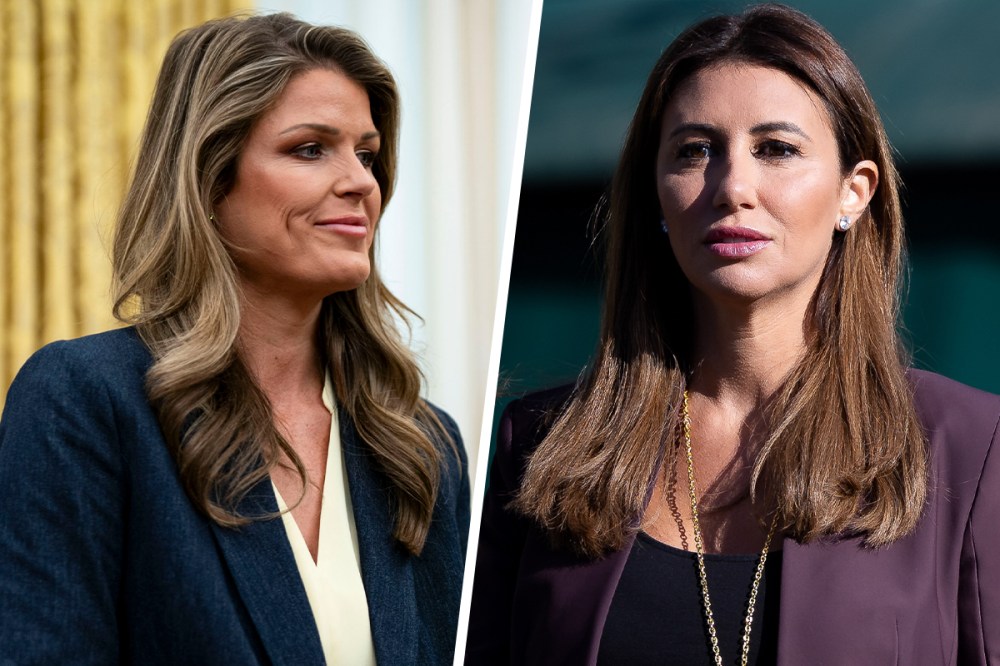
Last week, the federal Court of Appeals for the Third Circuit — just one level below the U.S. Supreme Court — found that President Donald Trump’s former defense lawyer Alina Habba, who had been appointed as the interim U.S. attorney for New Jersey, had not been put in that role lawfully.
On Monday, Habba stepped down from her post, saying the decision was to “protect the stability and integrity of the office that I love.” She noted she’s waiting for further review of the court’s ruling but 24 hours later, DOJ asked for more time to even seek that review. In the meantime, Attorney General Pam Bondi has created a new senior advisor role for Habba at the Justice Department.
There’s a process to install the 94 U.S. attorneys throughout the country, and it starts with being nominated by the president and then confirmed by the Senate. Also part of the process is a tradition called the “blue slip,” through which a nominee’s home-state senator can veto them before they even get to a committee hearing before a full Senate vote.
Trump himself has made clear he wants to scrap the blue slip process, citing partisan obstruction. But Republican senators have defended the tradition, which has led to the administration embracing a sidestep to the confirmation process.
Earlier this year, Bondi began appointing people as “interim” U.S. attorneys, using statutes that allow temporary appointments for 120 days from when a Senate-confirmed person leaves the role. Under Bondi’s strategy, she also found options that would prolong that period, preventing the judges of a district from appointing someone of their own choosing after a position has been technically vacant – meaning without a confirmed nominee – for 120 days.
To date, Habba is not the only U.S. attorney whose appointment is being either challenged or scrutinized, and you only have to look at a different court’s recent disqualification of Lindsey Halligan – who is still calling herself the U.S. attorney – to understand why it’s so important. If a person was never lawfully installed as U.S. attorney, can they bring criminal indictments? And aside from indictments, what about any prosecutions that happened under their direction or supervision? Should we now question their validity?
Here’s a look at six U.S. attorney’s offices currently under scrutiny for how their lead prosecutors got, and in some cases, performed, their jobs:
Alina Habba, District of New Jersey
Despite her lack of prosecutorial experience, Habba, known as one of Trump’s personal defense lawyers as well as one of his most aggressive cable TV champions, was first appointed as interim U.S. attorney in late March 2025. As she approached the 120-day limit for “interim” U.S. attorneys, the judges of her district ordered that Habba’s deputy, a career prosecutor, replace her. Yet within days, Bondi fired the deputy, appointed Habba as the first assistant U.S. attorney, and again elevated her to head the office. Several defendants then sought to dismiss their indictments on grounds that Habba was ineligible to serve as the U.S. attorney.
In August, a court found that those indictments were not necessarily invalid, as career prosecutors had investigated and brought those cases. But the court concluded that because Habba had been functioning as the U.S. attorney without lawful authority since July 1, not only must she “be disqualified from participating in any ongoing cases,” but any career prosecutor acting under her supervision or authority could be subject to disqualification. A three-judge panel of the Third Circuit unanimously upheld that decision last week.
Lindsey Halligan, Eastern District of Virginia
Halligan, a former insurance attorney and personal lawyer to President Trump who had never prosecuted a case, was appointed by Bondi in September 2025, just days before former FBI Director James Comey was indicted. Halligan then presented and signed the indictments of both Comey and current New York Attorney General Letitia James, over reported objections of career prosecutors involved in each investigation. Late last month, a district court ruled not only that she cannot serve as the interim U.S. attorney, but also that both the Comey and James cases must be dismissed.
Part of the problem, according to the judge’s ruling, was that the 120-day clock had started — and expired — even before Halligan even took office.
The Justice Department has not yet appealed either decision — and it’s not clear that it will. The James charges of mortgage fraud are years away from expiring under the statute of limitations and can be refiled. Nonetheless, prosecutors’ second attempt to indict James last week was rejected by a Norfolk, Virginia, grand jury.
As for Comey, because his now-time-barred case was dismissed for other reasons, a federal statute could give prosecutors a six-month window to refile. Still, it’s unclear whether Comey’s case qualifies because, as the judge who dismissed his case explained, his indictment was void from the outset: Halligan was appointed only after her predecessor served his own 120-day term, was appointed by the judges of the district and then resigned. Meaning, Halligan could not have operated as the U.S. attorney at the time she brought the indictment.
To complicate matters for the DOJ, a federal judge in D.C. ruled this past weekend that it would not be allowed to access, review or use any evidence obtained years ago from one of Comey’s friends and onetime attorney, Columbia law professor Daniel Richman.
Sigal Chattah, District of Nevada
Chattah, a former lawyer for the Nevada Republican Party and the GOP’s candidate for Nevada attorney general in 2022, was appointed as interim U.S. attorney by Bondi in late March, just days after Habba. And she was also disqualified by a district court this fall after a handful of criminal defendants similarly argued that she was not validly serving in her role.
But the judge who ruled Chattah wasn’t appointed validly didn’t determine that it should nullify her indictments, unlike Halligan. Instead, he decided Chattah was ineligible to oversee certain cases or the attorneys who handle them. More notably, the decision was stayed pending an appeal to the Ninth Circuit, which is expected to last until at least spring 2026. Barring the Supreme Court getting involved in this one, that stay means Chattah will likely hang on to her job for a few more months.
Bilal “Bill” Essayli, Central District of California
Essayli, a two-time GOP candidate for the California state Assembly, also served as a career prosecutor in the same district to which he was named as interim U.S. attorney during the same March week as Habba and Chattah.
But by late October, a district court determined that he too could not serve as interim or acting U.S. attorney. However, there is one factual distinction from the other cases: Shortly before the expiration of the 120-day period for interim U.S. attorneys, and before district judges could have their say, Bondi named Essayli as first assistant U.S. attorney. In that capacity, the court ruled, she can delegate to him many, if not most, of the powers of a U.S. attorney.
In other words, Essayli lost the title, but remains the highest-ranking official in his district, which encompasses Los Angeles County and several surrounding counties. There are, however, criminal defendants who challenged his appointment who have now asked the court to reconsider its ruling on constitutional grounds. That motion is still pending.
Ryan “Ry” Ellison, District of New Mexico
Nearly 20 criminal defendants have sought the disqualification of Ryan “Ry” Ellison, the current U.S. attorney for New Mexico. Ellison was initially appointed by Bondi in late April 2025, but a week before his 120-day interim period ended, the judges of his district announced that they would not be appointing him to fill the position long term. Ellison resigned, only for Bondi to then appoint him as first assistant U.S. attorney with the authority to effectively succeed himself as acting U.S. attorney.
The challenge to Ellison is ongoing. The court has asked both sides to submit additional briefings later this month.
John Sarcone, Northern District of New York
There haven’t been any legal challenges — yet — to disqualify John Sarcone, the interim U.S. attorney for the Northern District of New York. When his 120 days were up, the district judges took no action at all, including appointing anyone new. Bondi then gave Sarcone the designation of first assistant U.S. attorney, leaving the U.S. attorney seat vacant. And pursuant to the Federal Vacancy Reform Act, Sarcone could then be elevated to acting U.S. attorney, resetting the clock for another 210 days.
Sarcone may have poked the bear by issuing subpoenas to the New York attorney general’s office in connection with an active criminal investigation into James for a personal matter not related to the alleged mortgage fraud indictment. In response, the New York attorney general then moved to invalidate the subpoenas, arguing that Sarcone lacked the proper authority to issue them. A federal judge heard arguments last week and openly contemplated that if Sarcone were improperly appointed, the only remedy would be to disqualify him.
So what happens next? While neither Halligan nor Habba has filed an appeal yet, expect the Justice Department to dig in on all of these challenges. It continues to insist, for example, that Halligan can continue as U.S. attorney because the court orders in the Comey and James cases “did not explicitly remove” her from the job.
But last week’s opinion on Habba will likely loom large in any ongoing dispute. That includes Habba’s own should she choose to seek Supreme Court review, as both Habba’s and Bondi’s public statements suggest.
In the meantime, hers isn’t just the first appellate decision of these role challenges; it’s also an extremely thorough one that’s likely to be picked apart by lower courts and other appeals courts considering other appointments. In short, it found that the various strategies to put and keep Habba in office violated federal law, the Constitution or both. Whatever the administration’s next move, the reasoning for that opinion might just be enough to stop it.

Lisa Rubin is MS NOW's senior legal reporter and a former litigator.