





Hamas has finished the process of freeing the remaining 20 hostages believed to still be alive on Monday morning, following through on part of its agreement to free all 48 living and dead hostages after Israel’s military halted its devastating campaign in the Gaza Strip — the first stages of an uneasy truce that has sparked hope for an end to the war. Hamas still must return the remains of at least two dozen deceased hostages, with the Hostages and Missing Families Forum Headquarters saying in a statement that only four bodies will reportedly be returned on Monday.
According to the Associated Press, the initial group of seven living hostages were handed over to the Red Cross before heading to an Israeli military base for physical and mental health examinations, and to be reunited with their loved ones. Another group followed in a handover more than two hours later as the multi-phase operation continued throughout the morning.
🟡 Operation “Returning Home”
— Israel Defense Forces (@IDF) October 13, 2025
Seven returning hostages are currently being accompanied by IDF and ISA forces on their return to Israel, where they will undergo an initial medical assessment.
The commanders and soldiers of the IDF salute and embrace the returning hostages as they…
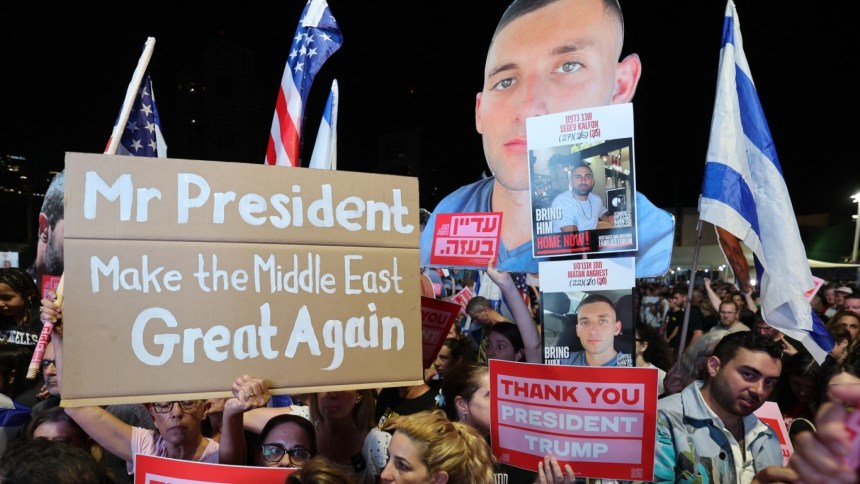
Crowds in Tel Aviv’s Hostages Square celebrated as they waited for updates to play on giant screens. Many had stayed in the park overnight at the urging of the Hostages and Missing Families Forum.

This marks a watershed moment in a conflict that has stretched for more than two years since the Oct. 7, 2023, massacre that triggered the bombardment, invasion and siege of Gaza.
About 1,200 people were killed in the initial attack in southern Israel, according to the Israeli government. At least 67,000 have died in Gaza since Israel retaliated, according to the Palestinian Health Ministry. Some international experts have deemed that a genocide, which Israel denies.
The hostages have been the main source of leverage for Hamas in its negotiations with Israel through intermediaries. Previous agreements have seen some of the more than 250 hostages released — some alive, others their remains — including women, children and seniors.
As a part of the deal brokered by the United States and key Arab countries, Israeli Prime Minister Benjamin Netanyahu agreed to transfer around 2,000 Palestinian prisoners held in Israel. Those releases and a surge of aid to Gaza are to take place after the return of the hostages.
President Donald Trump touched down in Israel Monday morning; He met with Israeli authorities and the families of hostages before delivering a speech to the Knesset in Jerusalem. Trump is also participating in a signing ceremony on Monday alongside Arab and European leaders in Sharm el-Sheikh, Egypt, to celebrate the first phase of a 20-point road map released by his administration. While Netanyahu declined to attend, Palestinian leader Mahmoud Abbas will be at the summit.
Trump, who campaigned in part on ending the war in Gaza, has expressed optimism that the hostage- and prisoner-exchange deal could lead to a lasting peace in the Middle East.
Other Iranian-backed militias, including Hezbollah and the Houthis, have traded crossfire with Israel since the Oct. 7 attacks. Earlier this year, the United States struck a nuclear facility in Iran.
“The war is over,” Trump told reporters Sunday aboard Air Force One on his flight to the region. “It’s going to hold,” he added, “but I think people are tired of it. It’s been centuries.”
Major hurdles, however, still remain before the second phase of the road map outlined by the United States and backed by officials from Qatar, Egypt, Turkey and other countries that have played crucial roles in negotiations. The proposal calls for a “board of peace” to be chaired by Trump. Former British Prime Minister Tony Blair has also been named to the council; other members are still unknown.
The board will oversee an apolitical committee of Palestinian technocrats and international experts. Both groups are intended to be temporary, but there is no specific timeline for either to be dissolved.
Questions also remain about the security apparatus to ensure there is no further violence in the region. Hamas has previously rejected calls to demilitarize, and Trump’s proposal calls for the militia to “decommission” it weapons.
Senior U.S. administration officials say they’re in talks with various countries to organize an international stabilization force in Gaza, but it’s unclear which countries will fund the effort and how many armed forces will be provided.
“I must tell you: The campaign is not over. There are still very great security challenges ahead of us,” Netanyahu said Sunday. “Some of our enemies are trying to rebuild themselves to attack us again. And as we say — ‘We’re on it.’”

Akayla Gardner is a White House correspondent for MS NOW.

Emily Hung is an associate White House producer for MS NOW.