




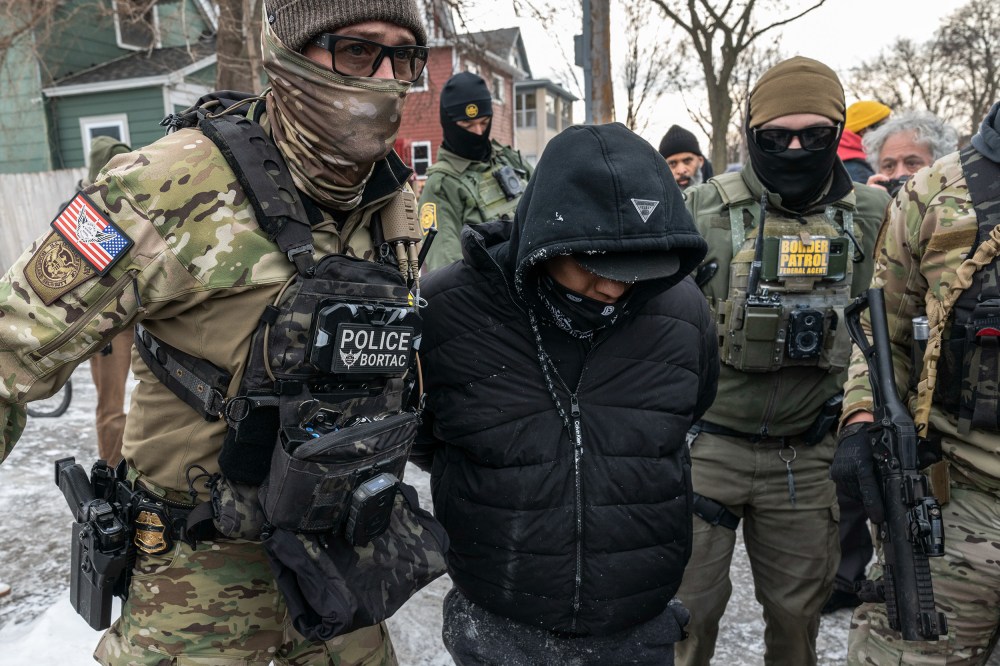
Democrats say they won’t vote to fund Immigration and Customs Enforcement without changes at the agency. The Republican counteroffer? What if we added money for body cameras?
The wide gulf between the two parties presents a major test for Democratic negotiators, who have struggled to determine where to draw the line on ICE funding. Progressives have demanded changes at the agency, after an agent shot and killed Renee Good in Minnesota, seeking measures to bar agents from wearing masks and to require warrants for arrests.
But Democrats are also eager to enact a full-fledged appropriations bill ahead of a Jan. 30 shutdown deadline. Doing so would help them place financial restraints on President Donald Trump’s administration — while failing to pass a funding bill would give Trump and Office of Management and Budget director Russell Vought greater latitude to make spending decisions.

In short, Democrats are in a bind: Support money for ICE and own the tortured politics of funding that organization, or oppose ICE funding and give the administration the power to make all sorts of spending decisions.
Democrats — or, at least, some of them — would support ICE funding if that legislation came with significant restrictions. But instead of actually negotiating on those principles, Republicans are hoping the body cams could be a workaround, as both parties try to avoid a government shutdown at the end of the month.
According to Rep. Mark Amodei, R-Nev. — chair of the Appropriations subcommittee that controls Homeland Security funding — Republicans want to send Democrats a new offer soon on Homeland Security funding. He told MS NOW that the offer would include more money for body cameras for ICE agents.
Amodei conceded that Democrats have “legitimate concerns” about accountability at ICE, but he said major policy changes are “not under serious consideration.”
Meanwhile, Amodei seemed to think a funding boost for body cameras could give Democrats a chance to claim a small victory. “You can walk away and say, ‘Hey, we moved the needle on the dial,’” Amodei said.
Democrats, however, have been quick to reject the idea.
“ICE has enough money. We’re not giving them any more,” the top Democrat on the Senate Appropriations Committee, Sen. Patty Murray, D-Wash., told MS NOW.
Rep. Jim McGovern, D-Mass., agreed.
“I’m not a cheap date, so no,” McGovern told MS NOW. “Not for me. That doesn’t satisfy me.”
Amodei’s pitch falls far short of a demand by members of the Congressional Progressive Caucus, who took a formal position against any Homeland Security appropriations bill that doesn’t include “meaningful and significant reforms to immigration enforcement practices,” the group said in a statement.
That could include stopping agents from wearing masks, requiring warrants for arrests, an end to the use of private detention facilities and requiring federal officials to share information with state law enforcement, Rep. Pramila Jayapal, D-Wash., told reporters.
But Republicans aren’t interested in those proposals.
Hard-line conservatives in the House could support more money for body cameras, but there’s no appetite for restrictions on agents wearing masks, Rep. Andy Harris, R-Md., chairman of the conservative House Freedom Caucus, told MS NOW.

“As soon as they stop doxing our ICE agents, I’d be willing to discuss that,” Harris said.
Other Democrats have shifted their focus from policy changes to stricter limits on the Trump administration’s ability to move money around unilaterally.
Sen. Chris Murphy, D-Conn., the top Senate Democrat on the subcommittee that funds the Department of Homeland Security, said he’s seeking stricter constraints on the Trump administration’s ability to shift money from one program to another. He cited the involvement of Homeland Security Investigations in ICE raids and the diversion of funds to pay for the South Florida immigration detention center nicknamed “Alligator Alcatraz.”
Murphy separately outlined policy changes he’s seeking at ICE, including a requirement for warrants, a ban on masks during enforcement operations and a requirement for Border Patrol officials to stay at the border. When it comes to appropriations talks, though, Murphy said he’s trying to stay realistic.
“I understand I’m not going to get all my complaints solved in the DHS appropriations bill,” Murphy told reporters. “So I’m not trying to write a perfect bill. I’m simply trying to make it as hard as possible for the money to be used for the purposes, for other purposes other than what Congress intends.”
Other negotiators aim to attach policy changes to the funding measure.
Rep. Rosa DeLauro, D-Conn., the top House Democratic appropriator, told MS NOW that Democrats are “exploring policy riders, looking at the best way to proceed” in the funding negotiations.
DeLauro said the stance held by the Progressive Caucus isn’t a fringe demand. Democrats are united in pushing for changes at ICE as part of funding talks, she said.
“It’s not a wing of the party — this is a uniformity,” DeLauro told MS NOW. “Everyone is so upset about the terrors in their communities. This is widespread. So it’s not a particular caucus.”
Republicans view the whip count differently.
According to Amodei, Republicans were never counting on progressive Democrats to vote for a measure to fund the DHS. And the idea that progressives would support a DHS funding bill only got more farfetched after the shooting of Renee Good in Minnesota.
The Republican offer is meant to be an olive branch to Democrats who are less concerned about major policy changes and more focused on avoiding a full-year continuing resolution, which gives the Trump administration more flexibility to spend money as they wish.
“It sure as hell didn’t help put the bill to bed,” Amodei said of the ICE shooting’s effect on funding negotiations. “But we also realize there are some folks on the D side who were never going to vote for a DHS bill. And it’s like, OK, tell me how you win with a full-year CR.”
Mychael Schnell, Kevin Frey and Syedah Asghar contributed reporting.

Jack Fitzpatrick covers Congress for MS NOW. He previously reported for Bloomberg Government, Morning Consult and National Journal. He has bachelor's and master's degrees from Arizona State University.